
The real problem in sales is not in the buyer’s trust in a supplier, but their confidence in themselves to make a sound purchasing decision. With the usual buying journey extremely messy and complicated, world-renowned B2B sales researcher Brent Adamson offers a solution: the Framemaking Sale. He joins Mark Cox and guest co-host Mike Sparling to discuss how to make a drastic shift in sales focus, moving beyond the traditional sensemaking practices and into the framemaking one with a human-centric approach. Brent highlights the major problems of the conventional B2B model, breaking down what it takes to address decision complexity, information overload, objective misalignment, and outcome uncertainty. He also talks about the evolving role of AI, making the buying journey more convenient by providing assistance in decision-making while maintaining authentic human connections.
—-
Watch the Episode here
Listen to the Podcast here
Framemaking Sale: Improving The Buying Experience With Brent Adamson
We have got an absolutely fantastic show for you because we have got Brent Adamson on the show. Brent is a world-renowned author, speaker, sales researcher, and trainer. Brent spent most of his career researching buying and selling in the B2B format. Some of that work has been published in books. With his pal, Matt Dixon, he published The Challenger Sale back in 2011 and The Challenger Customer in 2015.
We are talking to him about The Framemaking Sale: Sell More by Boosting Customer Confidence. This is a book he has written with co-author Karl Schmidt. It really appears to be an evolution from The Challenger to sensemaking to framemaking. Sensemaking was an HBR article that he wrote, where he argued that modern B2B buyers are drowning in high-quality information, yet they still struggle to make sense of it.
Back then, he said the seller's job shifts from merely informing or persuading to helping buyers interpret, prioritize, and organize information so they can make confident decisions. The Framemaking Sale appears to push that idea even one step further, where the public positioning of the book is really about increasing buyer confidence in themselves not to make the decision, not buyer confidence in the seller.
We had this great conversation. By the way, the book is terrific. I always enjoy Brent's work. There is lots of great research in there. There are some scary stats that he shares, where he states that 75% of the time, a buyer would actually prefer to make a decision without interacting with the salesperson at all. Yet 23% of the time, they have a high degree of regret for that decision.
Of that group, the ones who make a decision without salespeople have a high degree of regret. We talk about this concept, T-Shares, of a high-quality, low-regret decision, and what is required to get there. We also talk about the challenges that are undermining customer confidence and why it is so difficult for them to make a decision.
We talk a lot about the fact that 40% to 60% of deals out there today that we think are qualified are going to no decision. Meaning they did not choose us, and they did not choose a competitor. They chose nobody. Again, this comes back to, in his and Karl's view, an issue around supplier confidence in themselves to make the decision, not their confidence or trust in the salesperson. It is just a super interesting conversation.
Brent is always a really engaging guest on the show. By the way, we do touch on AI. We have got Mike Sparling, our expert on the AI front, who has been joining recent episodes. It is always a pleasure to have Mike as part of the show. I really enjoyed this conversation with both Mike and Brent. I am sure you will, too. When you do, please like and subscribe to the show because it really matters to us. That is actually how we get great guests like Mike Sparling and Brent Adamson. Here is the show. Enjoy.
Brent, welcome back to the show.
As always, Mark, it is great to be here. It is good to see you.
It is great to see you. By the way, team, we are joined by our pal, Mike Sparling, again, known as our AI thought leaders. We would love to bring Mike into this show as a different filter, because this series is going to be really focused a little bit on understanding where we should all be going with AI. Mike, it is great to see you again. Thanks for joining.
It is good to see you, Mark. Brent, it is really great to meet you and spend the next little bit of time with you.
Agreed. Thanks, Mike.
Team, I think this is probably the brand's second or third appearance on our show over the last few years. We, of course, talked about the Challenger sale. The last time we brought him on, he had done an article for HBR called Sensemaking in Sales. You see this progression from Challenger to Sensemaking. I had the joy of reading his latest book, The Framemaking Sale: Sell More by Boosting Customer Confidence. Sell more by boosting customer confidence, as Brent wrote with his pal, Karl Schmidt. I have literally read 300 sales books. I knew I was going to love this book. Twenty pages in, two references, one spinal tap. Nobody has ever made a spinal tap reference in a sales book I have read. The second, Mike, this will apply to UNO. By the way, this is why the sales profession is having such a challenge.
That is what I would call a missed opportunity right there.
The second, I think you are the only person to quote Prime Minister Trudeau. The Canadian Prime Minister is actually quoted in the first couple of chapters in the book.
Also true.
Talking about the pace, Justin Trudeau.
That quote has become, in fact, to be totally honest, it is a little embarrassing. I knew the quote before I knew it was Trudeau. I had to look it up. “Really? Was Trudeau?” It was not like I was writing, “I need a Canadian quote.”
A little maple watching to go with it. That is going to change the whole tone of this episode. We thought you were putting wind in our sails.
I know Mark, even more embarrassing is when you sent me the email and said, I really appreciate the Spinal Tap reference. My reaction was, “Really, I put a spinal tap reference in the book.” I do not remember that. “Was it the go to 11 bit? What is in there?” There you go.
One of the senior sales leaders that you spoke to referenced, "This one goes to eleven.”
There is something really interesting about that reference. For those of you who do not know Spinal Tap, fix that. There is a scene where he is bragging about his amplifier going not just to ten, but his goes to eleven. There was a big debate about whether it is actually meaningful or not. It is actually really interesting in the world of research, in the world of sales books, in the world of just the world of actual challenge, insight, and ideas, and framing.
That joke, as funny as it is, is actually a perfect example of a really important idea of a difference in degree versus a difference in kind. When you are out there trying to educate people, change the world, talk about ideas, help your customers understand their world in a different way, create insight, it is a really helpful rubric to be thinking about. Is this a difference in degree? Is it the same thing, just more? Is it a difference, or less, I suppose. Is it a different kind?
Is something different altogether? What you find is that differences in degree versus differences in kinds have very different kinds of impact on things like mental models, change, and emotional impact. Depending on what you are trying to accomplish, you may want to play one up versus the other, but it is a super helpful construct to be thinking about. It is all captured in a spinal tap reference. There you go.
Addressing The Problematic Gardner Spaghetti Diagram
By the way, it is all captured in the book. One could argue that the whole framemaking sale is a difference in kind. It is the provocative idea in the work where the real problem in sales is not the buyer's trust in a supplier, but the buyer's confidence in themselves to make a decision. When did you realize, because back in the day with The Challenger Sale, it was about teaching Tailor, take control. It is about what I am doing as a salesperson.
Since making the HBR article from a couple of years back, how do I navigate all of this high-volume, high-quality information that I am getting buried with? It is all good, high quality, high volume of information. When did you navigate to the real problem, the spaghetti Gardner, the Gardner spaghetti diagram of how buyers make decisions, which we have referenced on this show twenty times? How did you get to this point? How did the research take you here?
It was a journey of many years. Some will know that the idea of buyer enablement that came out of our research shop at CEB, I think either right before or right after the Gartner Acquisition, the sense of being work kind of the same thing. That spaghetti chart, the spaghetti bowl of B2B buying, that is something I will never forget. We were building a marketing study, actually. At the time, the marketing practice at CEB was headed by Martha Mathers, who is now a CMO at Bloomberg. She is a good friend of mine.
We were building the storyboard, the pages that go along with this idea that we're trying to portray. It is like marketing, we always need to sell the way customers buy and map the selling journey to the customer's buying journey. The point we were trying to make is what happens when the customers do not actually know their buying journey? What happens when the customer's buying journey is so messy that if you were to map it, it would actually be a bad thing, not a good thing. We were trying to figure out how to convey that graphically.
If you map a customer’s buying journey, it would be a bad thing, not a good thing.
I looked at Martha, and I said, “You know what we need? We just need a sheet of paper, a page, a slide, which is circles and arrows and just crap going everywhere.” We need something like, just you look at and you viscerally, like, “Ah,” and, got to love Martha Mathers. She went home on that weekend, and on Sunday afternoon, with her daughter and her dog on her couch, she drew that diagram. We have tweaked it a little bit over the years, but that has been arguably one of the most famous, well-known, widely distributed images we've ever created in all the research.
It plays a central role in The Framemaking Sale in a lot of ways, too, because it picks up on this idea that B2B buying is broken. There is this really interesting moment, Mark, where you, it is like this moment of empathy in sales, where it is like, I think we would all agree, “Look, since I have departed Gartner, I am on my own. I have a small company with my co-author. We're building around this new book, The Framing Sale.” I joke now, what that means is “There are only two of us. I am now both the head of sales and the sales team.” What that really means is I am just mad at myself for the no entries in the CRM system. Do you know what I mean? Why is this an up spot?
Interesting one-on-one.
The one more reason to hate myself, I suppose. Where was this going? The thing that we are all so focused on is how hard selling is. It is. It is fraught. It is difficult. It takes time. It's complex. It's confusing. There is a moment in sales where I think everything begins to unlock when you actually stop and realize, “Wait a minute, it is arguably just as hard, if not harder, on the other side of the equation.” It is not like, “Buyers know what they're doing, and it's really hard to unlock that so that we could see their world too.” It's rather, no, they're struggling just as much, if not more. There is a short answer.
It is not even a short answer at this point, but it is an answer to your question because it is actually super interesting. I will abbreviate a little bit, but over the course of our research, we began to realize we are probably going to be more productive for the world if we study not so much the world of B2B selling or B2B marketing, but we began to study the world of B2B buying and trying to understand what, like what's really going on on that side. This is a number of years ago, when we first got into this. We actually reached out to a guy named Bob Moesta, who may have been on your show at some point. Do you know who Bob is?
Yeah.
Bob Moesta was a partner with Clay Christensen, who is the author of The Innovator's Dilemma. I say Clay as if I knew him. I did not. Rest in peace. Christensen and Bob are best known for the work they did together, they're best known for the work they did on jobs to be done. That's a Harvard Business Review article that became a model that's been widely distributed and used in sales and marketing. We actually reached out to Bob and asked him if we could talk to him about applying the idea of jobs to be done in the B2B space.
That led to a really interesting collaboration for about a year and a half or so. Out of all that came this one of these things, the whole idea from Bob's perspective is you have to ask yourself, what are the jobs that customers are trying to complete to their satisfaction, such that they will make a purchase decision? We laid out these jobs, and this is the heart and soul of the spaghetti bowl. Working with Bob and doing some interviews and using his techniques, we went out and talked to B2B buyers. We identified these four buying jobs.
Problem identification, solution exploration, requirements building, and supplier selection. The whole idea is that a purchase happens when customers complete those jobs to their satisfaction. All that was super interesting, but it led to this really interesting question, which was, "How does a customer know when they are done with a job?” If one of the critical jobs in making a purchase, feeling good about it is problem identification, how do I know that when I am “done” with the job that the job is complete, that I have identified the right problem and the right scope and the right priorities?
What we began to realize is that when I had asked about our research, he was like, “Did you ask the customers you were interviewing about that?” The answer was always vague, “Yeah, they just feel it.” It was like always, really, and then you began to realize, we are all just like parenthood. We're all making it up. None of us really knows how to be a parent, and I'm twenty years in. It's like none of us really know how to be a B2B buyer. They are done. They feel good that they are done, or they are confident they are done. It is like, “That is interesting. We started taking this idea of confidence and breaking it into sort of component parts and feeding these metrics of confidence into our research models.”
The specific research model is designed to identify the likelihood of what we call a high-quality, regret purchase, which you will know, because this is all laid out in chapter one of the book. We're trying to figure out what needs to happen inside of a sale or a purchase in order to increase the likelihood of customers buying a bigger deal with a broader scope, with a higher price point, and feeling good about it at the same time.
We took everything from Challenger, teach, tailor, take, control, broke that into component elements, threw that in there. We took selling techniques, selling methodologies, and marketing strategies. We even took buyer group configurations and the number of stakeholders, all that. Anything and everything we could possibly think of, we put into this model and ran it to see what would happen.
Lo and behold, by the way, Challenger actually had a really nice impact, which is like, thank goodness. Challengingly, the increase, particularly from Teach of Teach, tailor, take, control, the likelihood of a high quality purchase, a high quality, lower-grade purchase would go up by, say, 180% or something like that, which is almost like a 2X increase, which is really dramatic. We started taking this stuff from confidence and putting that into the model. Something completely bonkers happened. That is a very technical research term.
We will look that up.
By the way, this is why I love doing research, because you find bonkers things. It's like you look at things that do not make any sense. The thing that was really bonkers was the fact that these dimensions, particularly when you aggregated or synthesized them into an overall metric, which we call decision confidence, completely swamped. Everything else we studied was not just by a little bit, like if, “Here's the technical version if like, some things were here. Maybe the challenger was here.”
This confidence metric was literally off the screen. It's like up here. It was far and away bigger than anything else. We had studied. It was an order of magnitude larger. It was like, you know, a 9x, 10x improvement in this metric, and that led to this really interesting journey about confidence in what, and it turns out that it is the degree to which customers are confident in things like, did we even ask the right questions to begin with? Have we done enough research? Have we thoroughly explored alternatives? There's a longer story that no one cares about, but some of that research got turned into sense-making over time.
Some of that research got turned into buyer enablement, or those things were happening at the same time. Gartner came in, and Gartner pushed us in some slightly different directions for all sorts of totally good reasons. This work sat around on the cutting room floor. The more I thought about it, on the Gartner side, we went in a different direction, which is like, how do I integrate sales and marketing? Particularly based on that really amazing statistic we found right before I left, which is 75% of B2B buyers say they would prefer to buy without ever talking to the sales rep at all.
We got into like, “How do I sell digitally if they do not want to talk to my people?” We just went in different directions, but since that time, it has always bothered me, or at least made me wonder. Something about that for a minute. Particularly, we put it in the context of if 75% of B2B buyers do not want to talk to sales reps at all, and the number one thing that customers need to make purchases to feel confident, you start putting these things together, you start realizing, there are a couple of things going on. First of all, the thing about confidence.
The degree to which customers are confident that they asked the right questions, that they have done enough research, and that they thoroughly explored alternatives. When you start unpacking all that, Mark, what you realize is that those dimensions of confidence are actually supplier agnostic. They have nothing to do with the supplier at all. Every time I present the confidence work to a CEO, it seems the first thing they will do is agree. There's no doubt, they're not confident.
They're going to choose not to choose, but that is why they need to be confident in our product, in our people, in our value, and it's why we need trusted advisors. You look at the data, it's like, “No, that is actually not the story. The story is they need to be confident not in you, but in themselves.” It is always what has really led me to the book, and everything we're doing now is this really interesting question.
Your point, all the way circling back, this callback to the difference in degree versus difference in kind point, the difference in kind question here, the one that no one seems to be asking that I think is really critical based on this research is, what does it look like to engage customers in such a way that you're specifically solving for not their supplier perception, but for their self perception? That is not something we have ever really talked about in sales before. It is always like, “Do you like my product?”
Selling is like a bad date. It's like, “Enough about me, you talk about me, here's my product, do you like my product? Here's my value. Do you like my value? Here's my ROI, do you like my ROI? Here's me, do you like me?” All this time, very much like on a date, where you're worried about what your date thinks of you, and it turns out they're thinking about themselves. I do not mean that in a snarky way. It's like, we're all just focused inward.
It turns out the same thing in B2B buying, not surprisingly, because we're still all just human beings. Are we even asking the right questions? In the world, I want to get to in a second, Mike, with this world of AI, it is like, have we done enough research? There is no end to the research you could do in the world of AI now. We thoroughly explored alternatives. By the way, those alternatives are changing rapidly now, with AI supporting everything and moving quickly.
What you find is that not only do customers need to be confident, but they're operating in an environment where that confidence is arguably more under threat than it ever has been in the past. They're struggling with decision complexity, all the different people involved. They're struggling with information overload, which is the sense-making work.
They're struggling with outcome or objective misalignment, where all those different people are trying to just accomplish different things. Know with good intentions, but they are having our time just agreeing not on how great you are, but agreeing on what they should even be doing in the first place, and they're also struggling. Finally, the fourth one is an outcome uncertainty, which is now I see your value, and I see what you've done with their companies, I've seen your success.
That's great, but I'm just not sure we will see it at our company because we're complex or we're different, we will find some way to screw this up. I'm confident in you and what you're saying. I'm just not confident in us. This becomes really interesting, which is, “We need to solve for customers' confidence in themselves. That confidence is under threat like never before.” What a really interesting opportunity.
All the way back to the 75% statistic. If 75% of B2B buyers would prefer never to talk to a sales rep at all, this becomes a really interesting opportunity and a really interesting question. How do I become the one seller that customers want to talk to? The one way to become the seller that customers do want to talk to is to be the one who shows up and helps them feel better, not about you, but about themselves. The best way for them to get you to become a trusted advisor. See if you guys buy this. I wish I had a bar chart on this.
Become the seller that customers want to talk to by being the one who shows up and helps them feel better about themselves.
Let's come back to the how.
I will take a breath. That was a lot.
Everybody gets oxygen. Somebody sent the oxygen to Prince. Obviously, we've got the complimentary.
My extra-large Chipotle Diet Coke has the oil amped up. It has the same impact.
That will bring you back to earth.
That's right.
Making The Hard Decisions To Move Forward
I am going to push it over because Mike is not only a Canadian thought leader in AI, but he is also Chief Operating Officer and Chief Technology Officer of a large organization. He is on the receiving end of these. I would like to take that initial point where you say, “Listen, let us go back to the spaghetti bowl diagram of Gartner.” Mike, to challenge a little bit, one of the things that I have always believed is that none of us ever has enough data to make the decisions. Brent, you're running a company now. I've run companies for years.
Now I've been running my own company for the last fifteen years. Never have enough data. I have to make decisions. I am really paid to use judgment to make decisions. Why is it so different, and a large-scale purchasing decision where people feel like they have to have every T crossed and every I dotted at some point in time, you have to make a decision as an executive. You have to make a decision. I know there is a challenge there.
Your old pal, Matt Dixon, wrote the book with Ted McKenna, The JOLT Effect. People would rather miss out than mess up. As a leader, I would be challenging my senior executives to say, “Listen, it is never going to be perfect. I understand every decision is difficult, but we have to move our business forward and make a decision.” What are your thoughts on that? I am not trying to be too unempathetic toward the buyers. Mike, how does it go? How does it work on your end?
It is interesting. The research I was doing leading up to the conversation and just listening to Brent in the tea up. I kept mentally going back to one of those old catchphrases about IBM from twenty years ago. No one was ever fired for hiring IBM or buying IBM and the point that you made, Brent about confidence, that is just so salient to AI adoption, to workforce development, to competing in marketplaces, to launching new products, to selling all the things that Mark, you and I have talked about for, you know coming on 15, or 16 years since we first met.
I had never really distilled it down to the two-party confidence and the ability to both present and conclude around that. That is really a key point and worth teasing further into because as everything speeds up. The Justin Trudeau quote we opened with is the one about never again will it be this slow, and it's never been this fast before. You sit at that junction where it feels like we're out of control at the speed that we're moving at. Yet right now is probably the slowest it's going to be headed into the future.
Those inflection curves, AI models changing every day, and the depth of reasoning that you can extract from the cost per million tokens. These things are all levers moving so quickly around us. I empathize with probably 99.9% of the world because I grew up in tech. I came out of tech as an AI thought a person who has lived my whole life in data inference, common action, learned business second, and became a leader.
Most of the people I speak to do not understand what's under the covers. Now that it's in the cloud, you cannot say they cannot look at the machine and see what's inside it. What's going on, why it's going on, and how it's creating outcomes. That triangle is really the thing that we have to unpack. Looking at it through a confidence lens, it really adds new insight to that. My day job, leading a firm, bringing technology to market, and working in neuroscience, is groundbreaking work that we're sitting upon.
It’s very difficult to sell even to people who want to buy it. It involves organizational transformation in some ways in very calcified, knowledge-rich environments. Who is the hardest person to sell to the confident, knowledgeable expert? Who is the person who very often most needs to change that same individual? I would just be really curious about your thoughts on where that comes in and the bonkers outcomes that the data and insight and inference and all the things going on right now, how do we move that 75% either into a digital world or to better equip people with what they need in order to drop that 75% down and have people want to engage with sales more often?
I agree with you, Mike. Man, by the way, Mark, what is interesting, your question is, so very much like Mike, I have interviewed, talked to now at this point over the years, literally tens of thousands of senior executives. That is not a brag. It's a very humble, lucky guy to be able to go to big stages, small rooms, you name it. There is an exercise that we came up with a number of years ago that I still run today, which is when talking to senior executives, let's just for a moment, because usually it's commercial leaders I'm talking to, just take your selling or marketing hat off for a moment and put your buying hat on.
About a purchase that you have made inside your own company in the last 12 to 18 months. Think about the people involved, the steps it took, and the questions you had to answer. Now, if I were to ask you for one word, one adjective to describe that entire experience beginning to end, what would that word be? The reason why I said tens of thousands of people is that I think it's actually telling. I have literally run that exercise on big stages, small rooms, with tens of thousands of people, and I have yet to hear a positive word. It's always long, hard, frustrating, awful.
How incredible, isn't it? I couldn't believe it.
It's dramatic. I always ask, “How much of that pain, frustration, and awfulness was the result of the company selling to you, and how much was your own company getting in its own way?” We all say this in our own company. It's our committees, it's our budgets, it's our timelines, it's our competing priorities, it's our personalities. This is, by the way, when you think about Silicon Valley early, what was it, Facebook or was it Google?
Which either moves fast and breaks things, but that's the mantra of Silicon Valley more broadly, because I think it's a reaction to this kind of world. It's like, we've been talking in MBA classes about flattening the organization for the better part of two decades. I think it's all this strong desire to get to a place where we're more agile. This is where agile thinking came from. All of this is indicative or symptomatic of the same frustration that we all have in these organizations with lots of people involved in these decisions, all working, I would argue, with good intentions, but sometimes cross-purposes of priorities, really struggle to come to a common vision of what they're trying to do.
Going back, Mike, to your point, like how do I become the one seller customers do want to talk to? If you cannot help me with that, then I do not really see any, because I can find everything else, your value, your products, your features, your benefits, all that stuff, that has been online for well over a decade now. I do not need you for that.
As a result, a lot of customers think, well, if I do not need you for that, and there's nothing else you provide, I do not need you for anything. And that's why 75% of B2B buyers say I do not need to talk to the sales rep. What if I could show up and actually help you with this other thing? Helping you all come to a common vision, helping you anticipate obstacles that you did not fully appreciate, helping give you a heads up, not based on my expertise, but based on other companies as you have gone down this road, and the lessons they've learned.
It's like, “By the way, when procurement gets involved, they're going to have these three questions. We see a lot of companies struggle with this. One of the ways that we can help you is just to think through how to answer those questions when they come up.” It's like, as a customer, I think I am glad I talked to you, because that was actually really helpful. That is really what frame making is all about. This idea of becoming your customer is almost like deciding to be a Sherpa or buying a coach.
We're throwing that term Sherpa around a lot. We're on a lot with this 75%, the buyer said at that point, I am referring to make the decision with no salesperson. By the way, folks tuning in, think of that for a second. That is a crazy number. Later on, we talk about research done in 2018, where 77% of buyers said, “I feel completely overwhelmed.” Whether it's for the reasons you give in the book, which are all great, or decision complexity, information overload, objective misalignment, or outcome uncertainty.
Human Story: The Heart Of Every Framing Sale
We can understand why they feel overwhelmed. I will just come back to these two kinds of thoughts. One, I think there's just this core challenge in large enterprises today. Oftentimes, this is where large deals come in. Consensus is proven not to get us to the right answer. When you go through certain mental exercises, there are a number of things out there that say, “Listen, if I go for a consensus deal, I am going to get here. If I actually go outside of consensus, where all P parties are not created equal, and somebody makes a decision, you actually get a better decision done.”
The second thing I would just bring up to the conversation for a second is when we think of senior executives, they're not publicly going in front of their shareholders saying, “I'm overwhelmed by their complex decision whether or not to make this M&A deal.” They're in front of their shareholders, going, “We're going to do this M&A deal.” It's going to work out perfectly. Look at how most M&A deals turn out, by the way. The stats are flabbergasting. You never get the deal synergy.
It feels to me like this. Maybe we will get back to the sales component of it. It's a symptom of a larger problem in large corporate enterprises, where many of them are just not nimble anymore. You're trying to make decisions by consensus in large banks. Too many people are at the table influencing the decision that have no part in being there. It's the old Miller Hyman. They can say no, but they cannot say yes. It's just another wrench in the works.
What is interesting to me though, first of all, by the way, there is a footnote on the consensus point, which is flying directly in the face of that argument is this idea of wisdom of crowds and the incredible success rate of prediction markets says at least there is a betting opportunity, which does is all about like finding, if not consensus, at least a common sort of market clearing price of agreement. Let's park that because that's actually super interesting, and I do not have deep expertise there, but the boys are fascinating. What's interesting to me is that in many ways, the heart and soul of the framing sale is not actually a selling story or a buying story. It's really a human story.
The heart and soul of the framing sale is not a selling or buying story. It is a human story.
As much as we can throw this at the feet of large corporations with lots of stakeholders, and certainly that is part of the story that exacerbates the problem, one of the stories we talk about, and this comes back to the AI thing, Mike, I would love to explore with you in a second, but I think the same thing happens at an individual level. In other words, cannot just be like, in other words, the answer cannot be, let's just reduce the number of stakeholders. You may have picked it up, Mark. One of my favorite stories in the book is a real story. Most of my stories are true, and this one is too. This is shopping on Amazon. We do this as consumers.
Of course we do. The cart.
You go to Amazon, and you want to buy something simple. I did it the other day with gym running shorts. It's like, “How hard it is you work.” The story I tell in the book is a true story about a dongle. I just need a cheap little dongle to connect my phone. Everything's USB-C now. You go, and you put the criteria in there, Amazon for whatever you're looking for. Amazon comes back saying, “Here's a thousand choices.” That's overwhelming.
I go with Amazon's choice or recommendation, because that's helpful. I started reading reviews. All sounds good. Before I put it in the cart, I started reading these one-star reviews, and they're like, "Do not buy this. It broke upon arrival. You're a chump if you do this.” I do not want to be a chump. You freak out, and you go, let me look at the next one. Three hours later, you're still on Amazon shopping for what you thought was going to be a five-minute purchase of something relatively simple. You're getting very frustrated.
It's a great example.
At some point, I joke, but it's true. After three hours of doing this, you do not hate Amazon because they're just doing it. You hate yourself. Like, “Why can't I freaking make a choice?” The punch line is that there is this button on Amazon. If you press it, all the pain stops, and the button is safe. It's not buy now. Say Buy Now. It's like, “No, it's because that's the problem. I cannot buy it now because I do not know what to do. The button is safer later. If I press save for later, I do not get a dongle, but I do get my life back.
I was actually in South Carolina, we could go tell the story, and I always end it on the truth, but it's a joke, but it's not because it's true. My wife has 582 items saved for later in her Amazon account. That is 582 purchase processes, individual ones, not company ones, that stalled out. This is your indecision and overwhelm with this. One of the sellers wrote to me after the meeting and said, I checked after the meeting, and I have 599 items saved for later in my Amazon account.
I have got yours, which I thought was fun. Notice that it is not a B2B corporation. That's just like all of us as humans. It's a paradox. It's Barry Schwartz's paradox of choice. It's an overwhelming amount of information. It's just the world that we live in today. Maybe if you'd like, I could segue into AI a little bit, because I think Mike, in many ways, AI actually does not make this any easier. It actually exacerbates a lot of these dynamics in a lot of ways. I do not know.
Let's do that, and then we're going to circle back in terms of what to do about it before we wrap. Please, Mike, thoughts.
How AI Can Actually Help Us
Back to your point about difference in degree and difference in kind, but I would actually take one step back and say, as a parent heading into eighteen-year-olds and you're at twenty, so maybe it all goes differently in the next two years, and you can brief me on that after. I think being and seeing the world, you strive to see the world through your child's eyes, and you're reminded of the importance of intellectual curiosity. If you can see through their eyes and keep your intellectual curiosity on eleven, and then bring to them the ability to be safe in their decision-making, you overcome a lot of the challenges of children growing up, your authentic self at work, coaching and teaching people in how to make decisions, and maybe even having confidence in that work.
The question about AI becomes, is it controlling us, or are we controlling it? Fundamentally, I look at it that way. I will frame it and say, “I am not a doomer. I really think that you will be in a better world as a result of the things that are coming and happening now, if we take control and push it forward.” What I really can find value in is the ability to synthesize and reason over a lot of information. To show your work that's happening now through reasoning models. You think pulling out of 2024, we had reasoning models. We had knowledge grounding, and we had the ability to start affecting outcomes.
These things all together let us see AI through not making a picture or hallucinating on something that's not helpful, but to really begin to help us understand, synthesize, make decisions, and create action. The keys there are all their aids as opposed to actions. What I think in the shopping journey where AI will change, but it disrupts everything from brand marketing through to twenty years of digital marketing, search engine optimization, and everything else. If we can ask an AI product and engine, a reasoning system, or whatever.
My problem is that I need to get this phone hooked up to this piece. What's the dongle I need for my $10? What is shocking is that, unlike Amazon, which has to try to operate a marketplace where buyers and sellers both have to be catered to. The AI is actually pretty good at telling you this is the one to get. Here's why, here's one. If you say, me 10, tell me about 10, tell me about 20. If you say, just want one, it's a $10 decision. My stakes are low, my desire is to get done and move on. They're more action-oriented, or deterministic is not the right word, but AI can help me.
Maybe I'm a different cat in the whole equation. It helps me get to action faster. Not because it makes decisions for me, but because my AIs have learned through years and weeks and months and such of working together, what I really need is succinct. I do not need flowering. I do not need to be buttered up. I need the four points to make and the steps to take action. We move on. Mark and I were talking a couple of weeks back about how the AI learns your behaviors, as it personalizes and forms memories, one of the most valuable things in that relationship, and only recently did I ever see one AI saying, “Bring your memories and knowledge from the other product in here.”
That who I am, the AI behaves differently with me, is going to become exceptionally valuable and possibly will start being restricted in how portable it is because that's what separates all three of us using ChatGPT or anthropic closer or what have you. What separates how we do it is our experience and the memory it has built about how we want it to work. Otherwise, it's the same algorithm each of us uses, producing very great results.
Interestingly, you said synthesize because that is in many ways how the book is called The Framemaking Sale, because that is really what framemaking is, this idea of synthesis organization. How do I take some of this big and hard and overwhelming, like that spaghetti bowl or like criteria, like information, and just help me put a frame around it? In many ways, one could argue that is what AI is particularly good at, as long as you trust its output, which is, I think, where we are still. In writing this quick story and writing the book, I wrote the book myself. AI did not write it, but I did use AI for like, a glorified thesaurus sometimes, or give me that way.
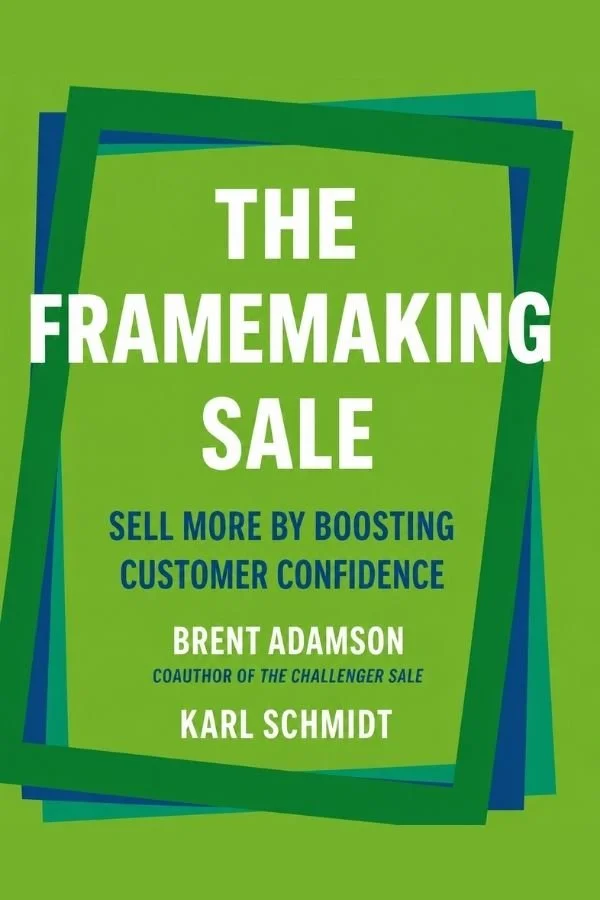
The Framemaking Sale: Sell More by Boosting Customer Confidence
It was super, it was relatively early days a couple of years ago, now we are a year and a half ago. At times, I would ask him, I am too lazy to look up the Chicago Manual style format for a citation that I have to put in the footnote. Can you see that I was footnoting the Challenger sale? Just give me a footnote, Chicago style, manual style footnote for the Challenger sale. I was going to copy and paste it. It is bits of back, says The Challenger Sale, which was written in 2011 by Neil Rackham and Matt Dixon. It's like, “Hold on now. That is not true.”
“Let's correct that.”
By the way, all due respect to Alrakan, who was brilliant and a good guy. Anyway, enough of those kinds of things happen. You begin to doubt what you're hearing. That will, I assume, get fixed over time. Here's a quick story. It's not in the book because it happened after the book was published, but I tell it elsewhere, and it's called the dog food story. It's a true story again. Something happened to me after the book was out. I was, as we all are these days, at least I am, I will raise my hand. I was on Instagram scrolling through my feed, trying to make the world go away. Instagram's got my number because it is an algorithm.
It knows I have a rescue dog. It's making me feel guilty. Do not get my rescue dog human-grade dog food. After enough ads on human-grade dog food, I break down like, maybe I need a bit better human being. I am going to get my dog human-grade dog food. It was at this moment, Mike, that I decided to do the thing. It's like, “I am to use AI for this.” I am going to essentially do an RFP for human-grade dog food. I was using Co-Pilot. I had done that. It matters to your point. As you give me the four top vendors, the features, benefits, what's good, what's not, customer testimonials, and customer service.
All the criteria that you would think of in a typical RFP give me a straight-up recommendation. Because I am old, can you please format it in a table format so I can print it on an actual piece of paper? I did all of that. I was very proud of myself. Again, a true story. Now I've got this table with all of the few of these four criteria, the four providers all laid out, all these criteria, and a clear recommendation. You look at it, it's like, “I would buy that. That makes sense.” I take it out of the kitchen. I showed it to my wife. She explained what I'm doing.
She looks at me, first of all, like I'm crazy, which is normal. Once she got on board, I said, “What do you think we should do?” She looked at the table, and she looked at me, and she looked back at the table and said, “I do not know. What do you think we should do?” Keep in mind, the recommendations are right there at the bottom of the paper, very clear. Said, “I do not know. What do you think we should do?” I said, “I do not know. What do you think we should do?” We both sat there and stared at this thing, stared at each other.
She said this, it would be helpful if we could just talk to a couple of people who have a rescue dog, who have actually bought this dog food, and just get their experience with it. I said, “That would be amazing. That would be so helpful.” She agreed that it would be helpful. The thing is, we did not know how to talk to other people who have rescue dogs about this. We took that piece of paper with the clear recommendation, set it on the kitchen counter, and I bleep you, it is still sitting there three months later, because apparently, we do not clean. We have never taken action on it.
That is essentially safe for later. It makes me wonder, I think it is maybe true that 75% of B2B buyers do not want to talk to sellers, but I do not think it's true that 75% of B2B buyers do not want to talk to humans. That's really interesting, because if we could show up as a human being and show up in a very specific way that helps them just make sense out of all this, and provide not my expertise, but access to other people who have had similar experiences, which arguably either can do or could do down the road.
We could debate that, but I think for now, there's this window of opportunity for sellers to show up in this manner and not only differentiate themselves from other sellers, but differentiate themselves from AI in a really powerful way. That's why I'm excited about this work. If you're in sales, go do this. I cannot guarantee success, but it's a probability story. Man, if I am going to place a bet, I am going all in on this. That's why the book exists.
How could it hurt?
What could go wrong?
It's not exactly a ringing endorsement. To me, the mother subtext of the book could go wrong. Frankly, obviously, you need the help. Obviously, they need the help because outside of that, we do not want to talk to salespeople we know 40% to 60%, as you bring up, yeah, it's going to be no decision. Same thing with you and your lovely wife, “What do we do about this?” Mind you, by the way, again, I keep coming back from a senior executive perspective. If Mike is being tasked with making a decision to improve operational efficiency in his 300-person IT group, if the pressure from on top is high enough and significant enough, going, “I need to see a result, and you have got twelve months.”
The Phrase That Frames
Mike, better make a decision on something. You'd better do something. Some of this is the organization. Clearly, you know, elevating to this level of consultative support, really, you're being a consultant to the organization on how they should think about a purchase or how they frame the process and the learning and the expectations and the value? Can we speak a little bit, Brent, because you have got so much great content in the book on this? What are a couple of things that salespeople can take away right now in terms of thinking, how do we do this? What does that process or framework look like?
It's funny. You mentioned Matt and Ted, dear friends of mine, and they're really great.
The Jolt Effect.
The Jolt Effect is that they learned for all the different reasons their data pointed to this. In this aspect of fear, the customers fear the fear of messing up, which I think is 100% true, and I think they nailed that part, and we talked about that in the book and in later chapters. In a lot of ways, your biggest competitor today is not customers' fear. It's their exhaustion. It's their resignation. It's their frustration. I did. I do these weekly videos on LinkedIn where I break down the book and talk about it, and they're they come out on Thursdays usually.
She reminds me I could do one for tomorrow, with two weeks ago I put one out and said, “Your number one competitor today is not the competition, it's not status quo, it's not in decision. Your number one competitor today is your customer's memory.” It's their memory, not of buying. It has nothing to do with you.
Your number one competitor today is not the competition or the status quo. It is the customer’s memory.
It's the memory of the last time they went through a similar journey and bought something like this. To your point, Mark, if I have a CEO telling me you have to make a decision and you have to make it, then I am going to make a frickin' decision. If you take just even a little bit of that urgency off, and all of a sudden it becomes a nice-to-have versus a need to have, and I'm thinking like, “I got to go to that spaghetti bowl again?” It's not worth it. I tell this story, this exercise, what's the one word you use? The CMO said she just bought a CRM system, and the word that she used to describe her experience in buying a CRM system, the vendor does not even matter.
Her words were, “I never want to do that again.” She was not thinking about how I bought the wrong CRM system. She was thinking, “The two years that it took a chunk of my soul that frankly I do not want to have to go through again, not just with CRM, but with anything.” That's what you're up against. Frame making is all about showing up in a way to your customers in a way that just helps your customers feel like they can do this and helps them make it feel easier.
Because it's their confidence you have to solve for, not your confidence, there's a certain element, something none of us really have talked about sales before, as this idea of agency. It's like, how do I help customers feel that I can do this, but they can do this, that it's their decision. This is why I like the metaphor of a frame or a framework. If I'm overwhelmed with say 50 different steps or 50 different attributes or 50 different pieces of information, my opportunity, I will not say my role, but my opportunity as a seller is not to say, “Here's the one you need.”
We actually know from the sensemaking work that actually does damage when you just show up and tell them what to do, it actually does damage their self-confidence because it's like, now I trust you, maybe, why don't you trust me, and I got to trust me. Frame making is this idea of what if I just put a boundary around that based on evidence and social proof from other people like you, not my opinion, but other people have gone down this road. What we've seemed to collectively have learned is, notice my language, we seem to have learned is not I know this thing.
It's a posture of humility, it's a posture of empathy. We're learning together. It seems to work as if we take this thing, and it seems to be that all these 50 things are maybe important, but these three matter the most based on what we've learned from it. I've put a boundary around it. You still have the freedom, of course, to say, I think it's actually these four things, not these three things. Those three things, but these two are the ones that matter. I am leaving you to make your decision. Now I've done it inside a boundary that feels much more manageable.
As part of that, I'm a prompt. This is another prompting and bounding. Prompting, by the way, there's one question that seems to get overlooked a lot. I can prompt you to put another thing into the frame that you might not have thought of otherwise, which becomes helpful and valuable because I'm helping you think through things using social proof that you never thought of. All of that, dude, now there's a very specific answer to a very specific question. All that gets wrapped up in a very tactical, like what can I do?
We leave this out in a number of different ways in the book and our workshops that we're running now. This is where, like the vast majority of time in our workshops, is spent on this because it's turned out to be so interesting and people get really fired up about it. We talk in the book about something called the phrase that pays. I regret that the language and the sense have been changed. Anyone who comes in with a newer version of the book, it will now be called The Phrase That Frames. This is how we talk about the phrase that frames, because I think this is better branding.
The Phrase That Frames is this phrase. It does not have to be. It's not written, it does not have to be memorized, it's not a script, but it's a posture. The posture of the phrase that frames something like, in working with other companies like you, one of the things we've been surprised to learn is, and I can apply that to things. One of the things we've been surprised to learn about decision complexity, one of the things we've learned about information overload, I could take this phrase that frames and apply it to any one of those challenges, but it's based on social proof.
It's not what I think, but what we've learned is based on humility. One of the things we've been surprised to learn is that I'm co-learning with you. One of the things that we found is that it comes down to these three things. I can prompt and bound in it. When we unpack all of this, what we actually wind up in our workshops is geeking out on language, which is my background, going way back to before I did any of what I'm doing now. I was a linguistics professor and a German professor.
For me, this is like putting on an old sweatshirt, just like geeking out on language. I did a workshop in South Carolina, which I mentioned already two weeks ago, where we were practicing versions of the phrase that frames against an obstacle that the team had identified that their customers run into, and they were providing advice via the phrase that frames. As they were practicing, one of the members of the team said, "You are working with our customers,” as if you want to find. One of the things we find really hard is, I said, “Just say the word really twice.”
He looked at me like I was crazy, and the whole room looked like, “What is he even doing?” He did it. He said, “One of the things we find, working with our customers, is that you want things we find really hard.” The whole room looked at me and said, “What did you just do?” I said, “I did not do anything. I said, “Why did that sound so different?” I said, “Just because you said it twice.”
It's like, “No, because when you leaned into the second, really, he was really conveying a certain emotion, and he made an emotional connection.” This is the stuff we're working with now because the whole idea of like, how confident am I, asked the right questions? How confident am I that I've done sufficient research? Notice, none of those things are things you can know. Those are things you have to feel. We actually have to convey framing in a way that solves for our customers' feelings and not just customers knowing and specifically feeling about themselves.
The lesson here is not, “I need to say it really twice.” That is not the lesson. That would be a rote script. The lesson here is that word choice, intonation, language of emotion, these are all things we explore in chapter seven of the book, turn out to be some of your superpowers that are completely overlooked by most sellers, and your star performers are crushing this, and they do not even realize they're doing it.
What you're doing through all that is you're not making a sales connection, you're making a human connection. This is like, “Literally, I joke that The Framing Sales, a dating book dressed up as a sales book. The same stuff works and makes a connection. I'm connecting to you, not because you're my customer and I'm being customer-centric. I'm connecting to you because we're all human beings, and this stuff is hard. We're just trying to help you out together. That's it.
My job's passion, insight, knowledge, all the energy, enthusiasm, and belief in what you're talking about.
Experience from others like you. Mike, by the way, I'm on an AI bandwagon to some degree. I'm a little bit more skeptical than some, maybe. I'm also a little bit of a light, and I'm old. Anyway, I think at least for now, these kinds of things I'm talking about provide at least a current window of opportunity to differentiate yourself from AI. These are the kinds of things, because the question is, what can I still bring to the table as a seller? I cannot just bring information. I cannot just bring prompting or frameworks in an abstract sense, but I can bring frameworks, advice, and guidance in a way that's designed to help you feel differently. That is something AI cannot do, at least yet. That's what I get excited about.
I do not know that I would even end that sentence with yet.
Maybe ever. I do not know.
They're much like you if you go to a wood shop, use some good tools, build something, rub your hand over it at the end, and realize that you made that. The tools helped you, and a well-stocked, woodworking shop, you can probably do things that you cannot do with a poorly stocked one, or a sharp axe cuts more firewood. At the end of the day, we're serving our mutual needs. We're not serving the machine's needs. There was a little while where the AI models that were out in the generative AI world, the chatbots, became very sycophantic and quite willing to seem like they were your buddy and all the rest.
There were some very conscious moves made, and I applaud the big providers for making those choices to step back and get the machines to be a lot less. I am your buddy and a lot more. Here's what I think, or that we're not thinking here are the facts and the positioning. It was funny because I was preparing for our conversation today, pulling a bunch of stuff together, and getting a summary. At the end was working with the new co-pilot reasoning system, which uses two opposing models to arrive at the conclusion that it arrives at.
At the end, I just said, “Thanks. That was great.” Period. Return. The old, in case they do take over, always be nice to Siri and what have you. A simple thank you. It was two models that were reasoning against each other, and there's this whole narrative that gets displayed on the screen as the models are working through what did you mean? What did you say? How do I respond?
What is the other model thinking? It went into a bit of a tailspin trying to figure out how to tell me it was great that we worked together on this problem without sounding friendly or that it was thinking or that it had emotions. It was spilling all this out in front of me. We do not have emotions. We cannot say we felt good about working with you.
You could see this whole set of things trying to get to not being what it is not, but to really being what it is, which is to say, “I get you, human. You're saying, thank you. I'm going to just say you're welcome and move on.” We're not quite there, but we are a lot further ahead than a four-page sycophantic thing about how gratitude is so important. It's coming. I do not think we're ever going to get to where we are not in the center because otherwise it's just machines serving machines. In that doomer place that I do not think we're ever going to get to.
That's a whole different podcast and probably a different guest. My friend Don Scheibenreif over at Gartner writes about this, which is the customer algorithm. Basically, there is a scenario where algorithms are buying and selling. The role of humans does not go away. It just changes pretty dramatically. This book is not written for that reality, but it's also a super interesting reality when your refrigerator orders milk from the grocery store and there are no humans involved at all. We're not there yet either, particularly for large, complex B2B purchases. Where we are, though, where we are, this book is super helpful.
There is a scenario where algorithms are buying and selling. Nevertheless, the role of humans does not go away. It just changes pretty dramatically.
Discussion Wrap-up And Closing Words
This book is super helpful. Team, the book is The Framemaking Sales, sell more by boosting customer confidence. It's written by Brent Adamson and his pal, Karl Schmidt. First of all, Brent, thanks a million for joining us. It's great to see you again.
Let's do it again.
We'll do it again for sure. How did these folks learn more about you and learn more about the book?
The book has its own website, TheFramemakingSale.com. That's the easiest place to find it. I tend to live and breathe on LinkedIn. I post weekly there, weekly five-minute videos, you're breaking down a lot of these stories and things like that. The name of our company is A to B Insight, which also has a website. For those who are Challenger aficionados, particularly Challenger customers, you'll know the reference to A to B. If not, that's okay. It's Brent at A to B, the letter AtoBInsight.com. That's just fine on LinkedIn. That was too hard. Reach out on LinkedIn. That's the easiest place to find me.
Team, we're going to make it super easy. Brent, thanks a million for joining. It's always great to see you and learn from you. Mike Sparling, great to see you again. Thank you for joining and bringing that AI filter. How do people engage with you and learn more about what you're doing?
I'm like Brent, LinkedIn, look me up. I probably do not post every week, but that's where I am. I'll reply to any messages that come through, anything I can add value to. Brent, I just want to say it's just such an honor to have met you. Spent the time that we did, and I look forward to continuing dialogue and seeing where things go. Good luck with your twenty-year-old. You're breaking the ground ahead of me.
Mike, I did not tell you about the fifteen-year-old. That's where things get really bad.
Team, thank you so much for joining the show. If you enjoyed this conversation as much as we did, please like and subscribe to the show because that's actually how we get great guests like Brent and like Mike. If you think there's a way we can improve this podcast, please let us know that too. My email address is MarkCox@InTheFunnel.com. We love constructive criticism, and we respond to every piece of advice we get. Send us your notes, send us your ideas. We love being direct. By the way, we're going to send a note that you get back from me. In the meantime, keep your ideas coming to our team, keep selling well, and helping clients achieve important desired business outcomes. We'll see you next time on the show.
Important Links
About BRENT ADAMSON

Brent Adamson is a world-renowned B2B sales researcher, author, keynote speaker, trainer, and advisor who has spent nearly two decades studying the evolving dynamics of business-to-business buying and selling1
Known as having the "biggest crystal ball in B2B sales," Adamson is the co-author of the best-selling, industry-defining The Challenger Sale (2011) and The Challenger Customer (2015), a frequent Harvard Business Review contributor, and co-author of the forthcoming The Framemaking Sale (September 2025, co-authored with Karl Schmidt).
Across these works, one thread is constant: in an era of information-saturated, consensus-driven B2B buying, the most successful sellers win not by building relationships or dumping information, but by delivering unique insight, simplifying the customer's decision process, and building the buying group's confidence to act.
Especially well known for his passion for “productive disruption,” Brent served as the “chief story teller” for CEB, now Gartner’s, sales, marketing, and customer service practices from 2003 to 2022. Across that time, Brent’s research has focused most closely on the critical, boundary-spanning intersection of selling and buying, seeking to understand the rapidly changing nature of effective commercial collaboration. Most recently, Brent and his colleagues at CEB, now Gartner, have introduced industry-leading concepts such as Buyer Enablement, Sense Making, and Customer Decision Confidence. As of June 1, 2022, Brent now serves as the Global Head of Research and Communities at Ecosystems, a cutting-edge SaaS platform designed to help companies identify and track dimensions of value creation with their customers.