Professional Sales Execution

ITF Office Hours Podcast - Episode 1

Are your sales reps stuck chasing "pipe dreams" while the real deals slip through the cracks? In our latest episode of In The Funnel, we are launching a brand-new format: ITF Office Hours. Joining me is special guest Dave Hanley—author of The Delusional Founder and a veteran who has exited three technology companies at eight-figure valuations.

In this session, we tackle the toughest questions from our listeners, moving beyond generic advice to provide real-world, tactical solutions. Whether you’re a sales manager struggling to identify which deals are actually real, a rep trying to sell up the ladder at a major account, or a leader dealing with a disruptive "star" performer who undermines your culture, this episode is packed with actionable insights. We’re pulling back the curtain on how to build trust, collaborate effectively, and stop forcing square pegs into round holes. Dive in to hear how you can elevate your sales process and start closing with confidence.

---

Watch the episode here

Listen to the podcast here


ITF Office Hours Podcast - Episode 1

Introducing The New "ITF Office Hours" Format

First of all, we have got a new format. I am really excited to introduce this new show we are going to be doing. We are going to intermingle these in between our normal selling well episodes. We will do it at least once a week. We are going to do what we are now calling the ITF office hours. This was not my idea. This was the idea of Dave Hanley.

Those of you who are friends of the show, you probably know Dave for a couple of reasons. First of all, Dave wrote a fantastic book called The Delusional Founder. In his context for writing the book, Dave is a very rare breed. Dave has actually started, founded, been the first salesperson, and then exited three different technology companies, and they all exited very well at eight figures.

One of the things I have found in my experience with founders, it is very rare for somebody to do well twice. To do well three times is extremely surprising. Although Dave is really humble, I do not want to embarrass him. He is Canadian. What are you going to do? This was Dave's idea. First of all, Dave, welcome to the show.

Thanks, Mark. Excited to explore this format and talk about some sales issues that some of our audience here have sent in. I know working with you for, I mean, how long has it been now, fifteen plus years.

Can you believe it?

Yes, it is crazy. Time flies when you are having fun selling. Some of the biggest insights I got when we are sitting in a boardroom, just riffing on questions, problems with deals, that type of thing, is when some of the biggest light bulbs go off. Hopefully, we can do that for the audiences here, talking about questions that have been sent in to us by clients and listeners, and just work through those.

It sounds great, David. By the way, team, thanks for doing that. As you guys know, at the end of every show, I put my email in the show, saying, "Please give us feedback in terms of how we can make the show better." First of all, we do get some great constructive criticism. Thank you, by the way. We love constructive criticism. The second thing is that we get some questions that get tagged onto it. These days, we are getting a lot of questions from LinkedIn as well. Keep them coming. Please ask the questions, but Dave, where do you want to take it from here? Do you want to go into the mailbag or the email bag?

Absolutely. As you said, Mark, if anybody has got some questions for maybe future episodes, you can reach Mark by email, LinkedIn, wherever, send in a letter if you want via the postal service, we will take them all. Let us start with question number one, Mark. This one actually is from Joe, and Joe asks, "I am a sales manager of a team with six sales reps. Some of my salespeople are crushing it, while others on the team are underperforming. Your underperforming reps, they always seem to have deals in the pipeline that just seem to get stuck or do not seem real. How do I do a better job helping figure out what's real and what is a pipe dream?" Love that little one at the end there, pipe dream, what is in the pipeline? I like it.

Basic Deal Qualification And Identifying Real Opportunities

There is a nice play on words there. A couple of thoughts. First of all, I think we do need salespeople who are eternally optimistic. One of the things when you are hiring salespeople, one of the attributes you are looking for is optimism. When they are working deals, they have to have this belief that the deal is going to come to fruition. You cannot have a pessimist in B2B sales. They are never successful over multiple years. First of all, we have to appreciate that we have a salesperson who has a belief in their deals.

The second concept, maybe I would think about, and Dave, you have all got great experience here too, is that sometimes it is hard to read the label on the bottle when you are inside the bottle. When somebody is in the weeds working a deal, they do not see all of the things that a sales leader might see when they are actually talking about a deal or a particular opportunity. When we go back to one of the roles of a sales leader, one of the things you are trying to do when you are in a one-on-one or you are in a deal review, is you prepare for it, where you assess what is going on.
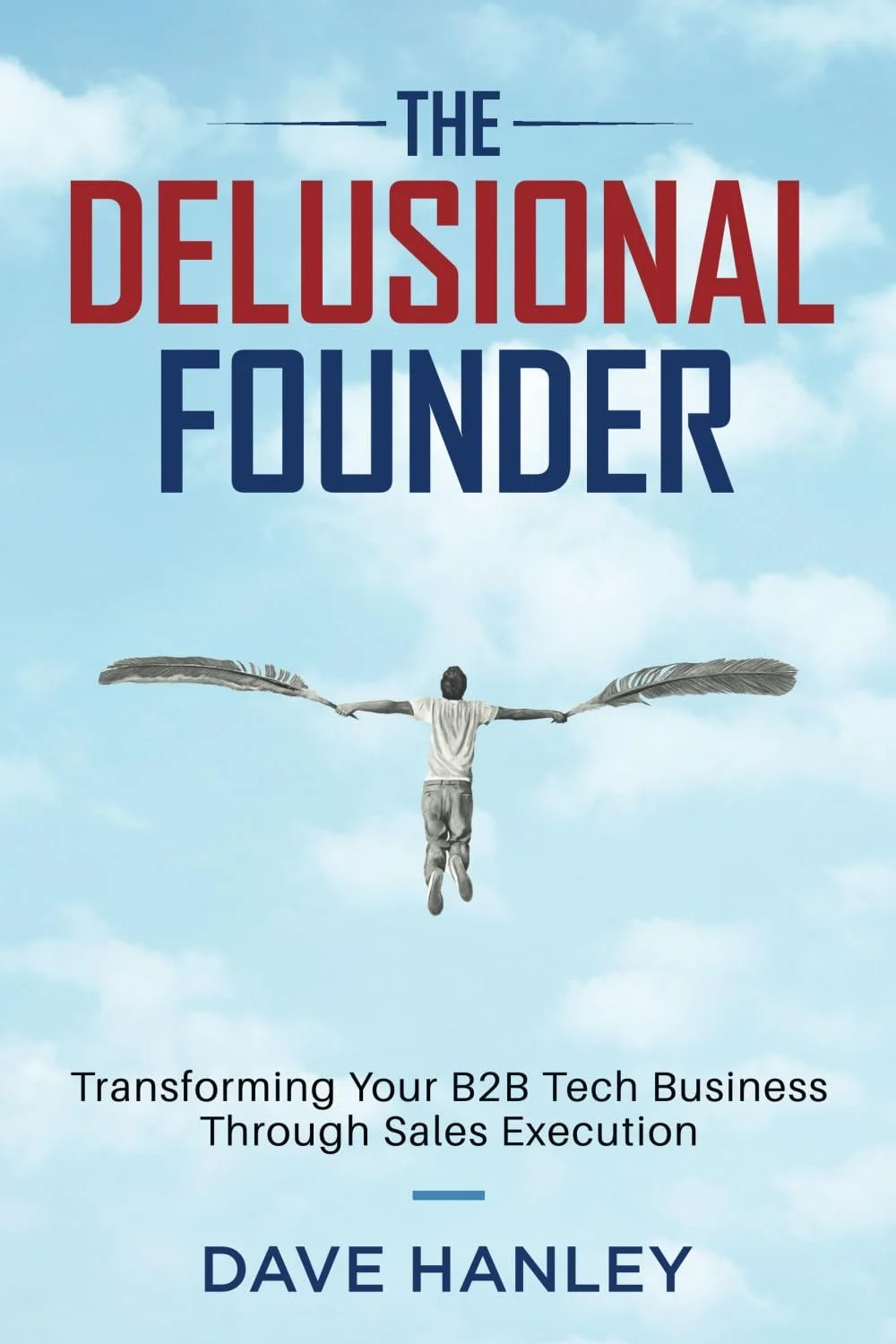
The Delusional Founder: Transforming Your B2B Tech Business Through Sales Execution

You want to question or come up with some great questions for the salesperson so that they learn and they come to the understanding of what is going on. You align on a go-forward plan, and hopefully, it is a go-forward plan that they created, because if they created the plan, they are going to buy into it. Something like deals that never come to fruition, I think we would have to go back to just basic deal qualification. Some of the things we like to think about, I think we have got a tool called the Fintastic Five Deal Qualifiers, if you are in the academy or you go on to any of our models.

First of all, in that particular deal, are we solving a meaningful business problem for that client? Just thinking about that, asking how big this problem is? Where is it on the radar for the client? Why is this something that would get priority over the 50 other things they could be doing to improve their business? The second thing I would think about is, do we have a champion in there who says we absolutely need to do this? I want to make sure this comes to fruition, and a team champion for us has to be somebody who has at least a medium to high degree of influence.

Sometimes we all end up getting caught, Dave, working with somebody who is friendly to us and responsive to us and does all the right things and is happy to go for coffee, but they have no influence really on making the decision. The third thing I would start to think of is whether we have created a business case or return on investment collaboratively with that client in their language, in their terms, and in their financial modeling?

One of the things you have seen so many times, Dave, is that a tech company, particularly a SaaS company, will give you a business case and go, "You are going to get a 47 times ROI on this." The client or the client's boss does not believe it. Why? It is not believable. It worked for that one company, one time in their particular industry, in their particular circumstance. I would really start to think about whether we actually collaborated and worked together.

That is something, actually, when this is when we first started working together, we would experience that problem all the time. We would go in there, they would say, "This is a great product. We love it." It would go silent. What we did back then was instead of forcing this business case down their throat, we essentially came up with a template, and we would sit down with that client and say, "Let us build this out." Half the time we would ask them, or probably more than half the time, frankly, "What is the next step in the process?"

They would say, "We need to put a business case in and get it approved." We would ask the question, "Is that something you do often?" They say, "I have never done a business case in my entire career." We brought the template out and said, "Let us sit down, fill it out together." Basically, we were consultants helping them put their business case together, and then they would take it up the ladder, and they were the ones who actually created it. Of course, it was built on our template.

By the way, see what I love so much about that, no one knew you guys were so successful. You are collaborating. One of the things about that is if we calm down and stop trying to pitch and sell and just hope and go, "Let us work together to actually figure out whether this makes sense for your business." Obviously, we have sold this hundreds of times, but it is really important that it makes sense for you in your business right now. If we say, "Listen, let us collaborate on a business case, take a look at these things."

Let us also think about what your boss is actually going to want to see? I think you bring up such a great point. A lot of the time, when we are working with people, they are not making decisions and building business cases five times a quarter. This is rare sometimes. Sometimes, trying to help them think through what the senior executives are going to want to see? How are they going to look at it? What are their objections going to be?

If you collaborate, you can earn the right to take the consultative approach and also let your client know if this does not make sense for you, that is okay too. We will try to help you in some other way, but it is not just about trying to force something in. It is trying to make sure they make the right decision for themselves and their business. If they feel that from you, "You are just trying to work with me to do what is right. I can trust Dave." I think they will open the kimono, and we can roll up the sleeves and help them.

Mark, this is one thing that I learned many years ago. It is like, if you are in there having the conversations and you are digging in and they say, "We really like this product," but you, as a salesperson, actually do not think it is a good fit. You should tell them straight up, "Look, I do not think this is actually going to work well for your business."

I have seen many times before where you do that, and that person ends up leaving the company, going to another company, and they call you and say, "Remember in my old business, this wasn't a good fit. I actually think now I am in a position where this is a good fit." Let us talk, and you build a ton of trust by doing that. It is not just about closing them. What is going to happen is you are going to close that deal, and it is not going to work out. You get a bad reputation. The person's upset. They go to a new company, guess who they are not calling next?

Who would want to do that for a living? Can you imagine trying to wake up every day and go, "I am going to try and sell somebody something, whether they need it or not." People like you and me would not be able to last a week doing that. We get into our mindset, the job of selling is really management consulting and trying to help a client achieve a desired business outcome.

If we go to our market that way, as you say, we are going to have a pretty great long career, because if people can trust you, the whole world opens up, but your reputation is so delicate. The one or two times a young person gets coached to do the wrong thing, that reputation will follow them, and in the heyday of SAS, there were a lot of these right demos and forcing things in and all these good things.

The whole industry was growing, sales teams did okay, but they basically populated a whole industry of people who hated selling because they did not like forcing a square peg in a round hole. They were young people. They are very impressionable. By the way, based on the timing, there were technologies that enabled them to get everywhere. Email blasts and all of this. Just take it back to the base principles. Help somebody, help a company get a better future, and things will work out well for you.

Sales becomes a lot more fun when you are actually helping customers solve real problems and are actually making and creating happy clients.

Some other tactical things, just on qualification with the question before we may jump to another one, would be, it is a bit qualified when, "Do they have a process for thinking through this? Is there actually a decision point, or is it going to be one day?" Eventually, you want to get to this point. Are you aware of how they make the decision? Who is involved? What is the role of each person involved? What is most important to each person involved? If you are single-threaded into the business, meaning you are only selling to one person, and that person does not really have the degree of influence, you are going to get a lot of meetings, you are going to get a lot of hope, and then it is never going to come to fruition.

One of the things that I learned from you early on is that we would be in our sales meetings, and you would ask the question, "How does this company make these decisions and how does the process work?" You kind of, I would look at you and go, "I am not quite sure." I was like, "How do we figure that out?" You go, "You ask." One of the things that salespeople really feel awkward about asking at first is just saying, "Susie, how does this process work in your company to get a project like this from now to live?"

Frankly, 99% of the time, they will tell you. Maybe the other one percent they do not know, which is a different concern, but they will usually tell you, "From here, I go to put this together, talk to this person. We present to this panel, this board," and they will tell you straight up. That is something you need to learn, map out, and work that into your own sales process.

By the way, that should be the soundbite from this show that we put all over the internet because the truth of it, I think it is so great on so many fronts. When you ask them that question, you might get an answer from somebody you are not super intimate with yet. They will say, "We do this, we do this." Sometimes they will leave that meeting, and what they are going to do is, "That is a very good question. I do not know how we make a decision here."

One of the tactics I always like to look at, or throw out there, is just ask it this way and say, "Listen, the last time you had a major decision like this, what did you do? How did you make it? Who helped you? Did you make it on your own, or who helped you with a decision like that?" It all starts with where you led us, Dave. If we do not have trust and credibility in front of that buyer, they are not going to spend time, and that can really open up to us on any of these things. Great one. Should we pull another one?

Selling Up The Ladder And Engaging Senior Management

Yes, let us do it. Let us see what we have got. Next, we have a question from Cindy here. Cindy is actually, it looks like Cindy is a salesperson, sales rep. Cindy says, "I have got a big deal on the go right now with a big bank and my main contact." She puts in brackets here, "The champion, maybe champion, maybe not. Is not letting me get in front of her management team to communicate what we bring to the table. I do not think she is doing a great job of selling us up the ladder. How do I deal with this?"

By the way, thanks, Cindy. What a great question that we all face. Certainly, with some of the larger deals I did long ago in my history with big banks that were tens of millions, hundreds of millions, one was a billion. I did not meet the president of the bank, but for a deal that size, I went in front of the president of a US bank, and that was somebody I would never have met. Now, our president did, but more tactically on this one, a couple of thoughts to share. It is not uncommon that our buyer is going to have to sell up the chain, but we have to remember they are not in sales.

We really need to spend a lot of time trying to help them because a lot of the things you have let people tuning in this show have learned over the years about helping a client make a decision. A lot of those things it has been so long for you. You cannot even remember it. It is hard to coach somebody who is not new to doing this. One of the things I always like to think about is if they are not great at selling up the chain and they are not letting us get in front of them, I think the only third option we have is we have to coach them well on how to do it with patience, kindness, and empathy. What you are really trying to do is engage in a conversation that says, "Let us think about how that executive team is going to take a look at what you are recommending."

Yes, that is a good one.

That might come out saying, "Listen, how do they make decisions? Who is in that room? What is most important to them? Why, why, why?" One of the things that I found, working with some great people and still doing deals to this day, Dave, would be that sometimes I am working with someone who is just so passionate that the company needs sales training. It might be somebody in mid-level leadership, or somebody in HR, and say, "Oh, we need this." Might be somebody in the product, "We need this." Sometimes we get the CFO's attention that we absolutely need this.

When you start to think of the other people who are going to be around the table, they look at things differently. For example, we might work with someone in HR who says, what is going to happen when you bring this up the chain, and your CEO says, "Exactly what return on investment am I going to get for making this investment in the sales team? What is your answer?" Just collaborating with them.

Are you going to say, "We know this training pays for itself if we get a 40% year over year sales increase," or does the training actually pay for itself if you get, like, a three percent increase in sales year over year? The second thing is, the CEO asks our buyers a lot, "What is the real cost of the training?" They will say, "This is the fee from the funnel." The CEO will come back and say, "That is not the real cost." Mark's company wants to be in front of our sales team four times a year. That is four days out of the field.

We have to fly everybody in, and a couple of these objections to the right executive team will immediately derail the whole thing. Sometimes, the buyers you have, if they are going into that executive meeting, they are not in there every week. They do not know how this group makes decisions, but 2 or 3 objections will derail that conversation. You will never get back in front of the executive team. For us, Dave, one of the things I like to think about is how to set up a meeting where we say, "Let us just think about how that executive team is going to look at this and prepare." You almost become the sales manager for your buyer, with love. What do you suggest in this instance?

Yes. Mark, I will put a different spin on this one. I love what you said there, just about having to coach that champion to take a certain approach within the company. There is another thing again, I think this goes back to your training with us many years ago. We were always selling back then to big insurance companies. We would have a person who is a VP-level, and they had several levels above them. Part of the time, they would not put you in the room with those same people. As a seller, you know that the person above them, the chief underwriting officer or something, is a real decision maker. As the seller, you cannot pick up the phone and call that chief underwriting officer because then your contact is going to say, "What are you doing?”

“You are going around me."

What you can do is something, I think you called it, like rank selling. What you do is you have, if you are the salesperson, maybe you have your VP or your CEO reach out to that person who is the real decision maker, the boss of your champion, or the person you are working with to say, "I know Cindy, in this case, is working with Steve. I am in charge of this, that, and the other in the business. I just want to make myself available.

I'm really excited about this project. If you have any questions as you go through this process whatsoever, do not hesitate to reach out." By doing things that way, your contact with the buyer cannot fault you for saying, "What are you going around? That is my boss." They are making the call up the ladder to really help the relationship, make themselves available. I think that is a great technique if you are locked out in that situation, because you can get the conversation started. Frankly, that relationship might pay huge dividends in getting the deal done.

It is a great idea. Just, I know you guys would do this, just a minor build on that would be I will share it with my contact and say, "Listen, I had a conversation with our CEO, and because it is such an important opportunity, they wanted to make themselves available to your boss, Dave DaCosta." I just wanted to let you know that they are going to be reaching out. Sometimes I wasn't asking for permission, but I was pleasantly making them aware.

I do not control what my CEO does. They weren't asking my permission to reach out, but of course, when they did that, the CEO would take the opportunity to let the other president know that their team was doing a great job and that we were really impressed with the skill, putting the wind in the sails of our buyers. That is an option to consider for sure.

There are a lot of companies that do not do that, and it is a nice differentiator. Get the senior, senior people to reach out, tell the person, "This is a really important project for us."

I loved your verbiage there, Dave. Your CEO says, "What am I supposed to say when I reach out?" You have got to coach the CEO on what to do. Just say, "Listen, out of consideration, I wanted to reach out and make myself available to you. I am sure this is a really important decision for you. You are a really important client for us. I wanted to make sure that I am available in the event you have any questions whatsoever about what is taking place."

By the way, delighted to connect anytime to share a few insights about what we are seeing in the industry. That peer-to-peer, by the way, at that level, of course, everybody loves networking. They love expanding their base, and they want to make sure. It is just such a smart thing to do. Any other thoughts on that one, by the way?

No, I think that should hopefully help Cindy get that big deal across the finish line there.

The Importance Of Collaborative Deal Reviews And Whiteboarding

By the way, team, one thing to call out, this is why I always love chatting with you, Dave, is that I am such a huge believer in the power of collaboration. As you are facing these challenges, please do not be afraid to go to your sales manager or your sales team. Put a few people in a room. It does not have to be an hour-long meeting, twenty minutes.

I can say, "Listen, if you have got a template for talking through the deal, we love our strategy builder that you can get from the Academy. If you do not, just have some way of briefly updating the team on where you are in the deal, whiteboard ideas of things I could do right now to improve my strategic positioning. What are the things we could do?" Always the idea of a whiteboard, it is almost like being in a comedy writer's room. There is no bad idea.

You can always put the ideas on the whiteboard, you can always take them off later, edit later, but get some ideas because riffing back and forth here, just you come up with an idea, and I had five percent, you had five percent. That is why it was so fun working with you guys back in the day, because there were such smart guys, folks in that company. We're also in a safe place because there was a lot of laughter in the room. People's brains work better when they feel safe. If they're in a room where I am trying to collaborate with the CEO, who is a real hard ass, and I get panic in my heart, I cannot think.

Mark, this is a, this is kind of a tool that is not really used. I think a lot of the time, by sales managers and sales leaders, is whether this is a big deal or a stuck deal review. It is great for a sales leader because, honestly, you do not have to do much. You get your sales team in the room. You say, "Who has got a deal that is stuck or a deal that is a problem right now?" Basically, they give the synopsis. As the sales leader, you look around and say, "Joe, what do you think? Susie, what do you think?" Just go around and get people's ideas and feedback. You are just facilitating the conversation, and what happens a lot of times is someone, "I had that problem last week. Here is what I did." Great idea. I never thought of that.

As a sales leader, look around the room and ask, “Joe, what do you think? Susie, what do you think?” Invite ideas, gather feedback, and make collaboration the norm.

Good Dave. For sales leaders out there who are always under enormous stress, you do not have to be the smartest person in the room. The hope is you are not. The hope is that you are developing a team of people who are smarter and more capable. By the way, not blowing wind in any sales, Dave, you and your buddy, Dave DeCosta, were those people back in the day with me, even, because we would get in a room and we would talk about a concept or an idea. A week later, we would have another sales meeting, and you guys would come back and show what you have done. In my mind, I was going, "You guys executed this thing way better than I would have." That is what you hope. As a sales leader, take the pressure off of you do not need to be the smartest person.

You do not have to have all the answers.

Your job is to really unleash the potential of the team and develop the people who are going to be the smartest people in the room and one day take your job. That is the joy of doing it. Do we have time for another day?

Addressing Disruptive High-Performing Salespeople

Yes, we have got one more here, Mark, maybe that we can address. This one could be based on my skimming of this question. It could be a more succinct answer here, knowing you. Number three here is from Rachel. Rachel is actually a sales leader. She says, "I lead a team of nine sellers, and one of them has amazing numbers and basically always beats quota. He has been with the company for about ten years. The issue is that he does not follow our protocols or processes. I feel like he undermines me sometimes in sales meetings. Honestly, it is a bit disruptive to the team. I have had several discussions with him, but he keeps insisting that he just does things his own way. What do I do?"

Rachel, I hope you're using a pseudonym, Rachel, for people tuning in. Dave, I will get your opinion on this one, too, but this is probably the hardest thing that I have had to learn in the early years of being a sales leader. Because you look at that person, that person might have good relationships with the rest of my organization. They have been around for ten years. You might have senior executives who like them. They bring in numbers, so everybody is going to like them. The truth of it is, you cannot have somebody who is disruptive on your sales team. You cannot.

Rachel talked about protocols. I almost position it as a value as a leader. I am bringing a set of values and a sales culture, hopefully to the table, and that we want the team to align on. The truth is, you have to do that. You have to get on side because you just cannot have a disruptive player on the team. Even if they're producing, the rest of the people wonder why they do not, why this person does not get held to the same standards, same protocols, same values, and same behaviors. Over time, it is not going to work out.

A lot of times, there is a little bit of imposter syndrome, I think, on new sales leaders. If you have got this person diminishing your authority, it is not good for you either. If it is not good for you, it takes you out of being your best self, so you cannot lead, help, and coach the rest of the team. The truth of it is, you have said you have had this conversation with a person a couple of times, you have to have that courageous conversation and say, "Listen, we have minimum expectations to be on the team. We have to do this."

That person is going to self-select and either do it. You then have to decide if they do not do it, you are going to need to replace them. They have to go. Now, the timing is something you need to think about. Given the pressures on the quarter and the year, what is the timing, and how do you address it with the customers they work with, and how do you get in front of some of those customers? We cannot have a disruptive person on the team. It is no different than any sports team. They do not just go after the most talented people. There are a lot of players in a league who are very talented, but nobody wants them on the team.

Even if that person is beating their quotas every quarter, you have to wonder what the negative impact of that person is on. It looks like Rachel has nine people on the team. What is the negative impact on the other eight people on the team? If you get rid of that disruptive person, potentially everybody else in the team is going to elevate. What I also see a lot of times is when you finally do.

The biggest mistake I have made throughout my career is, and I heard this phrase a while ago. “The time you should let somebody go is the first time you think about doing it. You have always waited too long to pull the cord, so to speak, thinking, “It will change, maybe it will change.” Unfortunately, they often do not. Once you actually do that, the rest of the team is like, "I never thought that was going to happen. It is about time." They are relieved, and immediately everybody gets a better morale and starts performing better. That is something that is kind of underappreciated.

The right time to let someone go is usually the first time you seriously consider it.

A cloud lifts. One of the things I always like to share, particularly for sales leaders, is to protect your confidence. That same thing we talked about a little while ago. You think best when you are in a good place. When you are in fight or flight, or feel like you are at risk or there is some danger, your brain spends most of the time in that zone. By the way, you cannot really think well.

This is why when you are having an emotional argument with somebody, you leave the argument, it is over, you are driving home, and you go, "I should have said this, this, and this." You cannot think well when you are in the middle of something emotional, or you are not in your best self. The truth of it is, I think for sales leaders today, the job is tough enough. I need a team that is aligned and on side. I need to make the expectations very clear.

I have to set expectations and coach people, and then have those courageous conversations to guide. Everybody needs feedback. If somebody wants to declare, "Dave, I am not too keen on your program. I am just going to be over here doing my own thing. By the way, I know what I am doing. I am getting my numbers. Do not worry about me," but I am to be disruptive behind your back. I am going to chip away at your authority. Whether you want it to be the case or not, tenured people in a sales organization influence new people. Because the new people go, "They must be good at what they do because they have been here ten years."

They are hitting their numbers. They have been here a long time, so I am to start doing things the way they are doing it. All of a sudden, you show up at the office one day, and you are looking around, going, "Why is everybody a total jerk in here, and why doesn't everybody like me?"

That is right. Making sure you are clear on what your expectations are, but the team has got to be your team. You have got to run the sales culture your way, and people have to be aligned with that. That is a really important thing in terms of being fit. By the way, both of us, I am sure, we will qualify. These decisions are never fun, gang.
No, the worst part of the job, by far, is losing a customer. It is never easy. I know it is easy for us to say, "Get rid of the person," but it is the most difficult thing, being a leader, being an entrepreneur, having a team, and having to make a decision like that, that does affect somebody, their personal life, and that type of thing. It is not easy.

It is not easy at all. The reason Dave and I are so crisp on it is that we have lived this multiple times. Too many times. We know the end game ends up being the same one way or the other.

Mark, that is all we got in the mailbag. We are running out of time here, but this was super fun. Hopefully, the listeners learned a few things, and I know I did.

Me too.

Like having these conversations. A couple of things you talked about were like, "That is right." I remember Mark telling me that ten years ago, and I have not thought about it. It is a good refresher, too.

Closing Thoughts And The Mission To Elevate Professional Sales

Me too, Dave. Just talking about it gets the thought process going again. At any given time, we are working with four or five different large sales organizations. We are training thousands of salespeople these days. These are the things that come up frequently in our workshops, whether they are for leaders or for salespeople. These are the issues we are all battling with. Leadership is tough. Selling is tough, and it is not getting any easier. By the way, Dave, what a great idea to do these office hours. Thank you so much for coming up with the idea.

It was fun, Mark. We will look forward to doing another one soon.

Thank you, Dave. It is always great to see you. We will see you next time. Folks, thanks for joining. As we mentioned at the top, the reason we run our company, the reason we exist, we are trying to improve the lives of professional salespeople. We do that through coaching, teaching, and elevating professional sales into the profession it deserves to be. We love your feedback. Thanks for tuning in. We hope you enjoyed the show. If you did, please like and subscribe to our show because that is how we get great guests.

That is how we keep doing this. If you have some ideas for us or questions that you would like us to take on in the next ITF office hours, you can send them to me, MarkCox@InTheFunnel.com. I respond to every piece of constructive criticism we get. That is my personal email, by the way. If you send a question, we will also say thank you, and we will put it in the mailbag for next time. In the meantime, team, good luck to everybody over the next couple of weeks. Thanks for tuning in. We will see you next time.
Important Links

How AI Is Revolutionizing Professional Sales & Strategy Execution With Mike Sparling

The Selling Well Podcast | Mike Sparling | AI Sales Strategy

Is artificial intelligence a threat to the personal touch of professional sales, or the ultimate tool for execution? In this episode, Mike Sparling joins the conversation to dive deep into the intersection of AI and modern sales strategy. Discover why simply having a strategy isn't enough—you need the resources and mechanisms to drive real success at every individual sales touchpoint. Learn how growth leaders are leveraging technology to bridge the gap between high-level execution and meaningful market impact.

---

Watch the episode here

Listen to the podcast here

How AI Is Revolutionizing Professional Sales & Strategy Execution With Mike Sparling

I’ve been running in the funnel sales coaching for many years. Within the first year of running it, I met with some of the smartest people I know to talk about it and think about whether I should be doing this for a living and so on. One of the people I met with, the first thing they said was, “You need to get into AI in a deep way.” This would have been 2013. Can you imagine somebody saying that to me when I started a sales training and consulting business? That was a pretty smart fellow. That fellow’s name is Michael Sparling.

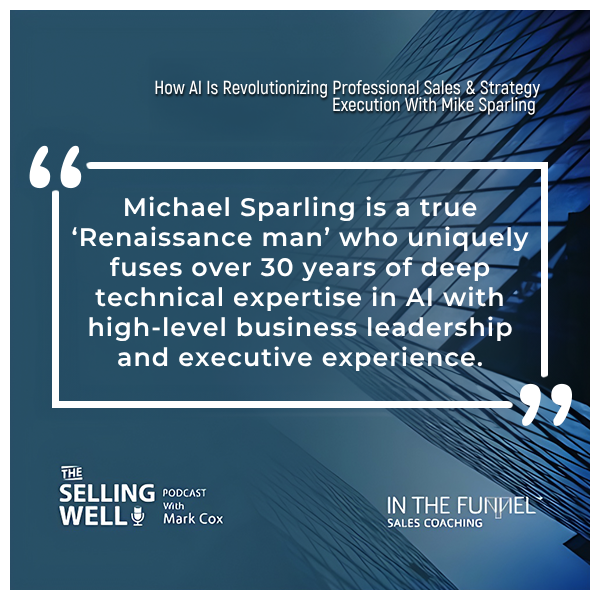
He’s our guest because we’re talking about AI and professional sales. Mike is a Renaissance man in terms of his career. He’s extremely deep in technology. He’s a chief technology officer for a major organization. He spent time running sales organizations, acting as a CEO. He’s run a very large-scale business school. I believe the business school he ran had upwards of 600 different lecturers. Mike is somebody incredibly broad and deep, but his focus these days is on AI. He’s a keynote speaker. He releases lots of papers.

I had to speak with Mike. That’s this episode. Now that we’ve re-energized and got back on the treadmill here with the show. You can expect a whole bunch of episodes focusing on AI. Mike was one of the first ones. I wanted him at the top of the list given his depth in my experience working with Mike. He’s got such a great way of explaining these complex ideas.

We get into some of these complex ideas in AI because, as sales leaders, all of us are very challenged. How do I leverage this to elevate the performance and professionalism of my sales organizations? It feels pretty complex. Mike and I have a great conversation. One of the things we start with is the November 2024 threshold. That’s a date and time and a term that Mike has coined in some of his work.

It defines the moment when AI capability begins advancing faster than professional adaptation, reframing AI as a leadership priority rather than a technology initiative. We talk about how to leverage AI, to get away from the how to avoid the how trap and focus on the why and what. How do we leverage AI as an infrastructure support for how to do something, while we still strategically have to determine why and what we’re going to do?

One of the questions I get into with Mike and a great answer, very practically is, “What should we be doing as sales leaders now?” What an interesting suggestion. He said, “Every day, you need a conversation with AI. Not just a question that you get a response to. He said questions and responses will give you some focus and learning. If you get into a conversation, you might change the way you think.” It elevated how I was thinking about leveraging AI. Certainly, we got into some practical applications for running in the funnel.

One of the other very practical things he brought up is using the audio for AI. I’m always typing into AI. He said, “Mark, you’re in the car frequently, jump on the audio. Have a live conversation with AI in the car to start to get much more comfortable with what’s taking place.” We talk a little bit about how information decays over time, and why it’s so critically important to stay current on everything. We know information’s power in terms of the sales cycle for sure, even more critical in the day and age of AI.

Folks, this is the kind of conversation we’re going to be having frequently moving forward on the show. Mike is a great resource for all of you to connect with. I enjoyed my conversation with Mike and learned a lot from it. I hope you do, too. If you do enjoy this conversation and learn from it, please like and subscribe to the show and tell your friends. Team, here’s Michael Sparling.

Mike, welcome to the show. It’s great to have you.

Introduction To AI In Professional Sales

It’s good to be here, Mark. Great to see you again.

This takes us a long time back. When we started to talk about AI and professional sales, Team and based on the timing of this show, I started in the funnel around 2013. We’re doing this in 2026. I’ve known him for about twenty years. I go to smart people and say, “I’m thinking of running a business.” One of the first guys I went to was Mike Sparling. I sit down for a coffee with Mike. I’m contemplating this idea of not running super large sales organizations anymore and instead starting a consulting company.

The first thing out of his mouth is, “You should get deep into AI.” This was in 2013. I’m drinking a cappuccino, going, “What is this guy talking about? I can’t even make the rent payment at the company office.” At this point, he’s talking about AI. Here we are fast forward thirteen years later. I’m so thrilled to have you on now as an AI expert. By the way, maybe I should have listened to you. Mike, give the audience that short story of your professional journey because you’ve got one of the more interesting professional backgrounds I’ve ever come across. You’re a Renaissance man.

Thank you, Mark. I’m glad we had a cappuccino together many years ago and here we are. My name is Mike Sparling. I’m a bit of an unusual animal and that I am a very deep technical person. I’ve spent well over 30 years in the industry working, always in AI. It’s not been historic to call it AI. It’s been called many things like industrial process control, knowledge management, or consumer behavior search. AI gets people to ask you questions at parties if you say you work there. The other side of the coin, though, is I’m also a deep business person, an entrepreneur, and an executive.

I’m in my day job as the chief operating officer and chief technology officer, fusing those two pieces, technology and business leadership for a global neuroscience company. I always like to say working with both the organic and the digital minds and finding the strength that comes from both. It wasn’t that unusual for me to say AI because I have seen this evolve. I’ve seen intelligence evolve both digitally and organically, and the challenges and strengths of both for a very long time. I’ve been a big advocate of what we can do to further transformation in business and create a competitive advantage for firms.

First of all, you didn’t mention it, but at one point in time, you’ve also run a very large business school. It’s the Renaissance factor, but what an interesting lead-in to something we often advocate. In sport, music, and professional sales, the importance of being a little better than the next company is massive. Selling better is competitive differentiation in the marketplace.

Our topic with AI won’t be a single show, but it’s so critically important because lots of things seem to be taking place right now where somebody is going to get an advantage. There’s no more dabbling. We’re in the world of advantage. Whether it’s a keynote that I’ve seen from you, Mike, or read something online. I know you referenced the November ‘24 threshold. Can you explain a little bit about what that is? Why should the CEOs, sales leaders, and salespeople, who tune in to this show, care?

Explaining The November 24th Threshold

That’s a very keen observation to pick that up. It’s a term that I’ve coined. You won’t find it in anything but work that I’ve published or speeches that I’ve given. I look across this large time space and this evolution of AI from its earliest days in the 1950s. Even earlier as a theoretical application, thinking about how our minds work. How would we replicate that in a digital space? You fast-forward through these eras of AI.

We started in what is referred to as symbolic AI, where AI principally worked based on rules. A lot of incredible things happen with symbolic AI. We went to the moon. We put autopilots in planes. We have cars that do a lot of amazing things. A lot of it based on symbolic AI. The world turned out not to be Black and White. We went to probabilistic next or probability. We added the shades of gray between true or false, and began to think about the probability of an outcome, versus the outcome being binary, yes or no.

All of a sudden, out of nowhere, although a lot of people saw it coming and there were many indicators that came first. In November 2022, Sam Altman, the CEO of OpenAI, put out this innocuous tweet at the time. We would call it an X now, or whatever the correct term is for messaging on X. He said, “We’ve released this conversational bot. We’d be interested in what you do with it and what you think.”

Suddenly, the world is introduced to the types of AI that we think about most now, which are these conversational interfaces with an AI. They can answer questions. Back in 2022 or 2023, they began to respond in more fulsome responses, such as a paragraph or maybe a page. You could stretch it out and get a little bit more happening. It was the time we were talking directly from our prompt interface to the AI model. A lot of things were happening. There were hallucinations, false information, and responses that were very puzzling and perplexing. Also, maybe required the engineers to go deep into the models and figure out what was going on.

As we get towards November 2024, a lot of things are changing. AI models began to reason. Reasoning is thinking about the response, breaking it down into tasks, formulating the response, and then providing it. Before, you were simply asking the model for an answer. It gave you back what it knew in its training. Now, it was looking and saying, “I can think about the problem more fulsomely and find a way to respond to what Mark is saying.” Reasoning is the first flag that I highlight for this November 24th pivot point.

The second thing was that a long body of work became practical. That body of work was around finding the right enterprise or alternative information to augment what the model had been trained on. Lots of terms get thrown around here. You’ll hear rag and vector database and all these other technical terms. The way to think about it is that we improved how the models reasoned.

We brought more pertinent, relevant information to reason upon. Specific to the question you were asking, or from the corpus of information that the organization has and has made available. The reasoning can look specifically at contextual data instead of generalized data. Suddenly, a whole lot of things like the hallucinations went way down, and the accuracy went way up. Things began to happen more focused on the question that you asked.

The last piece is that we learned a lot about how to build the models, deploy the models, scale, and make them available to you. A lot of things like guardrails, the controls on what’s going in and what’s coming out, began to fix and fixate on what the outcomes were meant to be. You had the reasoning like, “I’m thinking more fulsomely.” I’m in the camp that says machines don’t think, but the reasoning reflects a thinking model.

A lot more accurate information is coming in. Guardrails are preparing the data and response reflection to make sure that the accuracy coming back is right. Scaling makes it respond faster. An architectural pattern said, “I’m going to take your prompt and look at which of the different models I could send this to, possibly send it to multiple models to get a result, and then provide back to you that result.” That whole body of things together suddenly meant around about November 2024.

You were getting much more salient, relevant, lengthy responses from this alien intelligence, from this prompt window. It was coming back and saying, “Your sales last month were this. The leading indicators of the change were that.” Sometimes, it would even say, “I suggest the following actions to pursue corrective action against our sales patterns.”

You can’t point and say, “Here’s the date where everything changed.” In hindsight, you get to look and say all these forces coalesce together right around the second half of 2024. I picked November because that’s a lot more succinct to say the November pivot as opposed to the second half of 2024 pivot. It doesn’t mark it very well.

There’s some branding in there. There’s lots to unpack there, Mike. By the way, thanks for that super clear explanation. Team, when we start to think of it, that original tweet or text was in November 2022. It’s amazing what’s happened in two years. When we start to think of these impacts, one of the things we’ve always had a lot of empathy for, Mike, is that a sales leader is completely overwhelmed most of the time.

It’s the few and far between the sales leaders that are at this experience level where they can easily manage the complexity of having the three most demanding stakeholders in business. They are reporting to boards, which is stressful. They are working directly with clients and customers, which is, first of all, overwhelming at times, but very important. They are leading, managing, and supporting sales teams. An incredible amount of time is required to do that effectively if you’ve got the right intent and objective.

You add to the things that have happened to us, even starting with CRM systems in 2012 or 2013. It’s relentless. Every two years, there’s some major transformation. Gardner, McKinsey, and others go to the market and ask sales leaders, “What’s keeping you awake at night?” I always hate that question. When they ask them, they go, “Relentless transformation.” We never get a pause. Now, it’s AI. I can’t remember all of the sources, but you do say that sales is such a great testing ground for how AI is truly going to foundationally change business. Why is it that it’s such a powerful testing ground for all of the things you’ve shared?

Why Sales Is A Powerful AI Testing Ground

Let me preface my answer by saying, to the sales leaders tuning in. I sit around the same board tables that you and your teams did. Everyone around the table, at the board level, and at the senior executive level, even at the company meetings. It’s helping people feel comfortable about where the world is and is feeling the relentless pace of change. One of the drivers is that the change in the AI age is exponential. We are very used to, as humans, linear change.

Things got a little better tomorrow and a little better the day after or a little faster or what have you. This is a much faster change taking place. It is truly a phase shift in how technology is working. We should come back to that later. Let me tackle your question. Why do I think sales is such a great place to see where AI is making a difference and on? Folks will sometimes say, “All the press right now is about code, code bots, and all the things happening to coders.”

The change in the AI age is exponential. As humans, we’re used to linear change—things getting a little better tomorrow, a little faster the next day. But this is a much faster, more exponential shift.

That’s very true. That’s a field evolving fast because programming, code, and systems architecture are true, false, yes, no, and logical. Machines are good at that, where sales is more about reading signals, finding patterns, creating alternatives, and picking probabilistically the right one to follow. Sales have an important role in enterprises. It’s the intersection between the organization and the customer.

All the programs, products, and services come up as the organization. They meet the customer. That tip right there is sales and marketing. Where is AI going to make the first big changes for organizations? It’s making the salesforce more effective, bringing the messaging more complete, and satisfying customer demand more effectively. While there are fields moving faster, there are fields in very tight verticals doing incredible things.

Sit in a self-driving car in a city where Waymo or any of the other services are at and think to yourself, “This car is driving itself through rush hour.” That’s mind-blowing. Even knowing the technology, having worked with it when I was in academia, this stuff still blows my mind every time I see it. Sales is an important point where organizations change how they approach, and customers change how they buy.

That intersection says we, you, and I together are communicating and conversing about the most transformational change we’ll likely see this decade. Everything else around the board table is going to change. Sales is going to lead that change. The sales leaders who understand and lead that change in their organizations become vastly more important because they’re the scouts who see transformation long before the bulk of the organization does.

You speak about these scouts. This is great and complex. Let’s talk a little bit about what it’s going to take to continue. As a reference point, Mike, we’ve talked a lot about the evolution of sales from a trade into a profession. People who tune in to this show are sick of hearing me say that sales help them achieve a specific desired business outcome. Typically, when you’re working a complex sales cycle, the company that wins is the company that understands the client better than anybody else.

If you understand them and their problem and help them get to that desired future, you’re going to win. As we layer on AI into this whole conversation, let’s talk about some of the skill sets required for these professional salespeople or sales leaders in the future. What are they going to be doing that’s different from what they do now? What skill sets do they need? Lifelong learning and growth orientation are probably top of that list because of how quickly AI is changing everything.

Intellectual Curiosity And Avoiding The How Trap

Let’s unpack that in three ways. The first thing I would say is eSkills. Think about what’s going to make a difference for the next 5 to 10 years. Nothing will trump intellectual curiosity. By that, I mean a passion for understanding what’s different and the desire to learn more about what is changing. You bring those together, and it becomes the foundation of the change required to be successful in this space.

Other ones, like empathy, understanding how situations are evolving, pattern identification, and gut feel, sometimes, are all going to support the intellectual curiosity. That is the standout that brings the people who I find are passionate, versus the people who are hiding in the foxhole and saying, “I hope this blows over, and everything goes back to where it was.” First and foremost, I would unpack and say intellectual curiosity.

Getting a little more practical, there’s another thing I often talk about. I refer to it as the how trap. It’s funny because I use the word how both as an indicator, but then we have to use the word how a lot. If you think of how AI works, AI is good at figuring out how to do things. We can look at a giant body of information, find the pieces, and make a recommendation. It can build a slide if you tell it what to do. It can figure out how to adjust and build a probabilistic or analytic model to figure out the lifetime value of a customer or some of these other things. It does it fast.

How is strangely or ironically also how we grow up, differentiating ourselves. If I look at my resume, your resume, or our LinkedIn sites, all of them talk about the how. They are the achievements we’ve had in our careers. People get excited when a baby takes the first steps, or when you learn how to slap a puck at the net or make a big save. You’re a goalie. Make the big save with the catching mitt. These are all the applications of skills. It’s the how in action. We’ve been raised to differentiate on how, but the machines are better at doing how than we are.

If how becomes the domain of the machines, why and what becomes the domain of us? Where does intellectual curiosity suddenly show up? The second piece we unpack is why. Why is this important to the business? Why is this important to my team? Why would a customer find this intriguing? Why would this product enhancement be relevant to anything? What information do I have available? What is the capability of my organization? What are the tasks and outcomes that have to be put into the prompts or the programming of the AI to make things happen?

It’s a difficult problem to face because we’ve spent our whole lifetimes differentiating on how. You’re being asked to surrender how to not fall into the how trap, but to focus on why and what. They tend to have more senior leadership skills. You’re taught as you go up through your career, how to think more about why and what and less about how, and how to motivate people to do more of the how and pieces in.

You want the whole organization to think more about why and what, and a lot less about how. You want the organization and that intellectual curiosity to kick in to say, “What would we do different in all of our business processes? All the things that we do in your day-to-day actions to benefit from the how strength that machine intelligence can bring. It creates more leverage for the why and what strengths that you can bring as an individual contributor or leader.”

The third unpack that we would have would be, if you take intellectual curiosity and you avoid the how trap, the big piece is to recognize the exponential nature of change. Understand deeply that what you may try today doesn’t work, but it probably will work in two weeks. There’s the cycle time on these platforms. If you think back, if you started using GPT in November 2022, you were on GPT 3.5. I’m guessing, but it was about a year. GPT 4 came along, with a massive transformation in capability. GPT 4.5 came much faster.

A model that OpenAI called O1, their first reasoning model, effectively drove that reasoning pivot into the November paradox. It’s the November transformation. The models are changing so much faster. You can see Anthropic, OpenAI, Cohere, the big players like Google, etc. They’re versioning models every couple of weeks, or every month at most. They’re competing in the marketplace for dominance and benchmarking. They’re showing this exponential change, this pace of change in the models.

The capabilities, the orchestrations, and the outcomes are exponential, as opposed to linear and slow. It forces us to be much more comfortable. Intellectual curiosity, avoiding the how trap, forces us to be much more comfortable with change. People who can embrace change and are curious and comfortable taking that on find it much easier to thrive right now. If I put all that together, what I’ve learned from you over twenty-plus years of working together, the time we spent at business school together prior to that, salespeople innately are change champions.

They’re comfortable with the unknown. They’re very flexible in their approaches. They’re retooling their sales playbooks and strategies constantly for the specifics of the opportunity in front of them. They’re building their corpus of knowledge from that. They’re increasing their ability each time, but they’re not sticking right on the rails and only doing A, then B, then C. There’s a flexibility inherent in there. One of the things that I learned from you was that flexibility is the secret to being successful in professional selling.

Thanks for that, Mike. To me, it feels like that’s what’s required to be successful in life. There’s this ability to change and this growth orientation. By definition, it’s uncomfortable no matter who you are. I always liked the Ginni Rometty quote. Virginia Rometty was the first female CEO of IBM. After 100 years, she became the first female CEO. I might get the quote wrong, but I think her quote was, “There’s no growth without discomfort.”

Whether it’s physical fitness, I experienced it there. I still try to get better as an athlete. Doing sprint training is extremely unpleasant. Doing these kinds of things, you’re going to be uncomfortable. I was on an assault bike with a trainer managing me, thankfully. You believe your life’s going to end. You do as men, but enough of these. You go, “There’s no way I'm coming back from this thing. I’m over.” It is this idea that we get comfortable with some level of comfort with discomfort. I always point back to the growth mindset by Carol Dweck as a great reference point and a constant reminder.

Play on that for a minute because there are a couple of good threads there. Neuroscience tells us that most people are uncomfortable with change. You and I probably have friend networks that are very change champion-oriented, but that’s not the norm. As leaders and direction setters, we have to be aware that there are a lot of people uncomfortable with what’s happening. It’s our job to bring the uncomfortable forward, help confront, and learn and find their ways around that.

In Carol Dweck’s work, I always loved the fact that Satya Nadella came into Microsoft. He looked across the organization. I admire him in every dimension for all the things he’s done, but the thing I took away turned into a hashtag and was used at work. He’s been there for a little over twelve years. I’ve used this in multiple companies. He said, “I want to lead an organization that is not a know-it-all, but is a learn-it-all.”

That pivot to being a growth mindset, capable, conscious, and driven to learn, listen, reason, and act like that in a simple few words, sums up what we need to help the people who are uncomfortable with change. The people who are too comfortable with change and want to exceed what our organizational guardrails are bring all those parties together and focus that outcome on creating value for the enterprise.

It’s such a good context. I reread Carol Dweck’s book. At least the first half is a pretty easy, quick read. She went back to the early days of the IQ test. We all believe IQ is fixed and so forth. The name’s Alfred Binet. The guy who invented the IQ test in Paris in the mid-19th century or 20th century did so because he was trying to figure out ways of improving the intelligence of school children in Paris.

Through focused effort, trial, development, error, and all those good things, you do get better at everything. It’s how you process that discomfort. Mike, we could, we can, and I’m pretty sure we will talk for hours on this topic. Our show generally is to elevate the performance and professionalism of B2B sales, but give the audience things they can take away and apply to a couple of things.

The first question would be, what are some sources, resources, or ideas if someone wants to get deeper into AI? I know everybody says they’re doing this in AI. They’re picking their wives’ birthday presents through AI. Professionally, if we want to increase our level of acumen with AI generally, where would somebody who’s tuning in to this show go?

Daily Conversation As A Way To Increase AI Acumen

That’s a great question because the market’s moving so fast. I could say I’ll provide you with a paper that I delivered. I’m delighted to do that. That particular paper is going to show that the technology is so far ahead of a survey of senior executives’ appreciation and understanding. It’s the November paradox in practice, straight up. The thing I would say for almost everyone who doesn’t say, “I’m comfortable with AI. I want to get into agentic AI. I’m ready to change my organization top to bottom. I have a feeling I know what that means,” is this.

If you’re still moving towards that space, the best advice I give people from friends of my daughter, all the way up to CEOs, board members, and beyond, is to commit time every day to engaging with a particular AI. Pick anyone. They’re all good. They’re all different. They all have biases. They all have built-in limitations, but pick one. Every day, have a conversation with it. That statement has two deeply embedded points in it. Doing it every day and having a conversation means not a type one, prompt in, and get an answer.

The Selling Well Podcast | Mike Sparling | AI Sales Strategy

Commit time every day to engaging with an AI—pick any one. They’re all different, all useful, each with biases and limitations. The goal isn’t mastery overnight, but understanding: have a daily conversation so you can learn how they work.

There’s a lot of AI telemetry. It is being able to look either as a corporation at how your people are using AI, or more generally, the information released by a lot of model frontier model publishers. It tells us that most people use AI as a question-and-answer system. They ask a fairly simple prompt. They get an answer back. It might be a document. It might be a search. It might be an image or something else. That “conversation” has ended.

That is not a conversation. What I’m encouraging people to do is to set 10 to 15 minutes aside. Maybe it’s your drive. You’re driving to work. You’re driving to pick up kids at an event. Turn on the voice mode, put it on your Bluetooth in your car, and have a conversation with AI about anything. It can be the last thing you heard on the radio, something bugging you, a piece you don’t understand, or something that we said in this show that twigged you, but you don’t know why.

Start the conversation with whatever AI you’re currently using and go on. If you’re more comfortable typing or talking, pick your medium, but have a conversation. A conversation means you frame it, get a response, probe, get a response, back up, and reiterate. You go through that 6, 7, or 8 times to create a conversation. It’s like we would have if we had a glass of beer and a couple of hours. You’re talking about something. I’m not asking you a question and getting an answer. I’m having a conversation.

The goal of having a daily conversation with an AI is to learn more about how they work. What are their limitations? Where do they go? I like to say the more advanced part of that is you’ve got to challenge the AI in yourself to achieve three outcomes. Always focus on trying to learn something. Find out how it informs you about something. Find something that improves your thinking.

Learning something is a fact. Changing how you think is pushing you to stretch your neural boundaries and improve. Find something out you didn’t know. That’s great. That’s helpful at a cocktail party. You can say, “Did you know that X over Y?” It is interesting stuff. Forcing the AI to help you think differently is changing how you appreciate the intelligence on the other end of that conversation. It’s what we do naturally when we talk to each other, but it’s an important thing to do.

The other one is a little bit weird, but I still like to put it out there, which is forcing the AI to challenge your assumptions or how you view the world. You have to be careful there because you can fall into various bias traps and other things. I’ve done 3, 4, 6, or 7 prompt exchanges. We’ve got a body of outcomes to a point where I feel comfortable understanding it. I’m thinking differently. My closing will be, “Tell me the exact opposite of everything we’ve discussed.” Force the AI to give you the perspective that you’re not following. You don’t fall into the echo chamber.

You instead are using this very interesting, different entity to help you see the jagged edges and the different perspectives to give you different ways to think, to give you more information. On any given topic, you are more rounded as you decide your approach, your outcome, your style, and your decision. That’s how I try to encourage people to approach AI right now. You can try to go other ways. If you just do that for a couple of months, it’s every day for 10 to 15 minutes in the car as you drive. After you’ve tuned in to Mark for the Selling Well, have a conversation about something you’ve heard.

For the third time, they’ve tuned in to it. They shared it with fifteen friends, too.

They liked it in all of the other ways that we amplified. That conversation to me is the way that you learn how to then take that to work and apply it.

Let’s go over that again. This is the double-clicking. First of all, I picked something up. I’ve used AI frequently, every day for 2025, for sure. I’ve never done the voice module. I’ve never used the voice module. I’ve never done anything in my car. I had a lot of time in my car. I drive in and out of downtown Toronto.

That’s a lot of time.

It was a ridiculous amount of time. What a great takeaway there. It is easy to get in and start having this conversation. I want to come back to one other thought there. It is this idea of forcing you to think of something differently. What a great suggestion. “What’s the opposite argument to everything we’ve discussed?”

I know that you had one of my favorite lines. You had former Dean Roger Martin of the Rotman Business School on the show.

Thanks for noticing.

My favorite book that Roger Martin put out was The Opposab, where he frames across 300 pages. The people who are most successful in strategy, leadership, and outcome creation are able to simultaneously hold both sides of a perspective in their minds, habituate or switch between the two, and then arrive at a conclusion, having balanced both sets of thought. That’s such an important skill.

I don’t know how you teach it other than to say you have to be comfortable with challenging yourself. Have your friends challenge you, and spending time with people, including these new digital entities that can provide that counter perspective. It is a great prompt to ask, “Give me exactly the opposite perspective. Why does that exist in our world? What’s the thing I’m missing?” That little thread will change how you approach problems.

This is the nugget from this episode. If we only took one thing, if you got comfortable using your phone, jumping on with a conversation, find a different way. To build on your Roger Martin point. I believe one of the times we had him on the show was when we were talking through his book called A New Way to Thi.

It’s the same thing. He was going against conventional wisdom along four or five different core business myths. He had taken that thinking to take the opposite view. Mike, what do you think about this? I’m thinking aloud again, very selfishly. At the core, I’m a professional salesperson. We run this business. We do training, but at the core, I’m still an entrepreneur running a company or running a business.

Two things I’m going to start conversations with AI on are sharing our current strategy to 10X our business and sharing our strategy, how we think we can compete and win in the market. Part of that, Team, is an acquisition strategy of similar but smaller companies than ours. I love that idea of saying, “What am I missing? What’s the opposite side of all of this?” What do you think of that?

That’s a very fulsome conversation. There’s some research. Harvard Business Review had an article online where a team was looking at the bias of models in business outcomes. It was an academic team. They tended to look through an academic lens. They were discovering that if you fed business case studies into different models, they were all skewing in certain directions relatively similarly. It makes perfect sense.

Where does a current conversational model or an LLM, to use the correct term, get its knowledge base from the published works that are available or have been collected? I’m not an ethicist, so I’m not going to go into whether it was collected in the right way and how that works. That’s a whole other show. It’s a reminder that the model is not a thinking partner. The model is a response and reasoning partner.

What you said, though, is crucial, Mark. You said, “I’m going to talk about how I want to 10X my business. I’m going to talk about the potential of acquisition. I’m going to talk about the new market. I’m going to talk about other things.” You’re going to push the model in ways that you want it to look at and consider, and then respond to you. Back to that point about conversation, you’re going to have a conversation as opposed to taking a one-and-done approach, which is what this HBR article did.

It took, asked, plotted it on a chart, and moved on because there was a desire to show the probabilistic nature of response in LLMs, which is a very accurate reminder of bias and training. If you keep pushing the model, the thing about a model that has trillions and trillions of interconnections is that it will find other things in the conversation that will push your strategy along, and then throw that reverse in. What’s everything that would go wrong in my pursuing this approach?

It’s up to you, the human in the loop, to take all of that response and decide. Is it a conversation for tomorrow to take a different thread and continue to develop, or do you sit down with some organic partners or just yourself with a cup of tea and say, “I’m going to puzzle through this strategy”? Ultimately, you’re going to own the strategy because you’re going to make the decision.

Using AI For Deep Deal Strategy And Red Teaming

Here’s another quick thought. The juices are flowing now with the deal strategy. Team, believe it or not, my experience right now is deep deal strategy. It is about chasing a single sales pursuit and strategically thinking about how to improve my chances of winning. It’s becoming a lost art. We’re becoming a pricing and product environment and getting it out there. “The solution will sell itself.” No, it won’t.

The Selling Well Podcast | Mike Sparling | AI Sales Strategy

The same HBR organization that Mike speaks to, where he’s referencing HBR, published the surveys at four and ten times. A B2B purchasing decision favors a company that sells better, versus a company at the best price, product, or service features. That research was done by the Chally Group. It was done over thirteen years. It had a sample size of 100,000 B2B purchasing decisions. One of the things we like to do manually when we’re working with sales teams is be the red team on a deal that says, “Walk me through the current deal strategy.” This is not negative thinking.

This is asking, “If we were to lose, why would we lose?” I am thinking about having a conversation with AI about this and saying, “Here’s where we are. Here’s what we’re doing. We’ve addressed the key buyers. We’re meeting their desired outcomes. We can drive a better business outcome for the business. What are three things I’m missing?”

It’s not that they just go with a competitor. “What would be three reasons they do nothing?” Doing nothing is the biggest competitor in most sales cycles. How is that insight not going to be helpful just as a reference point? I’m still going to decide what I do with it, but it is a reference point while I still have time to change the future on a deal before they make that decision.

If you think about it, go back to the point we were talking about before about conversation. How are you going to untangle all of those potential parts? You’re going to untangle it by multiple iterations over an expanding body of work. In so doing, you’re going to surface things. Over time, there’s a term that you’ll hear in the field, which is digital twin. People will say, “What if I want to get on Mark’s show? How would I go about that?”

It turns out Mark publishes a blog. Mark has a LinkedIn profile. Mark has a lot of information, a book, and 100-plus episodes that I can have an AI analyze. It can come back, and we can have a conversation. I can say, “I want to catch Mark’s attention to get on his show. How do I go about doing that?” Here is a digital twin of Mark. It will help me see what avenues to use to approach.

People will often say, “I built a bid team. I built a decision team. I have an advisory board of ‘AI actors.’” You’ve begun to formulate the people you need around the table to help you make better decisions. I’ll often say I’m blessed and lucky, but so are a lot of the people that we have tuning in here that we have the means, whether it’s connection, financial, or what have you, to access two or three different AI products.

If you can take a formulating high-stakes idea and converse with OpenAI GPT, Anthropic Claude, Cohere’s products, Gemini, or what have you. That is going to give you different perspectives because they are different orchestrations, different engines, and different means of coming back. You will nuance your questions as you go. You’ll have your favorite. The more you can use different tools and different approaches, or even in your favorite, try the thinking option for a bit, try the fast option for a bit, and then try the previous model if you can still get to it, it’s going to show you subtle differences in the work.

One of the things I picked up for you a long time ago is that the sales leaders are the best people at reading unconnected signals. You’re in some of the best pattern recognizers in the industry. You’re sitting through a sales process where all these little indicators are popping up here and there. They’re not warning lights. They’re not dashboard gauges.

Sales leaders are among the best at reading unconnected signals. They are some of the strongest pattern recognizers in the industry.

They’re bits of signal that you can begin to build together into something that gives you a map of where you want to go. To the point we used before, it is pulling all of that different, diverse signal material together and seeing the topology to then plot the direction where you’re going. Different models, different people, different ways, and different prompt techniques will show you a path towards the goal that you’ve set for yourself.

For clarity, for those tuning in, Mike started that by saying, “If you want to get on the show.” Do what Mike did. Send us a briefcase full of money because we can be bought. I’m not above it. Send it in. We’ll take care of everybody. We’ll do a wonderful show with you. Mike, we could and will speak for hours. I’m pretty sure. I’m also 100% certain people tuning in are going to want to figure out how they can learn more about your thinking and stay connected with you. What’s the best place to stay connected with your thinking and AI?

One of the casualties of being busy is that I don’t necessarily have a deep and rich social media platform. LinkedIn is the best place. It’s Mike Sparling, COO, CTO, Multi-Health Systems. There are a few Mikes. He’s the chief counsel for 1-800-FLOWERS. There aren’t many of us. If you narrow it down to AI, you’ll find me quite quickly.

The other piece is to connect with me on LinkedIn and send me a message. Instead of blogging regularly and doing a lot of things, I like to have conversations like this. I like to sit down with people over a coffee. I like to answer a question that’s very specific. I’m more than willing to converse with anyone interested because, through those conversations, I learn and improve as well.

Mike, I certainly learned and hopefully will improve from this conversation. Thank you so much for being a guest on the show. It is great to speak to you.

It’s been a pleasure, Mark. Thank you very much. I look forward to continuing our coffee conversations.

You bet. Team, thank you very much for joining. As everybody knows, we run the show to improve the performance and professionalism of B2B sales because we believe that, by doing so. We’re improving the lives of professional salespeople. We’re also growth-oriented. If you enjoyed this show, please let us know. If you’ve identified a couple of ways where we can make this show even more valuable to you, please let us know that.

We love constructive criticism. I personally respond to every piece of constructive criticism. If you send something in, I’m going to personally respond and send a note saying, “Thanks for the feedback.” By the way, the way we run this episode is a result of some of that feedback. Thanks for giving it. We appreciate your time. We’ll see you next time on the show.

Important Links

About Michael Sparling

The Selling Well Podcast | Mike Sparling | AI Sales Strategy

Mike Sparling is the Chief Operating Officer and Chief Technology Officer at Multi-Health Systems Inc.

He has built his career at the rare intersection of deep technology and real-world business execution.

Trained as a software engineer and solution architect, he began by designing complex systems to solve meaningful problems. Over time, his perspective expanded beyond engineering into the realities of how companies actually operate—customers, competition, go-to-market execution, and value creation.

This shift led him into the world of enterprise sales—not transactional selling, but sales as a discipline. He saw firsthand how world-class sales leadership can transform a company’s trajectory—aligning product, partnerships, and execution to drive market share and growth.

Across multiple organizations, Mike continued to work closely with sales leaders, developing a practical understanding of how high-performing sales teams operate and scale.

In parallel, his career has consistently been at the forefront of artificial intelligence—spanning industrial systems, knowledge management, behavioral analytics, and most recently, neuroscience and biotechnology at the intersection of human and machine cognition.

Today, Mike’s work sits at the convergence of AI, value-chain transformation, and customer-facing execution—bringing together technical depth and a grounded understanding of how organizations create real value.