
Artificial intelligence is rapidly shifting from a futuristic concept into an essential driver of efficiency, strategy, and hyper-personalized customer engagement. Successfully integrating AI in professional sales requires leaders and teams to look beyond the hype and embed intelligent tools directly into daily workflows. In this episode, host Mark Cox is joined by David Fauser, Vice President of Sales, Marketing, and Strategy at CIMCO Refrigeration Inc., and Mike Sparling, Chief Operating Officer and Chief Technology Officer at Multi-Health Systems Inc. Together, they explore how top-performing sales organizations deploy AI agents to eliminate low-value tasks, elevate relationship selling, and orchestrate hybrid workforces. Discover how sales leaders can move past temporary pilots, build intentional AI strategies, and leverage technology to deliver unmatched value to clients.
—-
Watch the Episode here
Listen to the Podcast here
The Agentic Revolution: AI In Professional Sales With David Fauser & Mike Sparling
Meet The Experts: Navigating AI In B2B Sales
You’re in for a great show because we’ve got both David Fauser and Mike Sparling joining the show. These are a couple of our favorites in the funnel. Some of you know Mike because Mike has been our AI sherpa for the last number of episodes. David Fauser runs a massive sales organization for CIMCO Refrigeration with 150-some odd people. He's been a friend of the show. If you look into some of the past episodes, we've interviewed David. David has been a guest host, helping me interview some of our great guests.
With these two real thought leaders, we have a great open conversation about AI. At a high level, we cover four topics. One is what's going on with AI and professional sales. Somebody running a sales organization North of 125 people has a good line of sight in terms of how we're leveraging AI for productivity, efficiency, and a lot of those things.
We talk a little bit about where AI is going and what we're going to need to enable our teams in the future. Mike is super helpful for that conversation. We're talking about AI and the implications for salespeople. What are we all dealing with, trying to stay current with these technologies? There's that implication or opportunity for sales leadership.
Any opportunity you get to chat with people like this is a real pleasure for me, for sure, and a great learning opportunity for me. I hope it's the same for you. If you liked this episode with David Fauser and Mike Sparling, please like and subscribe to the show. Tell your friends because the more folks who do that, that's how we get great guests like Mike and David. I enjoyed chatting with these guys. I hope you enjoyed this conversation, too. Here it comes.
Welcome to another great episode of the show. David Fauser and Mike Sparling, welcome to the show again.
Thank you, Mark. Glad to be back.
Glad to be here.
I was pretty excited for this. We've got two of our favorites here. It's great to have you both back. Maybe we'll get the short story intro from both of you, if you wouldn't mind, starting with you, David Fauser.
Thank you, Mark. I'm super happy to be back again. This is a great topic. It’s very front of mind. I'm the Vice President of Sales, Marketing, and Strategy for CIMCO. With CIMCO, if you would have read and learned to love selling, you'd learn about our value proposition. We built half of the world's hockey rinks.
We do engineering, design, manufacturing, and installation and servicing of complex, customized refrigeration and thermal systems for all sorts of different industries. We're located across North America. We're North America's largest refrigeration organization. We have about 130 salespeople who sell projects and service as well. AI is something that's interesting to us. I look forward to sharing a few things about what we're thinking with your audience.
Huge sales organization. Huge opportunity for David when we think of the sales organization player-coaches. They service, and they're supposed to grow tricky business, for sure. Thanks, David. It's great to have you here. Michael Sparling.
I could claim that one of the things I'm trying to do is sit in every one of those hockey arenas and see a game that David built. I'm the Chief Operating Officer and Chief Technology Officer for a neurosciences company with global reach and lots of things there. My claim to fame is that I've spent 30 years, a little more, in my career always working in AI. It’s usually not called that. It's only in the last few years that it has been fashionable to say you work in AI.
I've been through industrial process control. I've been through search. I've been through customer evaluation. I've been through behavior change. I had a good stint in academia. I’m working on the intersection between our organic minds and the digital mind, and what we can do with that. Having a great time co-hosting with Mark here on the show for this time.
Also, doing a great job. We're so happy to have you, Mike. Gentlemen, thanks for joining the show. This is one of the things I thought might be a helpful structure for our conversation, but we can always go down tangents. I thought about first talking about what we are seeing out there with AI. What are sales organizations doing with AI as of the recording of this episode in 2026? I'd like to talk a little bit about the future and where we see this going in 3 to 5 years.
I would like to talk about the implications for our people. Those teams, David, that you've got in the field. Mike, as the CEO, you had many teams in the field. What are we seeing on the sales teams out there? What are the implications for the people we put on the sales team? Does this change the profile of the professional salesperson moving forward?
Finally, how does this impact us as leaders? We get a lot of folks tuning in to the show who are sales leaders. I'm pretty sure many of them are confused. At some points in time, I'm pretty confused as to what we should be doing, where we should be investing, and how we recommend or consult with our clients. If that's okay with you both, let's jump in here. Question one. I'm going to start with you, David, and then I'm going to go over to Mike. If we look beyond the hype, what are sales teams doing with AI? How are they creating measurable business value for their clients or for their own organizations with AI?
Beyond The Hype: What Sales Teams Are Doing With AI Today
A lot of different things are happening, but I'll think more best in class. If I'm thinking about what best-in-class sellers are doing, if their company doesn't have an overall AI strategy, they're certainly using the tools that are available through ChatGPT, Claude, or Copilot and are looking for ways to make themselves more efficient. That would be something that I see the seller would be doing. That could be through researching before they make a call. It could be doing some roleplaying, potentially. Developing questions, finding out more about the company, etc.
There’s a certain level, which I would consider to be really table stakes at this point. If you're not doing that as a seller, you're disadvantaged because it is so incredibly easy to do. Organizations are looking at agents that, first of all, can help individuals, but also sit on different platforms, like your CRM, for example. Good organizations that are on top of AI from where you could get value would be looking at ways to make their sellers more efficient by taking away their low-value tasks and trying to replace those with high-value tasks.

AI In Professional Sales: Good organizations would be looking at ways to make their sellers more efficient by taking away their low value tasks and trying to replace those with high value tasks.
We could be in the dawn of the relationship seller again. I know that never went away, Mark, but it's always, “I’m too busy.” There's a stock market ticker. They are shooting up in value like you wouldn't believe. The responders better be worried because those guys are going to be in trouble. Those are a couple of things, Mark, that are very high-level that I'm seeing. One is efficiency in the drive of trying to take away some of those low-level activities.
Thanks, David. What would you add to that, Mike? What's your view?
Great answer, David. You see across the spectrum. There are companies from very early adoption that are beginning to be AI-adjacent. They're looking at, “How can I do some basic things?” as David highlighted. Some prompts and some other pieces there. It goes all the way to companies that have restructured thoroughly, and they're very AI-forward. They're led by AI in support of their people. They’re allowing their salespeople to be more relationship-based.
We were having a conversation in one of our earlier recordings where we really honed in on this triumph where you can say personalization, long-term memory, and pattern matching drive everything that would go into the return of relationship selling. AI's ability to reason over large sets of data and find patterns that may not be evident to us or would only be evident to someone at a very high level of awareness and understanding, is surfacing those patterns to different parts of the workforce.
The memory, remembering what has happened through the whole relationship from prospect to repeat customer. The most exciting piece to me is the level of hyper-personalization the generative technologies let us take on, whether that's specific content tuned to a voice or an outcome, or a media placement piece. I don't want to imagine AI phoning and making phone pitches, but that is still the place that we're at. It is hyper-personalized. David gets a very different offer than Mark, and yet we're all being guided to the same set of goals and outcomes.
I love that hyper personalization. Mike, you know they are using AI. Think of professional services firms like a chiropractor or a dentist. Think of those organizations. There are some platforms out there that'll reach out with calls, confirm your appointment, and maybe book you for another appointment. With the conversations we’re having, Mike, we're seeing things like basic prospect research, account planning, and proposal development.
More sophisticated would be, “Can I help with data enrichment or identifying my ideal client profile by dumping all of our clients and what we've done for them? Can they help me find new clients or target markets or prioritize the messaging to them?” A lot of those data enrichment tools leverage AI for outreach.
I don't want to get too tool-specific because it'll be outdated by the time we publish this episode. They're using those tools to try and personalize outreach, so that we can get people engaged on the top end. The jury is still out. Email outreach still has a low return generally, but it's one of the highest marketing returns out there. Even though it's low, it's still one of the highest marketing returns out there. If we fast-forward this thing five years, where do we see it going?
Maybe I'll throw this one, Mike, if I can ask you first, because I know you're a proponent that things have changed dramatically in the last couple of months. You've seen some triggers for that that I love to hear about. Anybody reading this will agree with you because it has blown up in the last couple of months in terms of everything out there on the hype cycle about AI. What's happening that's causing that, in your view? Where's it going to be a few years from now? How do you think things will change? How will we, as organizations, be using AI to compete and win in the market?
The Rise Of AI Agents And The Future Of Work
What's that famous saying? The danger of predicting the future is you’re right sometimes. I look at the pace. The pace has changed. It used to be the frontier model companies. An OpenAI, an Anthropic, a Microsoft, or whoever would rev a model once a year. When we first started out, GPT came out with 3.0. 3.5 came about a year later. That was time for us to learn and figure out the confusing pieces of the whole puzzle and make it work.
We’re now getting major model releases every 30 days. Every one of those models breaks all of the past records, the benchmarks, and all of the things there. That pace of change is driven by a bunch of things. The availability of compute has continued to grow. Not in my backyard. You don't want a data center there. There are massive amounts of data capacity coming online to allow these models to scale new training techniques and new ways that they develop their skills and abilities.
The biggest thing in the last couple of months is the emergence of agents. David, you referenced that in your opening piece, too. Agents change the equation. A prompt is when you author something and hand it across to a machine that has no recollection and no memory. Everything that comes as a response to that prompt, you've had to type into the keyboard at that moment. Agents operate over time with memory, goals, objectives, and access to tools. This longevity, tool access, and goal setting let us point those agents at much more complex problems.
Agents operate over time with memory, goals, objectives, and access to tools, letting us point those agents at much more complex problems.
If I look out five years, cooperative workforces, agents, and individuals will manage our organizations from a hybrid org chart. We'll have agentic behaviors and organic behaviors. I always hate saying humans are organic. We'll look at our org charts and see agentic capabilities along with our traditional staff. We'll set goals for both sets of outcomes.
We'll see embodied AI as well in the next five years. Robots or purpose-built interfaces will engage with us, be they particular things in shopping experiences or different ways that are cognitive extensions in how our phones behave with us based on AI. That agentic intersection will change almost everything for us. That's a lot of ways to say I have no idea what it's going to look like, but some of the trends to me are a much richer co-intelligence where we're working together on outcomes and seeing that happen around the clock.
David? What are your thoughts on that same question? Where are we going with this? Even another question. How does what Mike said make you feel?
It makes me feel exactly how I have been feeling since January 1st, 2026. I've been immersed in how AI is going to be affecting us now and into the future. As a leader, Mark, it's super challenging. Our managers’ meetings were all about that. We're trying to figure out where we invest, how we invest, and where we put our bets on the table. For every good AI opportunity, there are probably five bad AI opportunities. You could probably cause a lot more confusion if you don't put it in very deliberately.
Where I think the future's headed, though, for selling, is going to be completely different. Even the size of our salesforce is going to be smaller. I'm sure there'll be other roles, but I think that it'll be smaller. All organizations better get their value proposition highly figured out because the sophistication on the buyer side is going to outpace us because we used to have information.
We talk about the internet age. Before the internet, we had a lot more information on sellers. We're going to have even less. That knowledge used to be valuable in certain circumstances. We won't be able to lean back on that value as our main source of finding and keeping customers. The bar is going to be higher in regard to what we're offering in regard to how we find and keep customers and opportunities. That's going to be challenging, for sure, but in the midst of difficulty lies opportunities. The opportunities will be for our ability to get faster, better, smarter.
For the first time in human history, there's something that's smarter than us that's available at our fingertips. What can we do with that power? What can we do to make things better and enhance our value proposition? For all those reasons, it is hard for me to say what's going to look like with robots and this and that. I do know that with these agents, Mark, I've got an unlimited workforce.
Mike speaks to that, too.
I can deploy these guys like crazy. Productivity can go through the roof for training and for sorts of interesting things. One other thought on this, Mark, is that if you do not have an AI strategy in place right now or you don't think you're going to, you're probably going to be out of business, to be quite frank with you. I don't know how you would compete otherwise. Those are my thoughts on that, Mark.
It leads to a couple of thoughts. With loving kindness to everybody out there, for a lot of years, there was this role of revenue operations or sales enablement. Call it what you will. In different companies, based on the sophistication of the sales organization, it was a mid-level, prestigious position. Maybe sometimes, not always. You had folks in there who maybe hadn't come from a sales organization. They were doing policing on reporting and all of this kind of stuff in Salesforce.
To me, all of this turns that role into this incredibly strategic role for a sales organization. If we look at what a sales leader has to do, they have to build the strategy, build the team, enable the team, and lead the team. Enabling the team became massively important through AI because AI is going to enable the team.
The agent is a person, Mark. Enablement was one person with a bunch of salespeople. Now, it's a bunch of enablers, agents almost, with one salesperson. The salesperson will never have more support than what it's going to have in all aspects of enablement.
What does that turn the salesperson into, then, Mike?
It turns everyone into an orchestrator, understanding the company policies, goals, and objectives. Governance is going to be more important. More people in the organization will have to think in governance and compliance terminology, even while the guardrails and frameworks have to enforce it. When you're orchestrating agents, you're going to need to understand more.
Rethinking Sales Leadership, Enablement, And Orchestration
What are they empowered to do? Where are you required? I was saying human in the loop. There'll always be a human in every decision loop. We already see that 60% to 70% of a lot of agent deployments operate autonomously until they meet a threshold where they escalate and someone else is involved. It takes a deep understanding of the process.
One of the things about learning to love selling is that it calls out through the frameworks that are required in order to affect the outcome of the sale. That framework then is able to be annotated with guardrails and conditions to say, “If it goes on this path, I don't need to be involved. I’ll look at the deal at the end and be happy with it.” These are the points of escalation where you have to see my input or, to David's point, another agent who works at a higher level, who has a different budget, allocation, or capability. That orchestration piece is what is key.
A lot of people's job titles over the next five years will change to include words like orchestration or articulation. We're building agents, not a computer science problem. It's a business articulation goal-setting problem. That's going to empower a lot of people, but require some things that maybe organizations didn't use to teach to be key skills that we develop in our staff.
It's now a business articulation goal setting problem. That's going to empower a lot of people.
What a great way of thinking about it. David, I'll build on that point that you brought up at the beginning, saying, “The core elements of a playbook, whether it's ours or somebody else's, are still there.” Before I start to scale something like outreach, I do need to understand my value proposition to a market. You're saying the buyers are doing lots of scanning as well.
With love to everybody out there, many times, organizations still have a very difficult time articulating their value proposition to a marketplace. What do you do? How does what you do tie to a desired outcome for your client? What makes you unique and different from their other options in the marketplace to achieve that outcome, including doing nothing and keeping doing what they're doing?
That question that we posed when we're consulting and training the sales team continues to perplex them. We've all been so accustomed. We have so much motor memory to regurgitate marketing bumb, which is meaningless, including my company. We got embarrassed in a large workshop once where somebody said, “We're doing the value proposition exercise.”
We were speaking at an event for Deloitte. There were 100 people in a room, and we were training them on value proposition. They said, “Explain your value proposition.” I had a very confident salesperson from our team at the event. I said, “I can do it, but I'm going to pass it over to this fellow.” I threw him in the deep end.
He became a little uncomfortable, and then he regurgitated and said, “In the Funnel is a group of sales coaches and consultants that help companies sell better. Clients engage us when the sales team is dramatically underperforming.” He went on to say, “We're unique and different because of A, B, C, and D.” Half the hands of the room went up and said, “Our sales team's killing it. We're here because we want to keep getting better. We're not underperforming. That's the wrong value proposition.”
This poor salesperson, who will remain nameless, and I were both pretty embarrassed because it woke me up that. Although that was a value proposition five years prior when we started, we'd evolved and had become different. We were selling to different clients. The clients weren't in pain. They wanted to keep doing well. It’s this challenge around articulating the value proposition and then understanding your ideal client profile. I don't want to scale outreach. I don't want agents doing anything unless I understand that I've done the hard work of refining those two things. Would you agree, David?
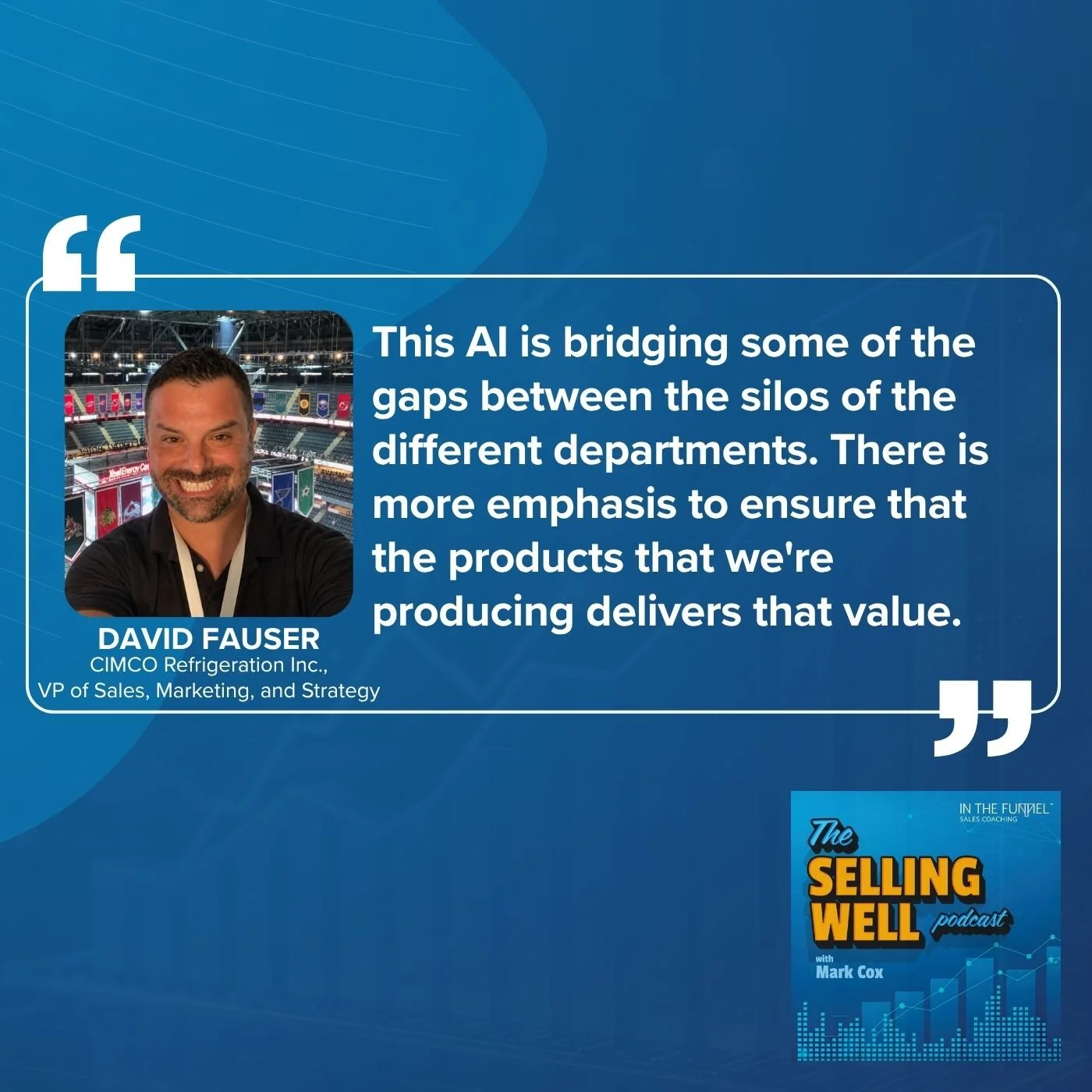
Yes, 100%. Your fundamentals, especially in the level of selling, are where it's at not only for sellers, but for organizations. One of the things that I'm finding is that AI is bridging some of the gaps between the silos of the different departments. There is more emphasis to ensure that the products that you're producing deliver that value as well. It's more important than ever, Mark.
That's one thing we haven't had on our list. What about leveraging AI for better understanding our existing clients and how they feel we compete and win in the marketplace? There are the old-school CSATs that are always a little benign to me. They're a little generic and benign. Can we leverage these agents to interact with clients to truly help us define why we get selected and why clients invest in our companies so that we can continue to refine and then let the whole world know what is unique and different about us? I'm thinking aloud as we do this.
If you think of what an AI is very strong at, it's reasoning over a large data set and finding patterns. Likely, within every selling cycle that you've executed in all the communications, all the engagements, all the notes, all the work that was done, there are signals that you have not yet seen that explain your value proposition, why you're differentiated, and why you won. Turning that over with an open mind and letting the system surface those patterns probably calls out things that you hadn't thought of before.
Moving Beyond Pilots: Implementing Intentional AI Strategies
Thanks, Mike. What a great thought. David, you're in executive meetings where you're getting called out on AI and what the strategy is. If we’re thinking about the future, any suggestions for the people tuning in as to what to do outside of being able to respond and saying, “We're doing a pilot,” which we're seeing a lot of. Have you guys seen a bit of that? We're seeing a lot out there in the marketplace, which is, “I've got a pilot started.” Any other suggestions for where to start, how to deploy, or how to initiate projects without it being career-limiting?
I'm happy to share because I don't think it's rocket science. I’m using the word intentional quite a bit as a vocabulary word. I’m being very intentional in regard to the exact way, from when we don't even know there's a client yet, or when we first realize that we want to contact somebody, all the way to them renewing, and every single step that actions that our sellers do in that process or those that touch them. That's pretty painstaking to gather that detail. What’s very important is this is not a judging exercise. I don't care how we're doing it. It is what it is.
Map out the truth.
Mark, I love your saying everything starts with the truth because it does. It’s making the employees feel comfortable that there's no sense in leading me down a path, because if you lead me down a path, we're going to be solving the wrong problem. It is what it is. It’s a full map-out of it end-to-end. From there, I'm looking at high-value, high-time and low-value, low-time type of activities.
For example, for our salespeople, we'd be putting a proposal together. Is that valuable to the client? No, that's not valuable to the client. From there, I'll be able to start to say, “One thing I want to do is make a proposal. I will make an agent for that, and that's going to be their only job. They're going to do it well.” I'm taking a look at low-value tasks. Start with low-risk things that you can do throughout that and then start to build from there more.
Also, the other thing is using and utilizing our CRM with all the data that we have in there for things that Mike was talking about. I want to identify those key points that Mike was talking about within the selling process that I think I know, but I may not know. I want to then make sure that we build out on those key points to understand that so we're positioned well moving forward.
David, that aligns exactly with what Mike said at the beginning, where he was saying to map out the whole entire customer journey, including post-sale, renewal, and growth. If we start and map that out exactly, then you could delineate in terms of the core activities and functions in each. You might be able to crawl, walk, and run with AI to say, “We're going to pick out certain things and start to get in the game at least a little bit.”
That seems like a good strategy to me because I could start to get comfortable with, A) Consulting companies that might help us go through that kind of journey. B) I get a little bit more comfortable with some of the platforms and technologies before I make the huge leap all in and lose my job, picking the wrong ERP system. I can crawl, walk, and run to figure out which organizations are staying current and which platforms seem like they'd be the right idea for us. It's great thinking. Your thoughts on that, Mike? Anything to build on there?
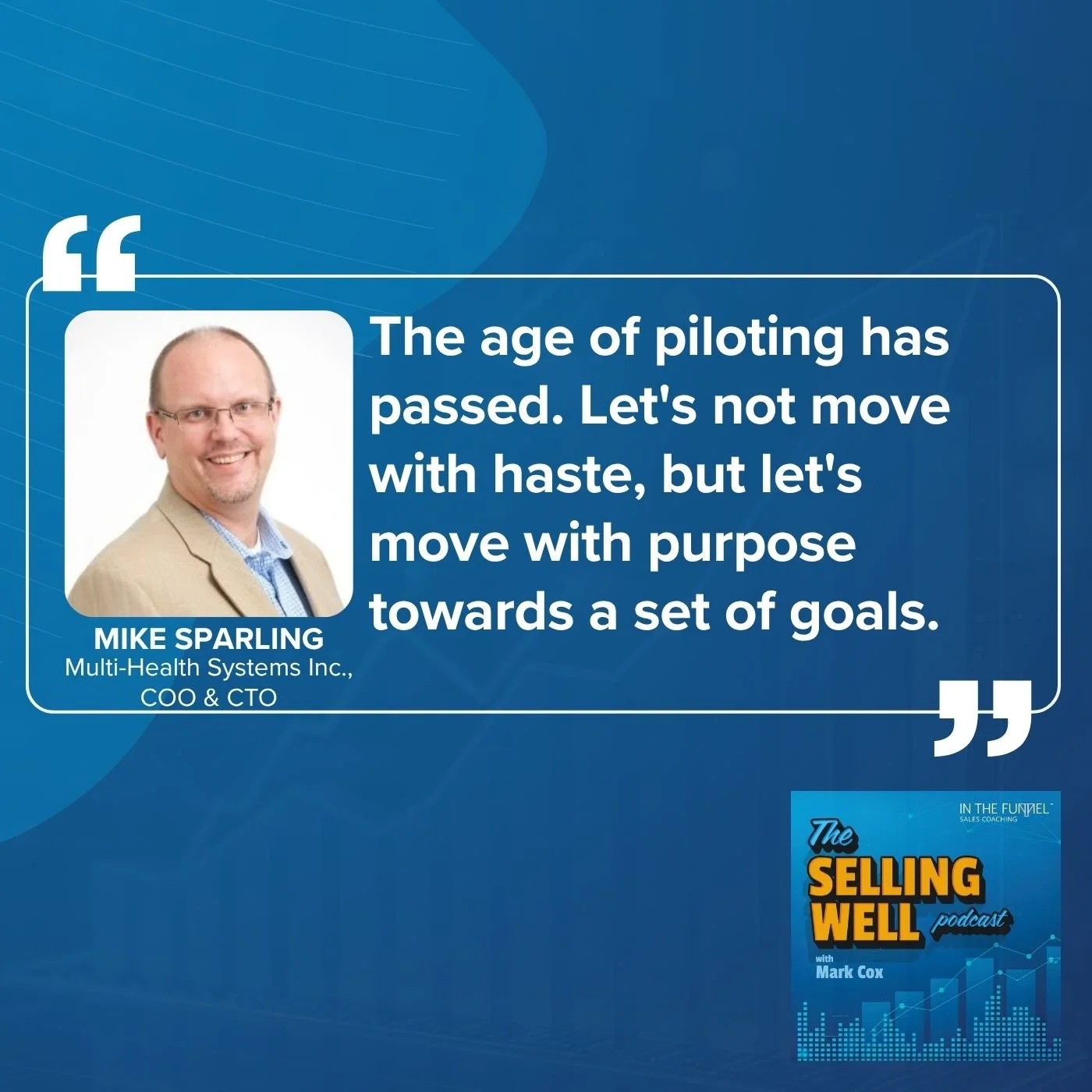
It’s such a great scaffold to build on, for sure. At the start of each year, they always talk about what the word of the year is. The word we're going to retire in 2026 is pilot. The age of piloting has passed. As executives, business owners, and leaders, what I think we have to be doing now is purpose. Let's not move with haste, but let's move with purpose towards a set of goals.
To the points David was making, David and his team are building agents. If you jumped in a time machine, went back 3 years, and told yourself in 2022 or ‘23, “One day, you're going to be building agents and their software. They go and do these things. They're deterministic or probabilistic. They can generate documents,” you would think, “This future me is crazy. What happened to the world? What was in the water?” That's where we have to be.
Mark, you and I have talked a number of times about two things I coach people on whenever I get a chance. One is to have a conversation with an AI. Don't type a prompt. You’re like, “Here's a prompt,” you get an answer, and you’re like, “I'm done,” or take that answer, go off, and massage it mechanically on my own. That doesn't further your ability to do more with AI. Creating those cycles where 5, 6, 7 times I've refined through the conversational interface the work I'm doing.
Microsoft did a major update to Copilot, which is a platform I use a lot. Copilot agents are no longer beside Microsoft Office. They became part of the Office experience. In Word, I can say, “Do this action to this document,” and it acts on the document. Before, if I said, "Change all the fonts here. Rewrite this chapter because we're not using this set of terminology. We're using this now,” and go. The sidecar would do a lot of things and show me a lot of things in the conversation window that I then had to take, copy, paste, act upon the document, and make happen.
Suddenly, this one upgrade quietly comes out, and the agents work directly with my spreadsheet, my Word document, or my slide deck. A senior Microsoft researcher said, “One of the things is we always dreamt we would do that when we first launched Copilot, but the models weren't strong enough. Compute wasn't there. The local devices didn't have the access means to make that happen.” A couple of years later, it started to happen. If you weren't leaning in or if you were practicing only by, “I type a prompt, I get an answer, and I go and do the work.” You would have missed one of the most fundamental work transformation things of the last couple of months.
Suddenly, you're that much more productive. You're able to talk to your spreadsheet, ask it questions, and go on. If you're not a Copilot guy because you're an Anthropic user or a ChatGPT user, their plugins natively activate within those products. That's the thing that brings such productivity. If you are not practicing with the AI every day, or maybe you're talking to it or typing to it, but you're saying, “1st, 2nd, 3rd, 4th outcome,” once uncomfortable with the outcome, then you say, “Now, I want you to analyze this and tell me what's wrong, or what's the counter thought, or what I missed. Teach me something I don't know yet about my body of work and my expertise.” You learn a little more.
If we don't kind of get rid of the word pilot and go, “I am now engaged. We are orchestrating this outcome together.” We're going to still be watching the firms that are AI-forward and pushing ahead. They're going to keep moving ahead of us. We'll have to say to our boards, “I spent all the money on the tools. I did some training and people prompt. Here's my telemetry. It says people prompt. Why is the competitor so much further ahead?” I would almost say it's because they're orchestrating and cycling instead of tasking. Those are really big distinctions. Piloting hides behind tasking. Executing drives forward with transforming, modifying, or rebuilding.
That's the key point to take away from this episode. Get away from pilot. I won't quote the article properly, but the last couple of quarterly business review magazines have talked about this. They’re like, “Get out of pilot. Forget pilot. Get in and start so you can learn in real-time.” I cannot believe the time in terms of how quickly it's gone. I'm going to throw out a cheeky question. I'm not sure this has a perfect answer.
The Edge Of Excellence: Competing In A Level-Playing Field
I continue to be this believer in B2B sales, and frankly, in life, the incredible impact of being a little bit better than a competitor. We've seen it in hockey in game seven. It's one shot, one inch against the skate. One puck and one team moves forward. They didn't have to blow them out in four games. It goes to game seven, and it's one shot. That's how Canada lost gold. One shot, one inch away from the goalie’s skate.
If we imagine this world in the future where it eventually becomes this level-playing field, every organization's got access to the same AI tools and platforms. It becomes a bit democratized where it's not cost-prohibitive in any way. Salespeople who want to can get in there and leverage it. They're all leveraging it the same way. How do salespeople compete and win against each other? What are the things they need to focus on to be 5% or 7% better than a competitor where they still win? Thoughts, David?
Value. Understanding how you're bringing value to that individual and making their job easier, and what value you bring to their organization. I don't know how else to say it, but to me, value and relationships are going right back to the way sales used to be back before it had gotten into sales. It seems to be going full circle. That's how you're going to be competing and winning. You're right. The smallest company will have the same advantage as the bigger companies in a lot of ways. Mark, the future of the people that take some of the concepts from your book, some of your teaching, and some of the other professional habits, the age of the professional salesperson is here.
The age of the professional salesperson is here.
Eventually.
We've talked a lot about how important it is in the skill gap. There's going to be a time where we're going to say, “There used to be a lot of sales jobs out there. Mediocre salespeople could have a career.” I don't think that is going to be the case in the future. If you're out there and you're tuning in, and you're a salesperson, start gearing up your talent because it's going to be pretty valuable moving forward.
Well said. Mike?
That’s an excellent set of ideas there, David. We're circling around something that I've often referred to as the how trap. We are not going to differentiate based on our tools or our execution for much longer. It might be William Gibson's “The future is already here.” It's not evenly distributed. If everybody can do the same thing at the same level of outcome, what's going to separate us is how we organize our people, what we choose to do, and why we choose to do that, so strategy, planning, organization, and leadership.
Let’s go back to the point you were making before, David, about how you've got all these agents, and you've got your workforce, and they're working together on those outcomes. From the time you're first learning how to stand up as a toddler, you’re rewarded through life by how. “How do I shoot the puck? If I shoot the puck better than someone else, I can get a contract to play hockey. If I can lead an organization, how I do that is what I explain to a board and get hired to go forward and do.”
In November 2022, when ChatGPT launched, we began to very quickly enter into a world where how is not the differentiator anymore. It is looking at the how trap as an organization, an individual, or a professional salesperson and saying, “I can't be trapped by how. I have to differentiate by who, why, and what.” Those soft skills, strategy skills, governance articulation, and value creation all have to be the tools that we bring to the job site because the tools of execution will already be the job site. We're going to have to do an awful lot of retraining to make that happen, but we'll be better for it when it comes to be.
Cultivating Curiosity: Resources For Staying Current On AI
What a great discussion. Thank you. Last question, and then we're going to wrap this out of respect for your time. I could keep doing this for hours. Resources. How do you stay current? Mike, any suggestions for the group and team, and then David? For the people tuning in, they want to know something they can do to get deep, to figure out more, and to learn more. You gave us a great tip about having a live conversation with AI and trying to learn a difference in terms of a point of view rather than getting tactical research. Other thoughts or resources that might be helpful to people tuning in?
We live in a golden age of information and access. I could list five podcasts. Each of you could list five more that I've never heard of. We could spend our whole time plugged in and learning from that. Intellectual curiosity is the most powerful tool you will have. Mark, you and I have talked before. When you're sitting in the car in traffic, and your first instinct is to turn on Led Zeppelin and let your brain go away so you can get home somehow, turn on your favorite ChatGPT agent.
Turn the voice mode on and say, “Something's bugging me. I heard someone say this term.” You're in a safe zone to say, “I keep hearing people say the word inference, and I don't understand it or why do I need so many data centers?” Keep that narrative for 15 or 20 minutes and say, “Be more technical. Explain it.” One of the great strengths of the models is they can take something exceptionally technical and explain it to you like you're a grade nine student.
In matrix algebra, maybe most of us are grade nine students, and we need it explained in a way we understand it. There's a feature in ChatGPT called Pulse. When it learns the things, you're interested in, it'll surface or curate a collection of articles and ideas every day for you. You can pick one and go, “I got a 25-minute drive. I'm stuck in traffic. Tell me about this idea. What is neuro symbolic architecture, and why will that change the future of agents?”
Mark always likes this line. When you're all the way done to the point where you feel like you're ready for the cutoff, then throw at the curveball and say, “Now, tell me why everything you told me is wrong.” Your intellectual curiosity will then pick out, “I like it. This other opposing view, I get. I'll synthesize my own worldview from that.” Let the AIs teach us what we're going to learn by mining all of that data, all of those podcasts, and all of those releases. Lather, rinse, and repeat. Be intellectually curious. Always look behind those doors that say, “Do not enter.”
Be intellectually curious and always look behind those doors that say do not enter.
I've used AI the way you've suggested. I have a couple of slightly compressed vertebrae in my neck. The learning point is don't fight somebody in beer league hockey who has no teeth. They got that way because they're good at fighting. In an incident from many years ago, something popped up. I had some X-rays done. I'm getting a little help on it. I used ChatGPT and said, “I have no idea what this means.”
They'll send me all the legal terms and give me the X-ray. I say, “Explain it to me like I'm in grade nine.” It said, “Don't worry. You're fine. What you have is very normal.” That's how it started. Suddenly, my blood pressure went down, and I could breathe normally. David, any other thoughts or comments on resources to stay current?
For resources, we could find thousands of them. I didn't know you could have a conversation in your car. I'm going to do that on my way home.
Thanks, Mike.
My final thought on this internally, especially coming from an engineering-first organization, is this whole idea with the waterfall and how we used to approach things. You talked about the pilots and agility. The resource, to me, is to try. That sounds pretty simple. As long as you're not making major investments, try, fail, and see. Let it become your friend. The train has left the station. This thing's coming. It's not like you’re going to say, “I'm not going to do AI.” It's coming. The faster you embrace and make it your friend, the better. That's my thoughts on that.
If I can add one more piece to what you're saying, David. We've talked about this through the last 45 minutes. Remember that your intellectual curiosity sets the bar. If the AI can't do it today, the model is going to rev this month, and it may be able to do it in two weeks. Forever going back and retesting what you believe are the boundaries, you will discover the boundaries are moving that fast, and they're that fluid. I hire for curiosity. The rest of it, I figure I can teach and develop.
I love that. Why don't we end there? What a great note to end on. David and Mike, thank you so much. Mike, if people want to learn more about you or they have some questions about this episode, are you comfortable if they reach out to you directly? How would they connect with you?
Reach out to me directly. LinkedIn is my platform of choice. Look me up on LinkedIn at Mike Sparling and send me a message. I answer all of them.
David, how about you?
The same, LinkedIn. I’d be happy to hear from any sales leader out there. I’m always happy to connect, learn what you're doing, and share ideas.
Thank you so much for joining. Thanks for all the help, tips, and insights. Every time I talk to the two of you, I learn something. Team, thank you for joining. We run the show because we want to improve the performance and professionalism of B2B sales. We believe that in doing that, we improve the lives of everybody in professional sales. This show is one of the ways we do that. Thank you for joining. I hope you enjoyed this episode.
If you did, please like and subscribe to the show. Send a copy of this episode to your friends. When you do that, that's how we can attract fantastic guests like David and Mike. One other note, and a shameless pitch here. We've initiated a second show because we do get questions from amazing people tuning in either through LinkedIn or through my email address, MarkCox@InTheFunnel.com.
What we do is we review some of those questions in what's called the ITF Office Hours Podcast. That's going to be starting. We've got 5 or 6 episodes in the can, so they'll come back-to-back. Keep an eye open for those. Let us know what you'd like us to comment on because that'll help guide future episodes. In the meantime, thanks so much for joining. We wish everybody a great year for 2026 in terms of selling. We'll see you next time.
Important Links
About Mike Sparling

Mike Sparling is the Chief Operating Officer and Chief Technology Officer at Multi-Health Systems Inc.
He has built his career at the rare intersection of deep technology and real-world business execution.
Trained as a software engineer and solution architect, he began by designing complex systems to solve meaningful problems. Over time, his perspective expanded beyond engineering into the realities of how companies actually operate—customers, competition, go-to-market execution, and value creation.
This shift led him into the world of enterprise sales—not transactional selling, but sales as a discipline. He saw firsthand how world-class sales leadership can transform a company’s trajectory—aligning product, partnerships, and execution to drive market share and growth.
Across multiple organizations, Mike continued to work closely with sales leaders, developing a practical understanding of how high-performing sales teams operate and scale.
In parallel, his career has consistently been at the forefront of artificial intelligence—spanning industrial systems, knowledge management, behavioral analytics, and most recently, neuroscience and biotechnology at the intersection of human and machine cognition.
Today, Mike’s work sits at the convergence of AI, value-chain transformation, and customer-facing execution—bringing together technical depth and a grounded understanding of how organizations create real value. He is the Chief Operating Officer and Chief Technology Officer at Multi-Health Systems Inc.