Sales Leadership

Why Your Win Rates In Sales Are The Real Productivity Metric With Andy Paul

The Selling Well Podcast | Andy Paul | Win Rates

In the competitive landscape of B2B, mastering win rates in sales is crucial for long-term growth and sustainable business success. Join host Mark Cox as he sits down with Andy Paul, the renowned sales expert and author of Sell Without Selling Out, to challenge the status quo of modern selling techniques. Instead of relying on top-of-the-funnel activity, discover why shifting your focus to "change conversations" and optimizing your current pipeline is the key to true sales productivity. This episode provides actionable strategies for leaders who want to stop discounting products and start closing deals effectively by truly understanding the ROI for their buyers.

—-

Watch the Episode here

Listen to the Podcast here

Why Your Win Rates In Sales Are The Real Productivity Metric With Andy Paul

The Legend Of B2B Sales Podcasting

What a show we've got for you because we've got Andy Paul. All of you know the name Andy Paul. Andy is by far the goat of B2B sales podcasting, and it's not even close. He's the greatest of all time in terms of business-to-business sales shows. He actually had three shows. He had a show called Accelerate that then became the Sales Enablement Podcast and finally had the Win Rate Podcast. The combination of those three probably did somewhere between 1200 and 1400 shows. Everybody who was anybody in B2B sales or leadership or coaching was on that show.

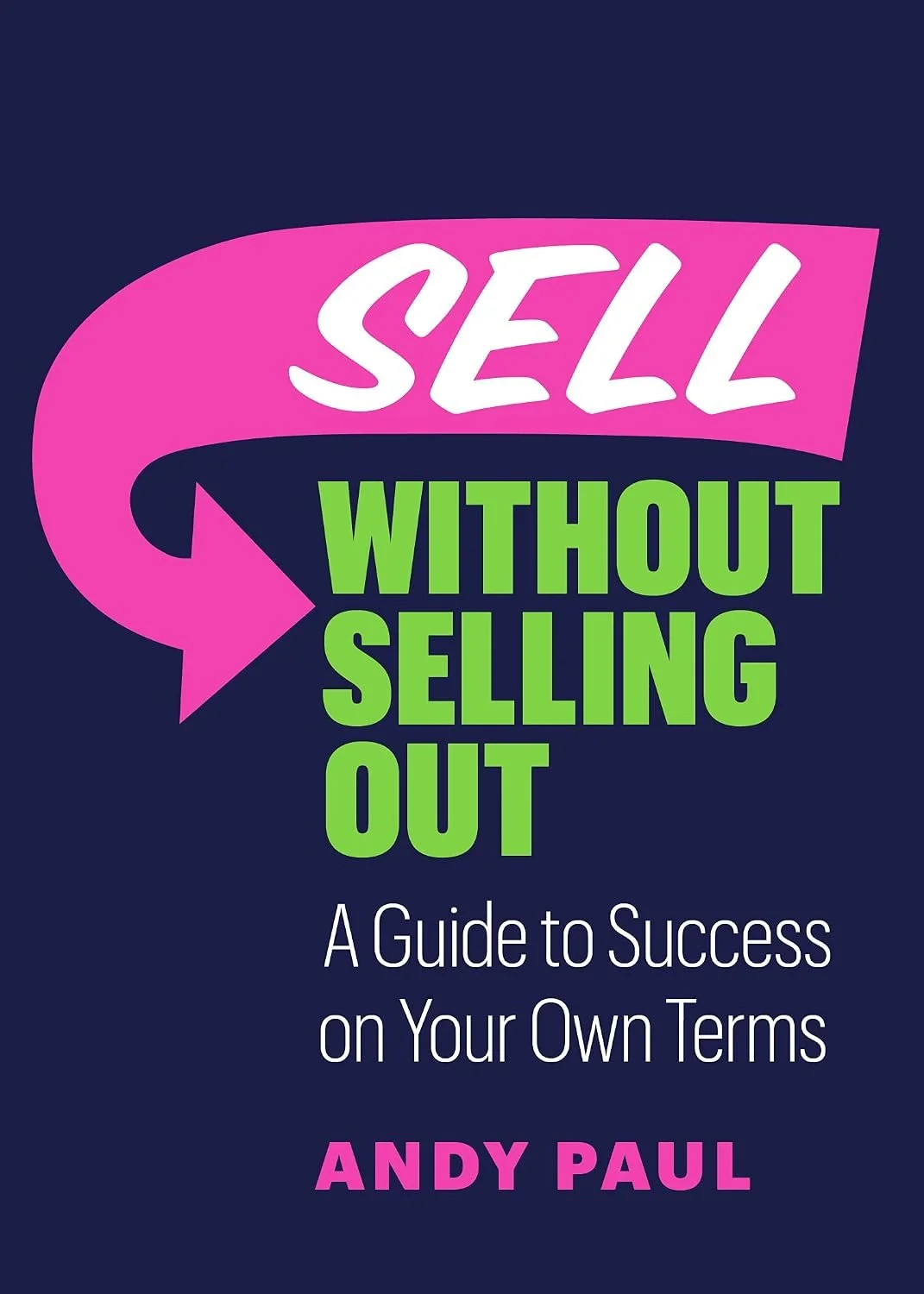
Andy's also the author of three fantastic books, Zero Time Selling, Amp Up Your Sales, and then the book with the greatest title of all time for selling, Sell Without Selling Out. I met with Andy eighteen months ago in New York City. Coincidentally, right after that, he took a sabbatical. I hope it had nothing to do with meeting me, but he took a sabbatical from our industry. Although you'll hear in this episode what he was up to, I always knew he'd be coming back, and I'm so thrilled that we've had a chance to get him back into the industry and starting with this show.

He's working on a new book that he talks about during the show. We really talked about a couple of things in this episode that I think will be very interesting. Andy takes an approach that we actually do not need to go up the funnel. Andy's approach is that when we look at win rates for most businesses, they're somewhere between 20% and 30%. They're just way too low. Andy's focus is how do we actually just get better at winning what's already in our funnel? That way we're not dramatically increasing the cost of sales. It can have a real impact on a business.

Really interesting discussion, as you would expect with someone like Andy. The second thing Andy zones in on is the cost of sales, but the true cost of sales or sales productivity makes a very interesting recommendation that we should actually allot our selling time to particular deals to really understand who's actually investing what time and what deals, and are we getting a return on it? It’s a really interesting conversation.

I happen to like that idea because I think in some cases our most important deals, we may not be investing enough selling time. We're so focused on solutioning. I do not know how much time we're spending on selling. There are so many different interesting conversations we have, folks, because Andy's absolutely on fire in this episode. You're really going to enjoy this one. I continue to learn every time I have a conversation with Andy. I hope you learned from this episode too. If you do, please like and subscribe to the show because that's actually how we get fantastic guests like Andy Paul. Here he is.

Andy, welcome to the show.

Reflections On A Sabbatical And Intellectual Curiosity

Mark, thank you for having me. It's been a while.

It's been a while on two fronts, actually. One, we took a pause on the show. You and I connected face to face in New York a little over a year ago, maybe a year and a half ago. We paused our show for a little bit. You've taken a little bit of a sabbatical. What have you been up to?

I paused. Trying to decide what I want to do with the rest of my life. The real answer. I've been working on a novel, which I've always wanted to write. Learning a lot there, which is what I always think of the famous Mark Twain quote, "I wanted to write you a short letter, but I didn't have time. I sat down, wrote you a long one instead," which is the story of my novels. Overwritten and way too long. Yes, working on a new sales book as well.

When we talked a year ago, and you said you were hearing a change ago, you're talking about the novel. In the back of my mind, I thought he's not done. I was just thinking, we'll stay close or we'll stay connected. There's lots more value to come in. For folks tuning in, you go back into we'll have the links to the past discussions with Andy. We're not going to get too many more interviews with someone with Andy's depth.

I'm going to talk about Andy's books in a second, but Andy, for those who do not know, is the world's top sales podcaster. You can have debates and argue with anybody. Andy ran two shows that were the best sales podcasts out there. One was called Accelerate, which merged into the Sales Enablement Podcast, and Andy combined 1200 episodes or more?

When you include that, then I started a new podcast after I left the Sales Enablement Podcast, yes, the Win Rate Podcast. Yes, more than 1200 episodes altogether.

When you start to think of the number, one of the things that I was always so amazed by, because I really enjoyed the podcast, I was likely to be a guest on the podcast a couple of times. We'll do those in the links too. One of the things I was amazed by was just the continual interest and excitement with every new guest. The other thing, even me in my earliest days, no book, no methodology, nothing, just getting started, you just had this sincere appreciation for the perspective of a guest. It almost felt like in the early days when we had nothing behind us, you treated me like one of the top global guests you had. I loved coming on the podcast for that, which I really appreciate, and thank you for that, by the way.

I enjoyed the conversation so much. Part of that, I think, is that if you want to be successful in podcasts or creating content, you cannot take it from the perspective that you know everything. For me, every time I met with someone on the show was a chance to learn something new and a new perspective, and everybody delivered on that. Give people a chance because you never know where the next great idea is going to come from. It's not necessarily somebody with 30 years of experience or more. It could be somebody that's got a fresh new perspective on the approach to sales. For me, it was just like, “I want to talk to as many people, widespread people, and see what I can learn.”

Meeting someone is a chance to learn something new and a new perspective. You can't take it from the perspective that you know everything.

What a great and absolutely spectacular approach. I'll be honest with you, that was something I stole and mirrored, and I learned it from you. The other thing I found, Andy, in the earliest days of doing my podcast, I'd study the person's book or their multiple books, a few of their books, and learn that from you. Not all podcasters did that. In the earliest days, I was pretty judgmental about some of the books. I'd be cramming a book and reading a book, and I'd be going, "I know more than this. I know a lot more than this. How does this person have a company ten times my size?"

You get the person in a discussion, and you go, "They really have some great context and experience and something to offer." The more I did them, the more I realized I got a chance to learn from everybody I'm speaking to, which completely changed my mindset, completely elevated my joy of doing the podcasts. Again, not air made delivers. I've had some rough conversations. By the way, did you have a couple of confrontational conversations or something that you could never air?

I have one or two. Where someone just was determined to talk only about themselves. I wasn't there to be a promotional vehicle for them. Certainly, if they had a book or something they wanted to talk about, we'd do it. For a couple of instances, somebody just wanted to make it all about that. Just never aired it. We could finish the conversation, but I made the choice not to put it up. It's funny, I developed this reputation of being a challenging interview. People didn't respond well to it. That's, by and large, most people did. I loved it.

One time somebody, LinkedIn F, had been a guest and said, "I survived my interview with Andy Paul." I never got a gotcha question or an attempt to be unfair. What I just expected from guests was that if they had a point of view, they could explain it. That there was a justification and a rationale behind it that made sense. If there was a hole in it, I was not afraid to say, "This part doesn't seem to make sense,” or “I really don't buy into that."

Most people got it right now, and we're perfectly willing to engage in the conversation. They have a small handful of 1200 guests. I think there are only 2 or 3 episodes I didn't air. Once I had some egg, it was a fairly well-known name at the time that, when I published the episode, they called me and said, "You need to change this part." I said, "What do you mean?" My answer to this question ran counter to what I'd just written about in my book.

Not my job to edit your responses. You made that response, that's and it really got almost to the point where they're threatening litigation. I said, "Fine, won't show. We won't air it." It had already gone out, but I took it off the inventory. A few people are sensitive. Again, by and large, most people have the same desire as everybody else does. As an author, I always tell people, people say, "What's this book about?" I said, “Let's have a thousand people read it first and then I'll find out what it's about."

The Evolution Of The Sales Mindset

How interesting you say that. That's a great number, by the way, one or two for 1200 plus interviews, not too bad at all. After our first interview, I didn't find you a challenging interview once I understood who you were and your perspective. The first time we had an interview together, I was really just starting the business thirteen years ago. We had people who booked me on the show. Somebody who worked for me booked me into ten podcasts. It was the early days of podcasting. This probably was 8 or 9 years ago.

I did 4 or 5, and they were the easiest discussions I'd ever had. What are you trying to do in sales? I'm just walking into these things. I'm not prepping for them. I'm not checking anybody out. I got so complacent that they booked me in with you when I was literally on a client site consulting with somebody. I had to go into a different room, jump on this thing, no prep, jump on. You said something about, I think it was something I should go back to, but it was, "Tell me, what do you look for when you're recruiting people?" I gave an answer like, “I read Who by Geoff Smart.”

I was so arrogant and confident in the answer. You said, "It's pretty interesting. Stanford just released a report,” which was almost completely counter to everything I just said. Also talked about how meaningless an interview process was, because it's like flipping a coin. I remember hitting the mute going, "Holy s***, I'm in a different type of interview here." Suddenly all my adrenaline comes up. Now I'm in fight or flight, trying to figure out, “I better wake up for this interview.” There were 2 or 3 after that, but it was just great.

I enjoyed it from the first time we spoke and identified a kindred spirit, which not everybody was, and that's fine. I said we all come from different perspectives about what it's required to succeed in this business. There is no one path, as I wrote about in one of my books. I just want people to be thoughtful about it, though. Unfortunately, over the last twenty years in particular, everybody thought we could take this game that's so highly personalized as professionals, highly personalized, and just turn it into a cookie-cutter business, and we've suffered from it.

Nolan, I do not think anyone would really make an argument that that has not been the case. We've seen win rates fall. We've seen quota performance fall. Yet there are people who think that the problem is salespeople or sales managers as opposed to what we're trying to do and what we're trying to teach people to do and how to enable them to do it and so on. It requires new perspectives, requires a different way of thinking about it. Recently, I've been doing work on a new sales book. I found a better way to express what I think the real issue is and how we address it. It takes time.

I'm going to circle back, by the way, to some of the earlier books, but let's go on that. What are you writing about, and what is the different way to express it? What is the real problem?

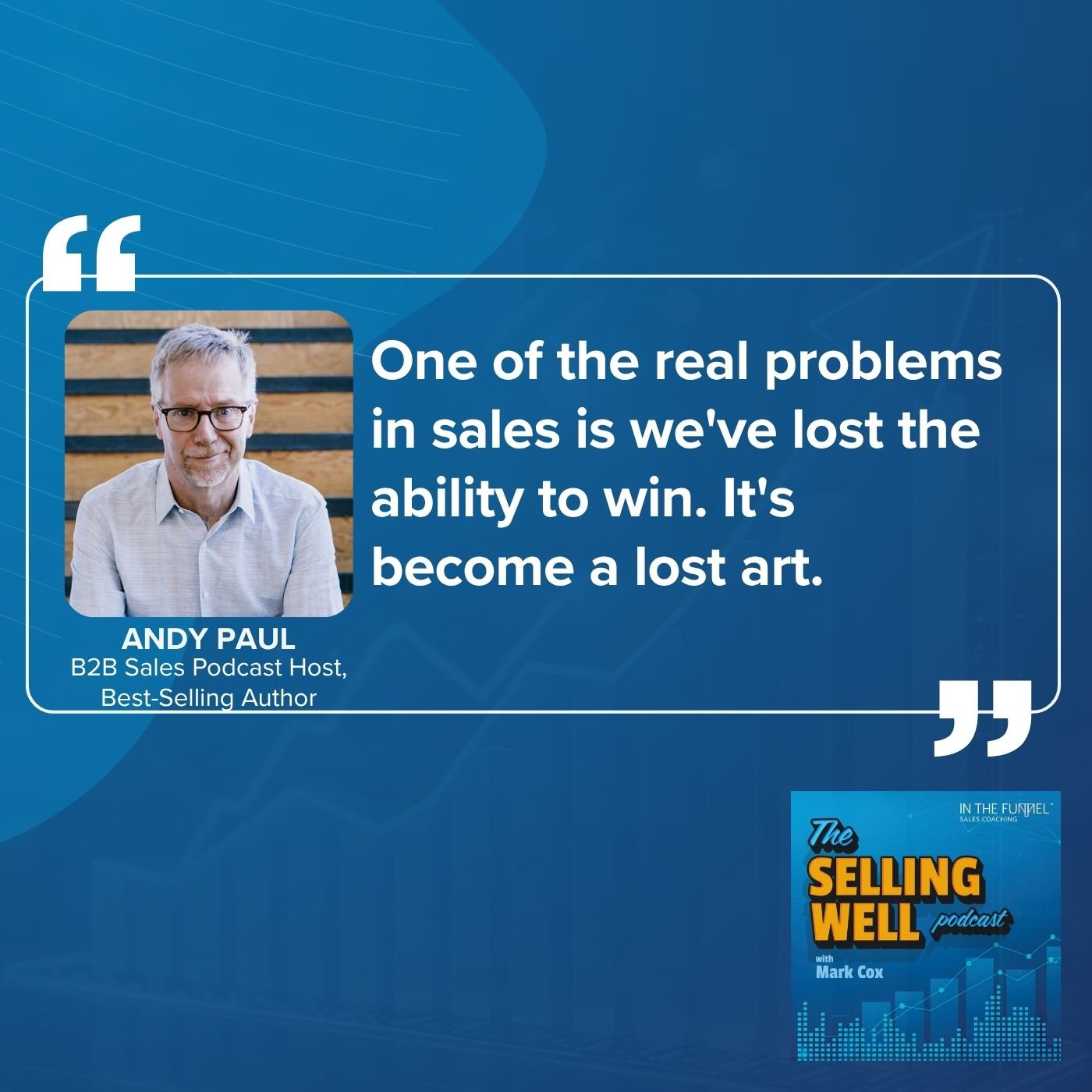
The real problem is that we're fundamentally doing the wrong things. I'm working in terms of what the new paradigms are. Paradigms exist really to change and challenge persistent problems that exist and big problems. It's really what's required. We've done this incremental change, just tweak here, tweak there, tweak there. It's like, now that things are more fundamental, we're just not addressing them, and they filter through the entire sort of sales ecosystem. One example, and it's funny, shocked audiences when I talked about this, but I said, “One of the real problems in sales is we've lost the ability to win.”

It's about that.

It's become a lost art. In most sales organizations, you can see this pervasively on LinkedIn and so on is, somebody, a seller, has got a 30% win rate. They're our top people. I cover the perspective and the experience in the background, which is that the minimum acceptable win rate for an individual seller is that you win more than you lose. Full stop, 50.1%. That should be the culture of the organization. That is what we stand for as an organization. If you have an opportunity, a qualified opportunity, you're going to win more of those than you're going to lose.

The impacts filter down. I was talking to senior-level executives about this, and they were taking them back a little bit because they correlate that with winning at all costs. It's like, “No, it's not winning at all costs.” Actually, it's just sort of the opposite. To win successfully, high level win more than they lose. It's the opposite of winning at all costs. You're so focused on activity. I said, “What are the circumstances on which you fire a salesperson?”

They miss quota.

They lose. They do not win. We pay salespeople to win, full stop. You do not win. You lose your job. That's not the culture that's in these organizations. Everything should be focused on winning more than you lose. That said, the trickle down impacts that are, if you have a sales team where, by and large, people are winning more than others, you're going to sell more with fewer people. The holy grail is basically, how do we sell more with fewer people? Increase your win rates. How do we increase our renewal rates? The data will show you that renewals won by deals with sellers with high win rates renew at higher rates than low win rate sellers.

The holy grail to selling more with fewer people is to increase win rates.

It’s because they sold with a proper business case in the first place. There was a real return on investment. It's easier to renew because we're actually solving a real problem.

Exactly. When you talk about management, why do you want to increase win rates? Your renewal rates are going to be higher. It's like no one's ever thought about that. There are other reasons to trickle down. The fact is that the other one, too, is individual productivity. The seller will go up. What I mean by that is, and you and I have touched on this in the past, I believe, but we should, as a management, be focused on what I'd like to reduce it to a number. What is the revenue that a seller generates per hour of selling time? Consulting firms, they track this.

Professional services, law firms, etc.

I had the benefit back years and years ago of working for a company that was in defense work in the United States. When you sell to the Department of Defense, everybody has to track their hours in the company. Not just the people working on the project, because those who weren't on the project, the hours are collected and used to calculate the overhead rate they got applied to the bids that you made to the Department of Defense. That was all audited and so on. As a sales guy, even though I wasn't working on defense business, I was still keeping a time card every day, eight hours.

I was charging an overhead account. Finally, one day when I took over this group and was leading us, I looked, and I said, "Why don't we assign job numbers to every qualified opportunity in the pipeline?" People charge their time, both the sellers and support, and so through others. Everybody charges their time to the job. It's not rocket science. Say consulting companies, everybody does it. Suddenly I knew to the hour how much time it took to generate X amount of revenue. I knew by individual how much time they took to generate a certain unit of revenue.

The Math Of Sales Productivity: Revenue Per Hour

I could tell, “Generate a million dollars with twenty hours of selling time. This guy's doing it with 40. Maybe this guy, what this one knows that this one does not. Why does this one require more support from the organization?” Much insight into what's actually happening when you do that. Now, the other insight you get, which is, again, one of the changes we need to make in sales, is you begin to understand that a sales cycle is not a duration. It's a quantity.

Tell me about that. Quantity of the aggregate hours?

Yes. The fact that it takes place over a month or two months or three months does not really matter. What you find is, “We're limited by hours.” Now, if I know that my sellers individually say, “Can generate X number of dollars per hour of selling time, I know at the beginning of the year, I can calculate how much they're going to sell accurately, barring a change in how effective they are in front of the customers.” I talked to companies about this. I say, "That's great. I know how many dollars they generate per hour of selling time. I'm talking more hours." I said, "That's not changing their productivity. Their productivity is still the same."

Have you ever rolled this out with somebody?

Just to come out of my own companies I've worked for.

Just your own company, the ones internally.

This is not because companies are not doing that. I've spoken with all the major big consulting companies. They fundamentally do this. Why it has not transitioned, why I'm able to translate this into just conventional B2B selling, is beyond me because the tools exist. The tools exist more easily than before. We were doing physical time sheets in Excel when I first started doing this. Now it's a no-brainer. This is data. Why wouldn't you want this? Why wouldn't I want to know that this salesperson requires 50% more support from the rest of the organization? Maybe that's good if they're generating 75% more revenue per hour of selling time.

You say, "They're making really good use of the resources of the organization, whereas maybe this other one is not." I said, why wouldn't you want that data? That really speaks to performance about how effective a seller is with a customer. This idea is, "We've got a 90-day sales cycle." No, you do not. You probably have a 30-hour sales cycle. When you look at a composition, your pipeline, does it really matter how it spreads out? Not necessarily, but you say, "Great. If we're trying to serve, get these decisions made within a certain timeframe.

The answer is, you see what most companies do. We're going to discount, or we're going to throw more people at the problem. We're going to make it more expensive." One client that celebrated, a software company, celebrated getting their first $300,000 deal, and they did a really good job of documenting. All the processes they went through and all the meetings they had and so on. When they did a debrief, and I was a consultant, I talked to the CEO. I said, "Congratulations. We had a great time." I said, "You're not going to do another one of these deals this year."

It’s because it took too much time.

When you track that, though, then you say, "Good. We need to change.”

Why change your ideal client profile? You might have to go after smaller deals.

How are we interacting with the buyer? This gets back to another fundamental change I think that we need to make, we absolutely have to make, we do not really change things, is we train our sellers from this perspective that your job is to go sell a product. That's a problem because that's wrong.

The seller’s job is not to sell a product, but to make a change.

What are they doing?

That's what they're doing. It's not what they should be doing because we have this whole idea of like we're monitoring intent data. We get these signals from our buyers. They're in the market to buy. No, they're not. They're in the market to make a change. Dramatically different, because we say, “Look, they're in the market to buy. I'm going to throw you into my sales process.” Try to make my first call. I'm going to try to make a discovery call. It's like, “Hold on a second. What they really want to do is they want to make a change from what they're doing.” They want to achieve a different outcome in some portion of the business than what they're getting.

What's that change they want to make? The conversation you have, what I call a change conversation versus a sales conversation, leads you down a different path. What I'm trying to do is I'm trying to instead of discover what the problem is, which we can get back to because think discovery is such a huge problem with us today, is what I want to do is I want to help the customer define the outcomes they want to achieve, the changed outcomes, and the change path they're going to use to get there. We go in now today in sales and say, “I've got this ICP, and everybody shares this one problem.” No, they do not.

Of course not.

Shifting From Sales Conversations To Change Conversations

What people are trying to do is they're trying to make a change. Where we get the cart before the horse is we think, “If we can identify the problem, we can identify a prospect and the path to selling. You really do not know what the problem is until you understand where they want to go because when you understand and help them define where they want to go, the problem is, what's the obstacle keeping me from getting there? If we can be the seller that helps to buy our approach from that standpoint, let's define where you want to be. Let's define how we can get there. We're going to provide some perhaps new thoughts about how to do that. The decision they're making is, are we going to change or not? Not, are we going to buy this product or not?

Am I going to invest in achieving that desired outcome? Actually, do I believe you can help me get to that desired outcome?

My experience has been pretty successful. It's a whole lot of stuff in my career. In almost all cases, being an underdog working for small startup companies, but selling a hundred-million-dollar-type systems in some cases, a million dollars, the largest, a well over a hundred million. It's all the same. If I could help the buyer define what it is that change they want to make. The way I do that is I build trust with them, and through the trust, I build my influence with them.

That's what buyers do is when you build trust, what they're saying is I'm going to open the doors to your influence. If I can do that, it doesn't matter how big a company I'm selling to the customer. I have the inside track because I'm not saying you have this problem. I’m saying let's define it together. Let's work together on where it is you want to be. This is an opportunity to invest, not just put a Band-Aid on a pain point.

When you build trust, buyers are going to open the doors to your influence.

This also ties back into our conversation at the beginning. Salespeople today, what do they do? They discount, or they try to give things away because I have no idea what the desired outcome really is. I'm pitching a product, and somebody said they had a modicum of interest. I'm to fire a proposal over fast enough, as fast as I can. Why? It’s because one of the main metrics I get tracked on is the size of my funnel. We start to track all these things. We're tracking the wrong ones. This is really such an interesting idea. This productivity, you talked about professional services.

Way back when, a few years back, when we had Dan Pink on the podcast, and we were talking about To Sell Is Human and his latest book, at the end I go, “Why are you so interested in sales?” He didn't, of course. He didn't grow up in sales. He said the whole idea of writing the book the first time was that he was seeing a huge gap between this stereotype of sales and what he knew. He had friends who were in sales. At the end, he said he went through this list of what his friends really are, problem solvers. They have huge levels of business acumen. They're smart.

They're forward-thinking. They're innovative. He said, “Today, B2B sales is management consulting.” Management consultants track their time. Management consultants have nothing to sell. They actually come in, and they work with you to understand what's going on with your business. Usually, they'll come in and say, based on public disclosures, you're lagging in your industry against a couple of metrics. Let's talk about it. They'll get pointed down a direction to say, "Let's get a room and see, figure out if there's a way of helping you achieve these meaningful business outcomes."

Sell Without Selling Out

Sell Without Selling Out

That's really this idea that I mentioned before about selling a sales conversation. Let's have a change conversation because, to that point, I wrote about what you just talked about, and Sell Without Selling Out was that I spent a chunk of my career working with these startups. Where often we didn't have the product yet. My job was to go out to one company. I got hired to start a division of the company that was selling.

They were the offense company. I was starting the commercial side of things, and the CEO said, “Go sell to whoever you want as long as they pay for the development of the product.” I'm like, “Okay.” That's what I did. I didn't have a product to sell. When you have to put yourself in that situation where you do not have a product to sell, you really open, first of all, it's way more fun than actually selling an actual product.

B is, you have to be more creative and more innovative and more thoughtful about how do I surface something that resonates with them that represents a change from what they're currently doing that they would perceive to be a great investment opportunity, great way to allocate their capital. That is the perspective that every seller should have on every single deal. I wrote that in Sell Without Selling Out. it approaches every deal as if you do not have a product to sell. I'm there to help you think about the outcomes that you want to change and how to achieve them.

For the folks who help us with editing, that's the blurb, by the way, for the podcast. Approach everything you do in selling as if you have no product to sell. I love that idea, Andy. Immediately, what it takes away from us is that most of the time, based on the way our brains work, I'm just waiting to interrupt you. I'm talking to a buyer. The way the brain works, they speak at 125 words a minute. My brain processes at 400 words a minute. I cannot stay focused. I just want to interrupt. All I want to do is pitch a product. Particularly the newer I am in sales, that's all I know how to do. I do not have business acumen. Maybe I have this much industry acumen. I learned my product because that's what they taught me before they unleashed me.

Again, not to hike my books, it was part of my just basic philosophy through all my books. I thought about self-outselling out is, there's four core strengths or skills you need to have as a human. Connection, curiosity, understanding, generosity.

That's great.

Your ability to connect with another human being to build trust. The trust leads to influence. Curiosity, not just the superficial curiosity that we see in discovery questions, really to connect with them, really understand where it is they want to go and where they see across the spectrum of stakeholders, where they see the opportunities in their business, which is not about fixing a problem. It's about what's the opportunity, which is we have to go away from being so problem-centric to being opportunity-centric. You have to fully understand it.

I talk about the book. It's certainly true in my experience. Again, being the underdog and the vast majority of deals that I've won, convenience, big tech companies of the day are, and ask the customer, “Why did you choose us?” I said, “It’s because you're the only one that made us feel understood.” You have to bridge that gap between knowing something and really truly understanding it. You have to be generous in how you help the buyer make these decisions to make change. People do not always connect generosity with sales. It fundamentally means that you're giving without the expectation of getting something in return.

The Selling Well Podcast | Andy Paul | Win Rates

Win Rates: People don't always connect generosity with sales, but it fundamentally means that you're giving without the expectation of getting something in return.

Tough, right?

It's not like you're not motivated to get them to do business with you, but it's just not a quid pro quo that's so pervasive in sales. If you can do that, even without business acumen, you can go and have a great conversation with someone. Business acumen will make it much better over time. As a new seller, I'm going to think back to my own experience because I graduated college with a history major. I know nothing about business to speak of. When I got a job, everything seemed to be in sales, right?

Other than having no discernible skills, curiosity a mile wide. I am very competitive. My first year selling computer systems, on-premise big computer systems, 50 years ago, was just listening to these CEOs and these founders of these companies that I'm assigned to talk to me about their business. What I found was that if I just showed up and was authentically curious. I was asking questions that just were not designed to elicit a response of, "Are they a fit for us or not?"

They spent as much time with me as I could, as I needed. No, never had anyone throw me out. Here's a kid. I was 21. Seriously, I looked 16. Yet they gave me their time because I showed up connected, and I was sincerely interested in understanding what was happening. I was willing to ask the questions, and it pays dividends. This gets back to the topic I talked about before is we really need to think, and again, I wrote about self-hustling. Expanding on what I'm working on now is moving beyond this idea of persuasion, really to think about influence.

Persuasion Vs. Influence: Measuring Real Impact

What's the difference?

One is coercive. The other is helping people change their point of view in a more collaborative fashion. There's a book by The Catalyst written by this professor from UPenn, Jonah Berger, who said that found in some research that 100% of human beings instinctively resist being persuaded. If you build trust and the customer says, “Let's talk about that or tell me what you got.” That's different. You're influencing. You can measure influence. Challenge managers tuning in to the show. I challenge managers I work with. Tell me what your win rate is on deals that you didn't influence the buyer's definition of what it is they're trying to achieve.

It's that your win rate is going to be zero. It's very close. It's going to be very low.

As I said, how do you measure your influence? I said, it's very simple. You do not even think of talking about this before. Just create a little simple table. Two columns, three rows. Could be a couple more. The first row is what the buyer's definition of the changed outcomes they want to achieve was before you talk to them? In the second column, you put what their definition of the changed outcomes they want to achieve is now. If there's no gap between the two, you have no influence. It's that simple.

The second row, second line is, what was the buyer's definition of how they wanted to achieve the change before you talked to them? What is that definition now? If there's no gap between the two, you're just competing on features and price. Why do you want to do that? You can actually measure influence. It's tangible. You say, “Let me go look at the deals we're working on right now. It doesn't have to be after the fact.” Their definition of what they want to achieve, their vision of what they're going to achieve. If we have no influence, odds of winning are pretty low.

This does lead though, Andy, like this leads a lot of the time to any point how you look at it, somebody's definition of a business case or an ROI, or these are things you work with the client on during discovery. I know you see discovery as a bad word. I do not because for me, the whole lifecycle is discovery. Actually, it's not a stage. It's what I'm doing the whole time.

The Selling Well Podcast | Andy Paul | Win Rates

I agree. You're always learning. Here's where I'll draw the distinction. There's a certain amount of, I'll say, journalistic discovery we all want to do. There's a certain set of facts that we need to understand about the buyer. That's a discovery. Beyond that, we're trying to help the buyer. We're trying to work with the buyer to help them define what it is they want to achieve. What is the opportunity that would come from making a change in their business? That's going to lead to, “There's a business case.” Actually, writing and spelling out in the new materials, there are actually two business cases.

The first business case is what I call a ballpark business case. We're going to get to a certain point, and I'm going to say to the customer, we'd find where you want to go. We're going to learn more. To your point, we're always discovering, so on. Based on where we are now, this is the business case we put together. If we get to the end of this process and we're still within plus or minus viewpoints either way, will you commit today that you're going to make a change? Not that you're going to say goodbye to me, but that you'll commit today that you will make a change.

If they say no, for me, oftentimes that's a disqualifier for them. I do not have time for you right now. Again, my limited inventory as a seller is my time. If I'm going to be as productive as possible. These guys may have to go back to a different status on my pipeline. They're not ready because if I push it from that point, I might get no decision. You have to do this preliminary business because I learned this from one of my early bosses. It's just genius. You weed out things pretty quickly. The thing is, you want to get there as quickly as possible. This is the other part that I think has to be changed.

It starts with this idea that, and again, I wrote about it, it's all about selling out. If I bring this basis forever, if the customers are not trying to make the best decision, they're trying to make a good enough decision. Herbert Simon, Nobel Prize winner, did extensive research on this. I have two types of people. Maximizers, satisficers, people who look at every alternative and make sure they make the absolute best decision. Satisficers, which are people who will look until they find something that satisfies requirements and suffices to meet their future needs. That's actually a lot of people.

It's actually probably more people. It's somewhat situational for business people. If people are looking to make a good enough decision, we're going to look until we find something that meets these requirements, satisfies requirements, and suffices to meet future needs. Where's the urgency? The urgency is I need to be the first to build trust. If I can be the first one to build trust, then I can be the first one to build influence. If I can be the first one to build influence, then I can be the first one to help the buyer define what it is they want to do and have an understanding of it.

They're going to reach that point of satisfaction first with me, then they will with other people. Given what Simon wrote about, we're going to research that until he finds it and satisfies us. We're going to pull the plug. We're going to go for it. I experienced that so many times in my career. Sometimes there was a gap where I basically knew I was going to win the order. Got told I was going to get the order. It might take a while to work through the system. You want to be in that position. Even if it takes another two months to work through contracts and legal and so on.

Of course, once you're through that, that's different.

As a seller, your goal should be that I want to be the first to trust, I'm going to be the first to influence, I'm going to be the first to define change if I can do that. First of all, in this preliminary business case, I'm going to win more often than not. This goes back to what we talked about in the beginning. We're here to win. Our sales processes that are set up are not set up to win. They're set up to complete a series of steps. I wasn't interested in that. I wanted to win.

The Sales Leader’s Mid-Year Pivot

Maybe. Your definition of what you're trying to do is actually my definition of discovery in our process. We've got people tuning in, Andy, like the running sales teams right now. We know most of them, you and I know most of them, are sweating. We know most of them are sweating. We're just finishing the middle of the year, and smart companies are doing a Q3 sales kickoff. Not so smart companies are taking it easy and going light on the kickoff, and they think they can make it up in Q4, and Q4 is just a panic the whole time.

What would one of those leaders running a team of 8 or 10 today say, because they're all experiencing that's a universal problem. When rates are dropping, no decisions, probably increasing, all those bad signs, we forecast a deal, and they went quiet on us. If you've got any trust and influence, people do not go quiet. They'll give you a bad decision, like something happened or the business changed. They will not ignore you.

Very rare.

What would you suggest? It's pretty hard, as much as I'd like to get you back to what you did to me eight years ago and dispute this stuff. It's pretty hard to dispute these things. We want trust. We want influence. What does the leader do right now? They're in the middle of a game. They're in the middle of a year. Maybe they're sweating. They still have some time left in 2026 to make an impact. What would you do if you took over a sales organization right now?

These are longer-term structural things we're talking about. In the short term, I want to look at the people in the deals. Understand whether these are deals we should be working on or not.

There you go.

That, to me, is first. Decide whether we're really in touch with the things that are going to drive the customer to make this decision to make a change. For me, these are these definition points. The buyer. We have this issue that we think buyers still are going to make monolithic changes. Are making monolithic decisions. We're making a product purchase decision. It's like, “No. They're making 4 or 5 decisions first.” The first one was, what's the change you want to make, and how do I get there? Three, what are the obstacles in our way? Four, does the business case make sense? Five, is this the vendor we want to work with?

Those are distinct decisions they have to make that you need to be focused on. How do I win each of those decisions? It starts with, is this something that's really somebody we should be selling to? Do they really belong in our pipeline? If they do, then where are we in terms of building a level of trust and influence to say we're going to have an impact or have the ability to impact those decisions they make? It's talking to the sellers, it's talking to the prospects, it's talking to people within the organization that maybe have been talking to the prospects as well.

You'd be surprised how they get different feedback from the customer. "John's not really doing that great a job with our CEO," or whatever. You just have to get in and investigate what's happening and then make some tough calls. It could be that you've got some good deals that you got the wrong people on and you need to make changes. That's hard, tough. What's at stake is your job and the health of the company and so on. You need to do what's best for the company. Interestingly, these days, too often you say, "We're going to give this to our sellers who've got a 30% win rate." It's like, no, that's not the person to give these deals to.

Chances are, you've got people in the organization who, if they were pointed in the right direction and given the right support, would not really understand what it is they're trying to do. The things I talk about are trying to build this trust and influence. We're trying to help the customer define what it is they're trying to do. We're just not going and saying, "We've got the answer." You may find people much better suited to the job than you and make a mid-course change. I made a career out of bringing people from electrical engineering into sales.

Really? By the way, you wouldn't think traditionally when you think of the attributes of a salesperson that people think of that stereotype. It wouldn't be an actual electrical engineer.

Just to give one example, as one client, that client ran sales for about four years on a two-day-a-week basis and doubled, more than doubled sales. We sold the company for a big chunk of money. We brought a guy in from engineering to be the lead salesperson. He was pathologically shy. I could sit in the lunchroom with him after working with him for years, and he still would not say hi to me. When he talked to the customer, he understood. He understood what it was they were dealing with. He understood their challenges.

He understood where they thought they wanted to go and how we might be able to help them with that. It didn't matter at that point. He just crushed it. Have example after example. I remember one engineer, as I was recruiting to come in to work for me at one point. He said, "I cannot do that." What he means is, "I cannot try to persuade people to buy something they do not want to buy." I said, "That's great, because that's not your job." Your job is to help them identify the opportunities and the better path forward and try to be more efficient or effective or whatever.

I said, "Isn't that what you do as an engineer every day in your designs?" He goes, "Yes, I can do that." One came in, “I took over, sir.” Not quite mid-year. It actually was. It was halfway through the second quarter, just changing people out. We could have kept the course. That wasn't a huge organization. It was five salespeople. I looked at it and said, "I could do this work myself. I can do the work of at least four of these people myself." I did. We then brought in people who could take their place. We started by the end of the year, we were staffed. In the next year, this was an organization we had. I took it over. They had done six million dollars in bookings. When I took over partway through the year, the next year we had about 175 million in bookings.

What? I hope you had a piece of that company.

None of the salespeople were salespeople. Engineers. The number one guy was actually a marketing guy that converted, and he was just dynamite. Again, he wasn't the typical salesperson, but very methodical, really understood what it was we were trying to do, working on big deals that he had never worked on before. He understood what we're trying to do is help this idea of them trying to make a change. They're not trying to buy a product. They're trying to make a change.

Engineering High-Performance Sales Teams

If we can help define what that change is, then we've established influence, and we're on the inside track to win. They crushed it. My advice is to look at the people hard. Do not be afraid to make changes. You may have to pick up the slack yourself a little bit, depending on the size of the organization as a VP. Tough. Go out and do it. If you do not know how to sell a product, that's your problem. Build the team with people who are, call it curious, open-minded problem solvers. I do not want to overdo the problem-solving too much, as curious, open-minded.

Maybe opportunity spotters are the better way, because that's what you're really trying to help the customer do. I say this with all sincerity. In my career selling the better part of a billion dollars, closing, I never once had a customer that said, "We're buying to fix a pain point." We're buying to take advantage of this opportunity that presents itself to ourselves by making a change. In the process, we may be fixing a problem that's the obstacle preventing us from getting where we want to go. It's not the problem that's driving it. It's the opportunity.

It's a better future.

People are to invest in that.

By the way, talk about jumping in deep right off the deep. It's not a minor change. It's suddenly we're just measuring hours in sales productivity. What are the things, by the way, about the sales productivity that's just stuck in my craw the whole time we've been talking? You talked about saying, we might find out we're investing way too much time in the wrong opportunities. One thing that jumps out at me is I think in some cases we're not actually spending enough real time on the most important opportunities.

We'd actually look at it and go, "This thing does have legs. It actually qualifies as an opportunity." Outside of solutioning, we're not actually spending enough time helping the client's influence and earning trust and helping them identify that better future and actually building the business cases with them and actually getting through their internal processes, depending upon who they are. In some cases, we'd find the opposite. Do not actually log time on deals. We do not spend enough time.

We've had enough of the right time. With the right people.

With the right deals.

Doing the right things. This has actually come up several times in conversations I've had with people in the last few weeks. This idea that you have to be selective about who you sell to. Everybody's talking about going to market, and now we've got an AI-driven GTM. When win rates are so low, the issue is not the pipeline. You've got more than enough prospects. I'm winning the average win rate in B2B sales is less than twenty percent. It's not that you do not know prospects. It's that you're not doing a good job of working with the people you have.

If you've really dialed in on your ICP, you're just executing horribly, and there's no excuse for that. You may have to be more discerning within that pipeline, even saying, "Look, we're trying to work too many opportunities. We should be working fewer and doing a better job of it." The vision I like to give people is that you're the bouncer at the head of the velvet rope and the club is your pipeline, and not every new person gets in because as a seller, you've got an inventory of hours. That's all you've got. How are you going to use those in that inventory? Unfortunately, people use it the wrong way. You talk about no decision rates.

We've all had no decisions. I've had very few in my career, but people misunderstand it. They think that status quo is the competition, and it's not. As long as you think it is, you're going to run into this time and time again. When a customer says, "We're going to stick with what we have." What they're not saying is that what we're doing is fine. What they're saying is you didn't convince me that there's a better reason, the reason to do something better. A no decision is a loss. Full stop. We're an offer. The buyer made the decision to not buy. Sellers and managers have to adopt that instead of saying, "Moral victory, there's no decision.”

A no decision is a loss, full stop. The buyer made the decision to not buy.

It didn't go to the competition.

It's like, bulls***, right? You lost because you didn't do a good enough job of helping define where it is they should go and how to get there and make the compelling business case to do that.

Andy, first of all, completely agrees. Secondly, I influenced you to get back into the game. I'm going to take full credit for that from that lunch in New York eighteen months ago. I'm so excited to hear you're working on another book. Team, by the way, we referenced a few times, but Andy's books include Amp Up Your Sales, Zero Time Selling, and one of my favorite books, by the way, that has the best title ever. This is the best sales book title ever. Sell Without Selling Out.

There is no better title ever than that book. By the way, it's also one of my favorite books. It reminds me of the Michael Bungay Stanier book, The Coaching Habit. Great read, easy read, easy to go back to. My books are always dog-eared and highlighted. I still like holding books and highlighting them. The links to all those books are going to be in the episode here, and you and I, as usual, could keep talking for another hour.

I'm surprised it's been almost an hour already.

It's just unbelievable. How do people get in touch with you when they inevitably want to learn more? How do they get in touch with you or follow your best thoughts?

The Future Of Selling In The Age Of AI

As I said, I've taken a bit of a pause. Not a lot of new content on LinkedIn. LinkedIn is probably the best place to message me if you want to connect with me. My website's a little out of action at the moment. Go to my LinkedIn page and message me there if you want to. You can message me at Andy@AndyPaul.com. Those are the best two ways to connect.

Listen, by the way, sabbaticals work. Look at the energy, the enthusiasm, the focus. It's like you never missed a beat. A little break is a great thing. We should all be so lucky.

As I told you when we had spoken a couple weeks ago, it's like, part of it was I looked at and said, "I've been gone for a year, and you guys still have not learned anything." I cannot. Do not be accountable for all of that. I'm trying to fix my little piece here. Just the things that have been a problem prior to every heavy adoption of AI are still a problem. If we're fundamentally doing the wrong things, AI is not going to fix it. If we're so focused on pushing and persuading people to buy our products, and we're just going to use AI to amplify those motions, our win rates are not going to get better.

If we're fundamentally doing the wrong things, AI is not going to fix it. If we're so focused on pushing and persuading people to buy our products, our win rates aren't going to get better.

We're going to find ourselves in a situation where, if the win rates continue to be low, why do they need you at all? If you can only win one out of every five deals, the machine can do that. We do not need you for that. Sellers are digging themselves a hole. There is research that Gartner put out that said, “Look, in 2022, everyone will be self-service.” They said in 2030, I think 75% of B2B buyers predicted that they'd want a human involved, that they would not want a pure AI interaction. That mirrors other research in other fields.

Trust in AI only goes so far, and we all have good reason not to trust it or to be completely trusting, let's say. There's a role for humans that I've always advocated. That role of that selling's become more human, not less. It's certainly successful selling. You have to continue to think for yourself. You can be creative and innovative. Use the tools to provide you with ideas and ways to think more broadly. That's one of the beauties of AI. I use it for that, but there's still a big role for humans if we're doing the right things. Again, what would be the focus of this book is just, yeah, these are things that real sellers have been doing. The working title of the book is Real Selling.

Great title.

It presupposes that something is not real. I believe that people who are selling with low win rates, that's not real selling. That's unreal selling. It has no value to them really and no value to their customers. Let's change that. There are a lot of things to change. You can pick just a few and start, and they'll make such a qualitative difference and a substantive difference in your enjoyment of the process and the buyer's experience with you. At the end of the day, as long as the human's involved, the buyer's experience with that human is going to be the primary reason that they make their decision.

I completely agree. Listen, we're going to hear lots more about that. Folks, we've got something exciting coming. We'll share more in the coming weeks. Andy, just a great discussion again. As always, I learned something when I'm chatting with you, and it's super fun. Thank you. We didn't even get a chance to talk about the World Cup. Next time.

Spain won.

Spoiler alert, if you recorded these games.

I have all this more free time in my day now because I'm on schedule and watch all these matches. Now the Tour de France is taking up a lot of it. That's ending soon too. I can be more productive again shortly.

Actually, we've had a couple of guests too who got the chance to win the lottery to do the legs of the tour. Punishing. The elevation on some of those legs. Just punishing.

I'm doing some of those on my Zwift.

How fun.

It's not. The scenery is not quite as good in my room as opposed to being outside the Alps. Still fun.

Andy, thanks again. We'll be chatting soon.

Thank you very much.

Team, thank you. As always, thanks for joining the show. We run this show to try and improve the performance and professionalism of B2B sales because we think that, in doing so, we actually improve the lives of everybody in sales. Thanks for tuning in to the show. If you like this episode, by the way, please like and subscribe to the show because that's actually how we get great guests like Andy to join.

If there are ideas you have for the podcast that can help us make this better, we love constructive criticism. My email is MarkCox@InTheFunnel.com, personal email. I respond personally to every bit of constructive criticism, saying thank you first. By the way, the way we run the podcast now is a function of some of the feedback you've given us already. Thanks for joining. We'll see you next time on the show. Take care, everybody.

Important Links

About Andy Paul

The Selling Well Podcast | Andy Paul | Win Rates

Andy is the author of three Amazon best-selling books on B2B selling: 

  • Sell Without Selling Out: A Guide To Success On Your Own Terms 

  • Amp Up Your Sales: Powerful Strategies That Move Customers To Make Fast, Favorable Decisions; and, 

  • Zero-Time Selling: 10 Essential Steps to Accelerate Every Company’s Sales

He previously was the creator and host of two top-rated sales podcasts, The WIn Rate Podcast and Sales Enablement with Andy Paul. With more than 1,200 episodes produced and millions downloads, Andy’s podcasts remain a go-to resource for sales leaders and top sales producers. 

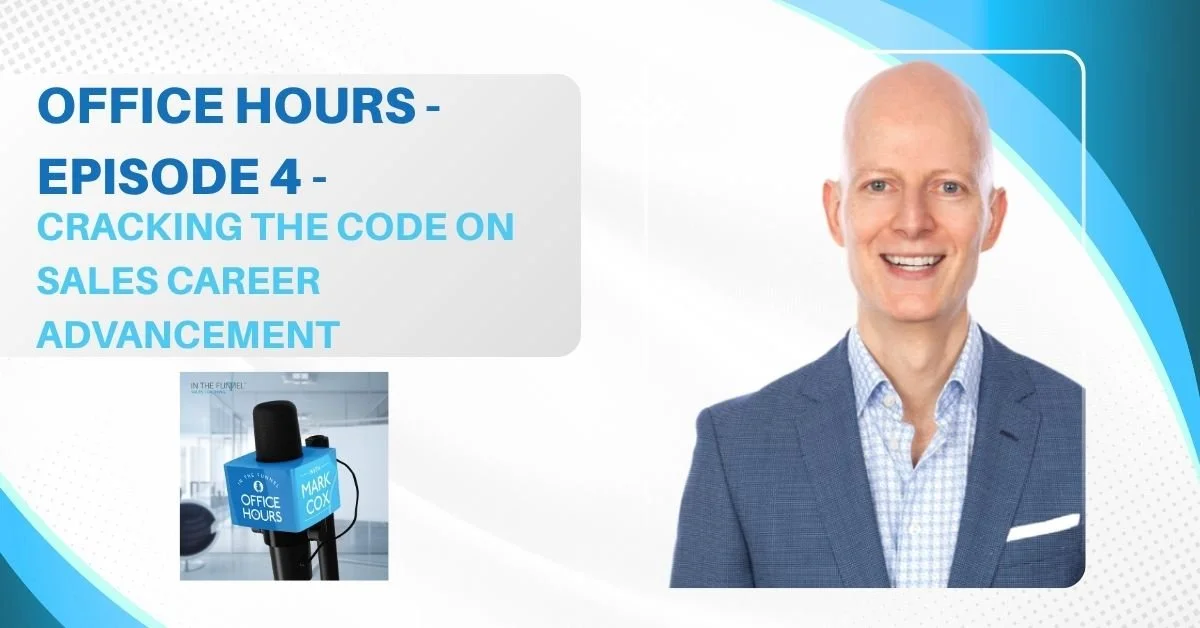
Office Hours - Episode 4 - Cracking The Code On Sales Career Advancement


Deciding on the next step in your professional journey is never easy, especially when you are a top performer eyeing a leadership position. In this episode, Mark Cox and Dave Hanley discuss sales career advancement, offering a roadmap for high-performing salespeople who are contemplating a transition into management. Beyond the promotion, they explore the complexities of internal sales approvals and the delicate balance between managing existing accounts and driving new business. Listen in as they provide tactical advice on building a sales playbook, prioritizing your time effectively, and ensuring you have the right support before making the leap into a leadership role.

---

Watch the episode here

Listen to the podcast here

Office Hours- episode4 - Cracking The Code On Sales Career Advancement

Dave, welcome back to the show. Thanks for driving this. We're in Friday casual attire.

It’s good to see you. It's a short week here in the US. I get the joy of celebrating both Canada Day and Independence Day here.

A Canadian in the US. I notice you enjoy celebrating all holidays.

I try. It's important.

Lots of different nationalities. Multicountries. You're on the Tim Ferriss one-day workweek.

I'm trying.

Dave, what do we have?

Transitioning From Top Salesperson To Effective Sales Manager

We got some good ones. The first one in particular is something that is always a tough one. I'm keen to hear your thoughts on this, and we can talk through it. Question one is from Sharon. Sharon says, “I'm currently the most senior salesperson in a small but growing company. The CEO has approached me about moving into a sales manager role, but I'm not quite sure whether I want this opportunity or not. I enjoy my day-to-day, but I am curious whether this is the natural next step for me. How should I think about this opportunity?”

Sharon, what a great question. We can take our time on this one. You're in a great position to weigh in on this as well. Sharon, there are probably three ways to look at this when this opportunity presents itself. First, you're looking at it from your perspective. What do you want to do? The second thing would be looking at it from the company perspective. What are they going to do for you? The third might be looking at it from the team's perspective as well.

There are three different ways of looking at it. As always, you've got to start with the why. It's nice that the opportunity presented itself. The first question for you, Sharon, is what do you want to do with your career? When you think of what you're doing and what you're enjoying in your lifestyle, only you can answer that question.

 What are your career goals and aspirations? What are you looking to do? Are you looking to stay in sales? Do you want to go into management? Are you looking to continue to be ambitious, grow in business, and do other roles and senior management roles outside of sales? Starting there, Sharon, is probably a good starting point, first and foremost. What are you looking to do with your career?

There are a lot of people that we coach and a lot of people that come into our workshops that are career salespeople. They realized early on in their career that they wanted to be direct contributors. They love working with clients. They love autonomy, and frankly, they love mastery. It’s easier to be a direct contributor salesperson, be good at it, and continue to be the Wayne Gretzky of the hockey team when you're playing. It's far more difficult to be the coach of that team.

Sales Career Advancement: It’s easier to be a direct contributor salesperson, be good at it, and continue to be the Wayne Gretzky of the hockey team when you're playing. It's far more difficult to be the coach of that team.

The other thing I’d take a look at, Sharon, as well, particularly because you said it was a small business, and we're a small business, is to take a look and ask yourself how long you have been doing your role. Do you understand sales enough before jumping into management? This is the first filter for all of these things. What's right for you?

One of the things we see very frequently is that because of the growth of the SaaS industry, and it exploded over the last couple of years, a lot of it was outside money coming in. That money had to be spent on sales and marketing teams. That's what the boards wanted to see. They grew too quickly. Those companies did very well, but for the most part, it was order-taking.

What would happen is somebody became an SDR for eight months, then they're managing a team of SDRs, and then they become an outside sales rep. They made every leap too quickly. As long as they were selling for Salesforce or HubSpot in 2016, it was order-taking. They might change industries. They got to a senior management position. They hadn't developed the skills along every stage of the process to be able to compete in a market that might not be growing, where you have to steal market share from somebody else. These are things to think of for you, Sharon.

The second thing that I think about is what's the company going to do for Sharon? Commonly, entrepreneurial companies are the same way. In The Funnel is an entrepreneurial company. Frankly, we're trying to get out of that. We pull a lot from the people who work with us. What Sharon needs to ask is, is the company going to provide any management training, or is she going to stop being a salesperson on a Friday, and on Monday, she's managing the team? Where is the training that's going to help elevate her skillset when she jumps to this next level?

What's the onboarding plan? Oftentimes, the Friday promotion and on Monday, I'm doing the role, what's the expectation? Are we going to give her a reasonable ramp-up to get good at this new job the same way we would give a new salesperson? Does she have 90 days before we're squeezing her to make sure the whole team is hitting their numbers? She's going to be pretty unhappy quickly, and that'll convert into her making the team unhappy pretty quickly. What do you think? Do some of these things resonate with you?

I seem to remember an excerpt from your book. You told the story about going from being the best salesperson on the team to the worst manager on the team. Companies need to be wary of that problem, taking your best salesperson and going, “You're the best salesperson. Let's make you the manager.” Not only did you lose your best salesperson all of a sudden, but you gained a manager that's not very effective.

It is a different skillset. I've seen a lot of people struggle with that transition where they go from getting their hands dirty every day, rolling up their sleeves, and doing deals to having to sit in a room with underperforming salespeople, coach them, and resist the urge to say, “Do this. Here's how you do this.” You have to sit back and say, “I need to coach this person to develop them and make them better.” As opposed to being tactical. You have to be a lot more strategic.

It's so much harder. Then, it is understanding why you want to do that. That was the thing for me. This is a long time ago, but the first time I made the leap, it felt a little late to me. I’d always thought, “I'm going up the ranks. I want to be the CEO of a large corporation. I want to get to senior executive levels at a minimum, so I've got to get going.” I never took the pause and said, “Why do I want to do that? Is it money?” Frankly, if it was money doing certain things, I could have made a lot more money continuing to be a direct contributor.

It's not uncommon for the top salespeople in the company to be making more than the actual sales leader. I've seen that several times.

Frequently. First of all, that comes into play. The second thing is I hadn't reconciled in my own mind that leadership was about developing other people. In my mind, I was still thinking leadership is making me look bigger and better. This is the Friday-to-Monday problem, where everybody on that team is arms and legs helping me get my quota. That's the real job. My quota is eight times larger than it was on Friday. That's the issue.

In fact, looking back, I was a better coach, in that particular instance, to the other seven people on the sales team. I was a better coach to them when I was a peer because I could be balanced and calm. I listened well. I didn't feel any pressure. When they were asking me what to do and how to do it and were looking for coaching, I could give them reasonable feedback. I had a lot of time for them. I enjoyed them. I liked sharing that way.

As soon as I got put into management, with me, there was no ramp-up time. A week later, I'm forecasting for the whole team. I'm looking at them, saying, “You're not getting the job done, and I'm not happy.” Since I didn't know what to do, I defaulted to telling them what to do. Nobody wants to be told what to do.

The Entrepreneur’s Dilemma: When To Hire A Sales Leader

Let's look at this one from the flip side. We have a lot of people who tune in to this show who are entrepreneurs, business owners, or CEOs, and they're running sales. What's the alternative here for them? I know it's not the easiest thing to do where you have a sales team with 3, 4, or 5 people, and you go, “Everyone's doing great. Now, I need some leadership.” Can you bring in somebody from the outside to become that sales leader? That also is a sticky situation. All of a sudden, the salespeople are like, “What's going on here? Why don't you promote one of us?” What does that look like? How do you do that effectively?

First of all, so many of our clients are entrepreneurs. I have a lot of love for entrepreneurs. There is certainly a very specific profile to a successful entrepreneur. There's almost a similar profile at every level. An entrepreneur getting a business from $0 to $5 million, one getting from $5 million to $15 million, one getting from $15 million to $50 million. There are these profiles of entrepreneurs.

My coaching to people tuning in would be that if you've got a sales team under 6 or 7, and you're an entrepreneur. You've got a product in the marketplace and revenue, and you're profitable. I'm sorry to say this, but you have to run the sales team. There are a number of reasons for that. First of all, you need to run the sales organization so that we can figure out how to scale this thing and capture what was in your brain and the way you were able to convince a client, and how you articulated your value proposition, and how you intuitively knew the ideal client profile.

If you're an entrepreneur, you have to run the sales team so that we can figure out how to scale and capture what was in your brain.

We've got to communicate those things to the first team of up to 6 or 7 salespeople. It's important for the entrepreneur to do that because they also start to have empathy for what the sales team is going through. It's going to get them in front of more clients and see it from the salesperson's perspective. They need to get to a point where they have a definitive sales playbook for the business. Meaning, we can articulate and share the value prop. We prioritize the target market. We have a demand generation program. We understand our sales process. We understand sales strategy.

When you get to that point, and you've run the team, and you have a playbook, that's when I'd go away and hire somebody else. You’re like, “Now, I need to get the team to fourteen people or I might need two sales leaders.” That's when I bring somebody else in. If I do it too soon and I try to absolve myself of that ownership and accountability, the new sales leader coming in to manage four people has to go to the owner-operator-entrepreneur so often anyway that it's like the owner-entrepreneur needs to run it.

That's a sweet spot for us. Those companies come to us to coach the entrepreneur to run the sales team. We build the system and the sales operating model with them, which is what we call our sales playbook, then they hand it off to somebody else. We've done that very frequently. We won't step in unless that owner-entrepreneur goes, “I'm in. We're going to be doing sales day one day a week. The funnel is coming in. We're going to be running it. We're going to be coaching the team, doing one-on-ones, and doing some training.” That's what I would suggest to the entrepreneurs that are tuning in.

It's super important to get that playbook in place. A lot of the entrepreneurs that find themselves leading a sales team are like, “I never signed up for this.” They want to bring in somebody that they see as a silver bullet to come in and formalize everything. That very seldom works. That person will come in, and they'll try to bring in whatever they were doing previously, which may or may not be a fit. You might get lucky. Many times, I've seen it fail. That’s a great point.

It's not fair on the person coming in. The cost of a failed new hire, particularly in an entrepreneurial environment, is so expensive. When you bring somebody new into a business, everybody spends so much time ramping them up and sharing information. You expose your client base to them, and then they don't work out. I've brought them out to the clients and all of these kinds of things.

That's my coaching for the entrepreneur. Try to build a playbook. You don't have to engage with companies like ours in consulting. Companies like ours have books that you can read for $25 or an online academy that you can go and learn from. Go to SellingWell.com. Any way you want to ramp up, go and do that. You have to walk in the shoes before you bring somebody else in to try and do it.

Staying Top-Of-Mind During Long Sales Approval Processes

That's great advice. Good stuff.

Thanks.

That’s a big topic.

Thank you so much, Sharon.

Let's move to number two here. For number two, we have Dan. Dan says, “I'm a big fan of the show. I love that you're doing these Office Hours episodes.” That's great. Dan says, “I have something for you that's a little bit more tactical, but I would love your feedback. Once we present a proposal, our clients usually have a pretty long internal process of approvals to shepherd it through to completion. How do I stay engaged with the prospect so that I'm not sitting there wondering what's going on without being a nuisance?”

Nice one, Dan. First of all, when they've got that long process, what you're always trying to do, through discovery, is build that relationship with the client where they get a sense that your primary goal is helping them. The whole intent of our sales process and discovery is that they get a feeling, and they understand truly that you're adding insight, value, and knowledge, and you're trying to help them.

Sales Career Advancement: The whole intent of our sales process and discovery is that they get a feeling, and they understand truly that you're adding insight, value, and knowledge, and you're trying to help them.

You only exit the discovery stage of a sales process when both you and the company believe there's a meaningful desired outcome for the company. There's an opportunity on the table. You both agree. You built a business case and a return on investment that makes this worthwhile for them, and then you do your best to prove that you can help them get there better than anybody else. The truth of it is the way you prove that you can get them better than anybody else is by knowing them better than anybody else. The whole process of discovery enables all of that.

When they then take it and go away, what you're trying to do through discovery is you're trying to work with them to understand, “What is going to happen once we put this together? How do you make a decision on this?” Try to get as much insight as you can. I can only do this after I've earned trust, built some credibility, and built relationships. Too many methodologies out there start to tell you, “I've got to qualify up front.”

Depending upon the size and scale of the offering you've got. You're going to be asking them at some point in time pretty detailed questions, like, “How do we get to a decision? Who's involved? What's important to everybody? Who's got what degree of influence?” Nobody is opening up and telling you all those things unless they completely see you as a consultant trying to help their business. Timing matters on this.

When you're doing all that in discovery, if this does go well, and you've earned the right for that kind of trust and credibility and earned the right to ask those questions, then you won't be seen as a nuisance. You're seen as a partner in the whole process. You might ask them and say, “How do we get from here to a decision?”

Somebody's going to come back and say, “I'm not quite sure. There's an executive steering committee meeting a week from now. First, I'm going to present it to my boss, and then they're going to go into the executive steering committee meeting.” You might help collaborate, think through that with the prospect, and go, “The last time you made a decision like this, what happened?”

I remember back in the day when we were working with you and the great team at RCT, Risk Control Technologies. Even having that kind of conversation, I remember you said that oftentimes, when you asked some of the buyers that question, they'd say, “We're going to go to my boss and then go to an executive steering committee, and they're going to make a decision.” You were smart enough to ask them, “When does IT get involved in this? How do they sign up?”

They were like, “Good point. Maybe we should include that in the process.” We've been burned so many times on somebody not including that in the process. It’s a great example.

That would be such a great example when you ask them that, and they go, “That's a pretty good question. I haven’t even thought about it.” It’s like, “I'm glad I brought it up.” First of all, they're saying, “Dave's not just waiting to figure out when he's going to get a signed contract. Dave is helping me do the right thing.” I remember you used to say, “How can I help you in that IT meeting?” I said, “We do this all the time. We know the 5 or 6 things you're going to ask and look for. Can I join you for that? Can I help in any way?” What a great way to slow down to speed up.

Specifically in a larger enterprise-type sale, the role of a salesperson is not to go in and be like, “Let's close these guys.” It's more like a project manager. I read a great book a little while ago. I don't know if you've read this one. It's called Selling With. It's by a guy named Nate Nasralla. The concept is that people think that salespeople are in there, closing deals.

He says over 90% of B2B selling happens during internal meetings. As a salesperson, how can you help the internal conversations move forward with you or without you in the room? It's a great read. It shifts the mindset, certainly of people who have that, “We've got to close this deal,” to, “We're here as facilitators. We're trying to help the prospect get this deal over the finish line. How can we do that?”

Over 90% of B2B selling happens during internal meetings. As a salesperson, how can you help the internal conversations move forward with you or without you in the room?

It's very similar to Brent Adamson. He was the original author, with Matt Dixon, of The Challenger Sale. There was The Challenger Customer and a couple of lead-ons. He wrote an article in HBR called Sensemaking in Sales that elevated to a book called The Framemaking Sale. We interviewed him on that. If you're tuning in to this episode, all you have to do is go back 4 or 5 episodes. We talked to him about it. It's the exact same thing. He said that the role of the salesperson is, first, you're trying to get an organization to say, “There's some pain we need to solve for.”

A lot of times, you're trying to say, “We want to give you confidence that we're the right company to help fix that pain.” He said that the real issue is you need to help the buying group get confidence that they're making the right decision. Not that they’re picking you, but they know they need confidence to make the right decision. It will inoculate against the biggest threat, which is the threat of doing nothing. They need to develop that confidence to make the right decision. When they're losing confidence, they do nothing. It’s an interesting topic.

The long and short of it is these things all keep coming back to this constant theme that says, “We're consultants. We have to calm down.” All those questions you asked about, “What's going on in the timing and the qualification?” Salespeople ask those questions because their boss asks those questions. The boss is trying to forecast deals and does nothing but say, “What's the qualification? Is it qualified?”

What we need to do is figure out how we work less, win more, and earn the right to be able to spend more time with the deals that matter because they are our ideal client profile. They're big enough for us. They matter. We know we can win because we add value. There's a lot of doing less and being better required in professional sales.

Good stuff. I love it. It's a good one, Dan.

Thanks, Dan.

Prioritizing New Business While Managing Existing Accounts

That was a good topic. Lots of good stuff. We got one more. We got Ravi here. Ravi says, “I'm a senior account executive. As part of my role, I'm tasked with bringing in new business as well as managing existing relationships to drive incremental revenue. I often find myself having difficulty prioritizing because my existing clients take up a lot of my time,” which I've seen before. He said, “The way our commission structure is set up is that I have more incentive to bring in new logo revenue. What are some things I can put in place to help me prioritize better?”

Let's spin it around. I got a lot of thoughts on this one. Why don't you start? What do you think?

Structurally, there is often the case where a sales rep is tasked with both of these things. As a company evolves and gets larger, they should scratch their heads to think about whether that's the right structure or whether they should have some kind of account management to take on existing clients. When you have somebody that's good at bringing in new business, they should be focused on that 100%.

Specifically on a tactical level for Ravi, think about time-blocking. It's like, “I'm setting aside Monday, Wednesday, half of Thursday,” or whatever it may be in terms of how much time you want to allocate. It's like, “I'm not doing anything in terms of existing customers. I'm only doing outbound.” Put your computer in Do Not Disturb. Do your research. Do your outreach. Put the blinders on and get that stuff done. That stuff is hard. You sit in a sales kickoff with 100 salespeople and go, “Who here loves prospecting?” There are not that many freaks that are putting up their hands up there, going, “I love being rejected all day long 90% of the time.” It's not that fun.

The real issue is you need to help the buying group get confidence that they're making the right decision.

That was my favorite answer.

It's so easy when you're doing both. It’s like, “A client emailed me. I better get back to them ASAP.” You’re tricking yourself into not doing the hard work. That’s the most tactical, simple way to address this. I would love to hear your thoughts.

I have a couple of thoughts. I agree on all fronts there. We're in this unique world where it is evolving. You do get someone who's not just an account manager and not doing outbound demand generation. It's a bit of a combination of both. Most organizations are coming and saying, “I need the revenue.” It's so hard to hit the revenue number.

There are always those spiffs for new logos. The first thing starts with basic territory management. Let's take a look at our client base. Let's say I've got 50 clients. How do I want to prioritize and spend my time with my existing clients, and then how do I prioritize and spend my time going after demand generation? It all starts with thinking through it first.

With my existing clients, how do I prioritize spending time with the biggest clients? I've got to do it. The second level is those clients that have the most upside potential. They might be my competitors' biggest clients where I get nickels and dimes. It's creating the short list and saying, “My job is to create sell cycles and grow business. How am I going to grow that business? Part of it is my largest clients. Presumably, there are other things I can be doing. Secondly, there are other clients that have been very little with us, but have a lot of upside potential. Let me get in and check that out.”

On the demand generation front, I have to prioritize the pursuit of that market. What happens with demand generation is anybody who's got a pulse, who responds to anything I do, salespeople are going to want this tendency to say, “I'm going to go after their new logo. I'll take the meeting. I'm going to work on it. I've got a friendly person. Our kids play soccer.” You're wasting time. We have to prioritize the account we want. It's much harder to get in front of those accounts and have that conversation, but if we do, the upside is much greater.

All new logos are not the same. We have to prioritize. Depending upon your business, your industry, how contracts are structured, renewal dates, and all those kinds of things, sometimes you are locked out of an account for a while. In other businesses, you're not. You can get in and start chipping away. Think about that. It always starts with this ideal client profile. Whether it's my existing clients or a new client, who's the ideal client profile for us? What's my value proposition to them?

One of the things that's a trigger for us is there are certain clients that are going to value what we do, and there are certain clients that won't. I'll use an example. On paper, you might be a $50 million SaaS business. You might have a large sales organization, and they need training and coaching. There are going to be behavioral aspects or more subtle aspects to that ideal client profile after I speak to the CEO.

Some CEOs will come to us and go, “I have the best product in the market by a country mile. My sales team is terrible. They should be doing way better. Come on in and train them. They either make it, or they don't, but I churned them. Who couldn't sell this product? Every time I go to an account, I win it.” Those kinds of CEOs have a view of the profession of sales. We don't agree with their view at all.

We have another type of CEO in the same company and the same sales organization who say, “I believe one of the competitive differentiations we have in our marketplace is we sell better than competitors. We're trying to help a client. We're not in love with our own product, but I do want to help elevate and invest in my team to make them better because we believe selling can be a competitive differentiation.” That's our client. That's the one we want to work with. It’s thinking through that ideal client profile for you and how you go through the pain of having that first meeting.

Team, another tactic for demand generation is not something people love. It's easier if you're in the Peloton. This is a very difficult thing to do. If you're isolated, working remotely, and trying to do it on your own, help yourself out. Book in time with your other four sales reps. It’s like, “None of us want to do this, but we need to. Every Wednesday, let's jump on a call at 8:00 in the morning with a beautiful cappuccino in front of us.”

“We're all going to share the twenty companies that we're going to reach out to. We’ll go around the room and go, ‘Does everybody have the name, validated number, and validated email?’ To the best of our ability, we validated them as ideal clients for us. We're all getting back on this call in two hours.” We're going to go around the room and go, “How many people did you reach out to? How many people did you have a live conversation with?”

“If you didn't get the live conversation, you had to leave a voicemail. Did you also complete your hat trick, which is to leave a voicemail, an email, and a LinkedIn note? Do the hat trick. Every time you reach out, do three things because you never know what somebody's checking.” It is going through that with a team and then getting back on at 11:00 or 10:00. Maybe we did it back with you.

We were also sitting in the same room together, so it was even more fun.

Somebody's going to have success.

It's not only that you get back on the call and you're sharing, “I got this great prospect.” You're also going, “You should have heard what this one guy said to me.” It’s commiserating a little bit and having a little bit of fun with it because it's a tough job, for sure.

It's a tough job, but you've got to keep doing it. There's slow prospecting, and there's fast prospecting. To me, the phone is still a fast-prospecting tool. It still does work. If you go to HubSpot, Salesforce, and all these places, always download their latest state of sales. It'll validate that you can connect with people and get a meeting with people. It takes professional persistence, for sure.

For slow prospecting, we love the idea of always building your network on something like LinkedIn. Don't connect and pitch, but do build your network of people and expand your base. If you're going into every conversation thinking about adding value, insight, and knowledge to the client or prospect, and you work very hard so you can be able to do that, from a mindset perspective, as long as you're giving, it's much easier doing demand generation.

One more thought for Ravi. The existing clients that are taking up a lot of his time, it's worth looking at that as well, as one more thing to say. What is this time being spent doing? Is it revenue-generating activities, or is he going to have lunch with them and build rapport? Not that you never want to do that, but you want to systematize that. Look at what you're spending your time on. Are you having lunch, or are you setting up a quarterly health check meeting to see where there's more opportunity in the account?

Maximizing Client Relationships With Strategic Health Checks

Thank you for bringing up the health check. Team, you can check out the health check component of the book. We talked about the health check meeting. There's also a video in the Selling Well Academy at www.SellingWell.com. Check that out. The idea of the health check is I'm setting up a regular quarterly touchpoint or twice-annual touchpoint with somebody where we're learning about them and their business, and then understanding their perception of how we're helping them achieve their most important desired outcomes. It does, at times, give us a chance to share what we're up to.

Sometimes, when you structure it this way, then when you do want to launch whatever, it can be pure relationship-building. You have that cadence to get in front of this important conversation with your existing clients so that you're understanding where they're going. That's going to identify for you, “Is there future opportunity within that account, or have we maxed out what we can do, and now it's about making sure service delivery is 10 out of 10? We're constantly building a moat around that particular account, so our competitors can't penetrate it.”

Your clients are much better when they prepare for those conversations and give you thoughtful feedback. They can't do that when you take them out for lunch and ask them off the cuff, “How are we doing?” There are a bunch of cognitive biases that are going to be entirely based on what happened to them. That was a great question, Ravi. It’s a challenge for all of us.

Another good episode. We had some good questions from readers. As you always say, keep them coming. There are no questions too big or too small. Whether you're an SDR all the way up to the sales leader or the CEO, a lot of this stuff comes down to the same principles. It's worth talking through this stuff.

It's one of the most difficult things in business. Most organizations out there, if you gave them truth serum, they wish they were growing faster. It's a hard thing to do. It's a tough business discipline for every business out there. It's probably not getting easier with uncertainty at the macroeconomic level and all of these things that come down. We appreciate your questions, everybody. Thanks for sending them in. When you see these links on LinkedIn, you can fire questions to either Dave Hanley or me, Mark Cox, through LinkedIn. We'll add them to the show. We'll see you next time. Dave, thanks as always for hosting these.

Thanks.


Important Links


The Future Of Selling Is Human (Even In 2025) With Mark Hunter

The Selling Well Podcast | Mark Hunter | Selling

Join host Mark Cox and sales expert Mark Hunter as they dive deep into the future of selling in 2025! This dynamic episode explores how to create business, build trust, and leverage AI for stronger customer relationships. Hunter emphasizes the importance of outbound prospecting, deepening the discovery process, and becoming a trusted advisor to your clients. He shares actionable strategies to de-educate customers, uncover their true needs, and ultimately help them achieve what they didn't think was possible. Plus, discover why AI is a powerful tool for salespeople and how continuous learning is crucial for staying ahead in the ever-evolving world of sales.

---

Watch the episode here

Listen to the podcast here

The Future Of Selling Is Human (Even In 2025) With Mark Hunter

Team, we've got a great show for you. My guest is Mark Hunter. He's also known as The Sales Hunter. Mark's the author of three books. The last time we had him on, we were talking about A Mind for Sales. He's also the author of High-Profit Selling and High-Profit Prospecting. Clearly, he's a deep thought leader in our space. In fact, so much so, he'll be on the stage at the Outbound Conference the week after we actually recorded this episode where he's doing a keynote along with his teammates there. Anthony Iannarino, Jeb Blount, Brynne Tillman, a lot of great thought leaders who've been on the show because they know this space. In this conversation, we cover a lot of things, but almost anything that comes out of Mark's mouth about B2B sales is something that you can take and apply.

The way he explains things is very simply so that they resonate. Clearly, somebody who's been doing this a while and has a good way of communicating something clearly because he understands it so well. We have a fun chat about why we're both so excited for B2B sales and how the fundamentals don't change about successful salespeople are always trying to level up or improve themselves even by a little bit by reading a show like this one because they're always looking for that ongoing, lifelong learning.

The ballots of our conversations about how do we engage in effective discovery, get an authentic conversation going with a prospect where we've earned the right for them to share what's going on with their business. We talked about building that trust and credibility, as is the case with every one of these podcasts. I learned something from Mark. You will, too. If you like this episode, please like and subscribe to the show. Thanks for doing so. When you do that, by the way, that's what enables us to get these great guests like Mark. Here's Mark Hunter, The Sales Hunter.

The Selling Well Podcast | Mark Hunter | Selling

Mark, welcome back to the show. It's great to see you again.

It is great to be back on with you because we're going to talk sales. We're going to talk that thing that we love to do.

The Importance Of Outbound Sales

I was going to talk about hockey, but if you'd like to talk about sales, let's go with sales. The name of the show is The Selling Well. I'm sure hockey's going to find its way in here somehow, Mark, but let's start with sales. It's an exciting couple of weeks for you. You've got Outbound with you. A couple of other great guests of our show, by the way, run Outbound. Maybe you can tell the audience a little bit about that. By the time they read this, Outbound will be over. It's a pretty exciting event.

It is a pretty exciting event. Outbound is just that. Outbound selling, you can do that. It's prospecting, pipeline and productivity. If you think about it, so many salespeople sit around and wait for the phone to ring, wait for the email to, “I got business.” We're all about how do you create business. Why be a rain barrel when you can be a rainmaker? That's what Outbound is all about. Nice. You talk about putting 400 or 500 people into a room who are excited, the energy is over the top because everybody's focused on outbound selling. That's what selling is all about. If you're just dealing with inbound, that'd be the customer service show. This is the selling show.

If you were to believe some of the internet platitudes, folks saying outbound is dead, it's just so completely wrong. This is part of the challenge, I think, in professional sales nowadays. There's a lot of these platitudes, or catchphrase on various different parts of social media. Those of us who have dedicated a good portion of our career to this or turned around multiple different sales organizations, this is what you have to do to grow pipeline. You've got to reach out into the universe and create demand. Whether it's you, Jeb, Anthony Iannorino, or all of the folks at Outbound, pretty much everybody's been on our show, and you all believe the same thing. I'm right there with you.

What Keeps Mark Motivated After Many Years In The Field

Even when we just start this, I always get the energy and enthusiasm talking to you, Mark. Also, reading your books. Briefly, what initially drew you into the excitement of professional B2B sales and after this tenure, you and I have kind of the same tenure here, how do you keep that energy and enthusiasm going forward?

The enthusiasm is very easy because I don't sell. I help people. Selling is just the medium I’ve chosen to help people. That's what enthuses me every day. I love closing the sale. In fact, no, I don't like closing the sale because I'd rather open the relationship, but that's a separate deal. Here's the situation. Selling is purely about helping people. If that doesn't excite you when you wake up in the morning, you need to go find a different job or maybe go find a different planet because, again, my definition of sales is the same definition I have for leadership. It's helping others see and achieve what they didn't think was possible. Think about that. That's what it is. We just help others see and achieve what they didn't think was possible. That's pretty cool.

The Selling Well Podcast | Mark Hunter | Selling

It’s such an important mindset. I think, for so long, that mindset of getting away from pitching or trying to cajole or all of that silliness and just helping somebody achieve this desired business outcome, this tends to be the nature of sales. We had Daniel Pink on the show a little while back, and at the end I said, “What do you see happening with sales?” He said, “Mark, your audience know this, but today, B2B sales is management consulting. For 30 or 40 years, management consultants have walked into offices to talk to the most senior executives at the largest companies in the world. They have no product to pitch. Have conversations about the outcomes that those organizations want, and then they figure out how to get those outcomes and how to take them to that better future.”

Maintaining A Resilient Mindset In Sales

What a great definition you've got. When we think about this mindset shift, I know you do a lot of work in this space, this very competitive nature of B2B sales for all of us now, it is competitive. How do you recommend that salespeople maintain that resilient mindset? We've been through a few things here over the last few years, but what is some of the suggestions you make when you're working with all of the teams that you work with, Mark, about maintaining that competitive resilient mindset?

I want to pick up on what Daniel Pink shared in terms of what we are in B2B because I firmly believe in that. My goal in B2B sales, and actually in B2C, is to be in the customer's R&D department. What do you mean about R&D? Research and development department. In other words, it's my duty; it's my job to bring to you ideas that you had not been thinking about and that weren't even on your radar screen. To allow me to do that, I’ve got to understand who your customers are.

All we have to do is help our customers create a solution for a problem they may not even know existed.

One of the challenges in B2B sales is that we have to understand the upstream and the downstream. The upstream. What are all those supply chain issues that are impacting and supply chain issues? It might be just employee retention. It might be just keeping employees there. It could be all those things that maybe you provide. Why? It’s because the customer ultimately has another customer. They're going downstream.

Who are their customers? When I can understand their customers as well or better than they understand their customers, wow. Here's the whole thing. I picked this up on a podcast I was listening to. I can't remember what it was, but it says, “Create a solution, you create profit.” Think about that for a moment. All we have to do is help our customers create a solution for a problem that they may not even know existed. It goes back to my definition of sales.

When you think of so clear and so powerful, create a solution, you create profit. I’ve always thought, Mark, that when you win deals, the sales team or the organization that wins the deals, I think it's when the client believe they understand that sales team understands them better than somebody else. All of us need to be heard and understood and all of those good things, but there's almost no limit on the level of customer intimacy that we can all try and get to that we want to get to.

The Selling Well Podcast | Mark Hunter | Selling

Timeless Challenges In B2B Sales

The more we understand that individual we're reaching out to, the issues, the challenges, the goals, the objectives, their professional needs and wants, their personal needs and wants, the better off we're going to be. Even saying that aloud, a lot of that came a long time ago when I had a beautiful long head of hair with Miller Hyman in the late ‘80s. Thinking of the personal professional needs, consensus buying, all of that kind of stuff, it was so very good. If I think back to 1990, why is it that we're still talking about these same things in professional B2B sales? Every once in a while, I have this thing that says, “Why is it taking us so long to get it??

I think it’s taking us so long to get it because we get confused by the shiny object. The shiny object right now is AI. AI can do everything for us. My feeling is this. AI is the ying. We have to be the yang. It's the yin yang thing. Everybody's so focused on what can AI do and can AI expedite this part of the process and do this and this. I think in so doing, it's craving the need for that intimate relationship that you mentioned earlier.

This is what's so valuable. People want to be heard, so they want to be understood. The problem is AI throws all this stuff at you. Great. Nothing wrong with it. By the way, nobody will be replaced by AI. They will be replaced by somebody who is using AI. We get all this AI stuff, but we don't know how to do it. The role of the salesperson is not only is it that consultant, as Daniel Pink was talking about, but I think we are becoming the de person. We have to educate the customer.

Stop and think about what this means. What this means is very simply is the customer is engaging the salesperson further and further downstream in terms of where they are in the sales process. Every study has shown that. That's nothing new. What's happening is the customer is developing all these opinions, they're developing all these views, and as a result, feel that they know what their issue is. The problem is they don't really know. We, the salesperson, has to come in and de-educate the customer. That's not telling them they're stupid, but that's allowing them to see a different light, a different perspective, a different view. We don't do this by breaching at them. We don't do this by developing a presentation and showing it to them. We get it by asking them questions.

Talking to them.

This goes back what Daniel Pink was talking about, the consultants. I remember when I was in Corporate America, there were two consulting groups that we worked with a lot. They would come in and all they did was come in with questions. It seems like every time they left my office, they left my office with another seven-digit deal. Amazing. We have to become better at asking questions to de-educate the customer and to allow them to be open and receptive to new questions we're going to ask that are going to get them believing and perceiving. Here's the whole thing. It doesn't matter what we believe is right for the customer. Totally irrelevant. It's what the customer perceives. Remember, I didn't say believe it's what they perceive because I may believe something, but I don't perceive it. I just can't see how this actually happens. That's where we have to get to with customers.

On the first point, de-educate, I'm a good example of this. I think people can be more informed, but that doesn't mean they're better informed. I'm a good example of this with my health. Something will happen to me, get a little spot on my face, I’ll go on the internet. I'm more informed. I’ve got lots of pages telling me that spot on my face is disaster coming. Until I get in, have a conversation with my doctor who says, “That's called basal cancer.” I said, “Cancer.” He said, “It's meaningless, it's nothing. You'll just take it off with a small scalpel.”

This difference, I think a lot of stuff online scared a lot of people easy, one everybody can relate to medical information. You're more informed, but you're not better informed because you need somebody with experience and expertise to take all that data and say, how does it actually apply to you?

Asking The Right Questions In Sales

This de-educate, I love. The questions to get there, I absolutely love as well. I think that's this critical opportunity for all of us out there in terms of those of us in professional sales, just continually, almost relentlessly figuring out how we help the folks we're working with. It all comes down to questions. When you're working with sales teams, by the way, how do you help them craft those questions? I know you do lots of sales training and you've worked with thousands of salespeople. How is it you help them craft, let's call it those discovery questions that have most impact?

Here's the whole thing, and I'm glad you brought up the term discovery because so many salespeople, what they do is they want to race through the discovery part of sales call to get to the close. I go, “Slow down.” If we would deepen and lengthen the discovery process, we would shorten the close. You know the reason so many salespeople can't close deals. It’s because they didn't do a good enough job in discovery phase.

The discovery phase, what I love doing is this, and this works in B2B. I'm going to first begin with a question relative to the industry. I'm not going to come in and try to get very specific, hone in on them. I want to talk about the industry. Why? It’s because I'm doing two things. One, I want them to feel and understand that I know something about their industry. This isn't my first rodeo.

Two, by getting them talking about the industry, it begins to get them a little more comfortable and a little more relaxed. If I were to come to you and say, “Your baby's ugly,” you're going to get pretty defensive. If I come to you first and start talking about babies in general, then I can begin to get you to realize I'm not saying your baby's ugly, but you get the point. What I'm doing is I'm starting off with the industry. Here's the key thing, and this is where the magic begins to happen. This is where so many discovery processes, discovery meetings break down. People come in with this predetermined list of questions that they want to get through 1 through 12. “We're going to get through all twelve. When we have all twelve answered, we're done.”

I go, “Forget it.” I couldn't care less. I never want to leave a meeting with all my questions answered. What did the salesperson just say? The salesperson just said, “I never want to leave a meeting with all my questions answered.” Why? I want to get to that first 1 or 2 questions and we wind up spending our entire time right there because there's a whole thing. This is what makes a discovery call worthwhile. I ask you a question, and you share a response with me, and I just ask you a follow-up question on that.

Here's something you can take to the bank. Short questions will get you long answers, long questions will get you short answers. How many times have you been talking to somebody and they drone on and on, and somewhere in the middle, there's a question that they're asking, but you have no clue what they were really asking.

Short questions will get you long answers. Long questions will get you short answers.

If I ask you a question, you shared me something and I say, “Can you explain more? Could you give me an example?” That's a short question that gets you a long answer. What I'm doing is this. I'm getting you to believe that I'm listening. That's something unique for salespeople. If I can listen, then I'm hearing things and I'm hearing things. Two, I'm asking you a question, so I'm inviting you to go deeper. When you go deeper, this is when you really begin to uncover. There's a simple number. It's the number seven. Remember the seven degrees of separation? It has gone away because the internet is now one degree of separation. I believe if I can go seven layers deep, it's amazing how much I'm going to know about your business because you're just going to share it with me.

Can I go seven layers deep on that first question? No, but I can go 1 or 2. I may ask another question, then I may come back. It's a little bit like peeling an onion. If I have an onion and I don't eat the whole onion, I peel off all that skin to get down to, I don't know what they call the part that you actually eat. I don't like onions. It’s that part that you actually eat. That's what we're doing. Too many salespeople don't want to peel the onion. They just want to try to get through to the close. My whole idea of you as a salesperson in preparing is you simply ask. You have 1 or 2 questions ready about the industry, and then you begin to drill down from there, “How does that pertain to you? How are you responding to that?”

They will automatically begin taking you to their individual needs and their individual organization. What I'm listening for is this. I'm listening for a key response. The key response is this: When you, the customer, begin sharing proprietary information with me, what's proprietary information? That's information not known publicly. When you begin sharing with me information that's not known publicly, you now trust me. You have a level of confidence in me. That's huge because in the discovery phase, I cannot move out of the discovery phase until I have created a level of trust and confidence with you. Otherwise, the deal is never going to close.

There are a couple of great things to unpack there. One, just on that discovery phase, when we're coaching these days on sales process, Mark, we actually have a discovery phase. The way we teach it is it's every stage of the process. I think that investigation and learning are not. “I started, and I'm done.” That type of discovery is what happens to me when I go to the dentist and the receptionist goes through a checklist to make sure I'm not allergic to penicillin. They've got a checklist and then they're done. She doesn’t know, and she doesn't care. There's no authentic curiosity. I like this alignment at the seven layers down on the onion.

A while back, we had a great guy on the show, somebody you should put on your podcast as well, a guy named Oscar Trimboli, How to Listen. In the episode, Oscar shared that we can think at 900 words a minute, but we can only speak at 125. The average person, we think at 900 words a minute and speak at 125, which almost perfectly aligns with your seven layers because we only get one seventh of the stuff in our head out. When we do something like you suggested, a multiplier question, tell me more. Can you give me an example? What else?

People have more to share. They never get it all out. If you can build that trust so that when you're in discovery asking great questions, you get authentic answers, I think you're in this beautiful position. I do think, though, and you coach a lot of these people, so do I, young people doing prospecting have difficulty building that trust. I'm willing to open up. If you called me, wanted to know what's going on with my business from an entrepreneurial perspective and ask questions, I can open the kimono and tell you everything. If somebody calls me and I can tell they're young, they're uneducated, they don't understand my business, they're kind of pitching, you've got to build that trust to get authentic answers to any form of questions, particularly discovery questions. How do you coach your students on that?

Several different things you got to realize. First of all, it's only a conversation. What happens so many times is young salespeople, not just young, we all do, way too much emphasis on every call. This has got to be the perfect call. Michael Jordan, I still believe he's the greatest NBA player. He made a comment. He said, “I lost more games than I’ve won.” Now think about that. You’ve got to put that in perspective. It's just a conversation. Dial it down. When you come across human, it is amazing at how much more receptive people are. Two, allow them to bring out their personality. Back when we were pre-COVID, that almost sounds like eighteen lifetimes ago.

It feels that way.

We always wanted to make sure that if we were going to do a call, I don't know if Zoom even existed back then, video call, we had to make sure everything was just perfect. It's amazing. I get on calls now. We don't have a dog anymore but when our dog used to bark, I used to go, “Super sales dog. He just closed another sale.” If somebody else's dog bark, totally okay. Just relax. When you relax, it's amazing how the other person begins to come across. Here's a key thing. On every call, you’ve got to remember BAMFAM.

Book A Meeting From A Meeting. With every call, I'm on the phone with you. I have to create a CTA, a call to action. Do you know what's funny? Too many salespeople don't do that. I just go, “BAMFAM.” Book A Meeting From A Meeting. You just simply book the next step. That next step is just going to be to follow up on one thing that you shared with me. That's it.

Here's where young salespeople go off the rails. Many times, it's because their compensation programs. Their compensation program is to get to the demo, and then we'll use the tech company. They're going to have the engineer. That is a big mistake because all engineers want to do is prove to everyone how smart they are. Not good.

My whole goal is I don't want to race to the demo. Here's why. When I race to the demo, I don't know what it is that you're looking for. New salespeople don't sit there and say, “If we get to the demo, we're going to show them, then they'll be able to tell us what they want.” No. A confused buyer does not buy. You never go to the demo until you know exactly what it is their challenge is. In the demo, you only show them that small little piece that is going to help them with that problem that they have. That's it. Don't show them. You don't open up the kimono because here's the deal. My whole goal in sales is to simplify things. When I simplify it, everybody gets along a lot better.

A confused buyer does not buy.

I'm smiling ear to ear. What percentage of Excel do you think we actually use?

One percent.

Way back in MBA school, I couldn't believe what that thing can do. It's a relational database. Everybody uses somewhere between 1% and 3% of it. Imagine if we tried to demo Excel and showed Solver and all of it, people would just go, “Oh my goodness.” What do people use it for? “I want to do a personal budget. I want to do a P&L. I want to do basic math equation.” I love this idea. Just have a conversation. Be you. Be the best version of you. Don't be the grumpy and tired and hungry Mark Cox. Let's try and be the well caffeinated, well-fed Mark Cox. There you go. We've got product placement there for Starbucks. I absolutely love that idea. Take confidence that you're well prepared for a call so you know who you're reaching out to.

You know the business they're in and the industry they're in. Psychologically, I think those things give us a little more confidence, particularly when we're new to sales. We've maybe earned the right. I always like trying to add a little bit of a point of data into a question. Do I have some industry research on their industry? Do I have a couple of data points that might be helpful? Can I identify the top three trends going on in their industry so that I could say, “Are these things affecting your business or how are they impacting your business?”

At least it cut a little bit of the Cialdini. There's a little reciprocity in place because I’ve done some work for the call and they'll acknowledge it in some way. They're not going to give me a sale or guarantee the call to action, but they might give me a couple of minutes more on the call or have a more authentic call.

It’s so key what you shared there because that's what AI can do for us. I can use AI. What are the challenges the industry's facing and so forth. This is what's beautiful. The tighter our ICP, our ideal customer profile, and the tighter the lane with which we prospect, the more information we're going to know about the industry, and the better off we are going to be. That's the beauty of AI. Any salesperson who goes into a sales call unprepared nowadays is stupid. It's all right there. Just with a couple keystrokes, I can get the answers I'm looking for.

Mark, I did it, a sales call with a new executive, new CRO with an existing client of ours. I was meeting the individual for the first time, and I know the questions that I'd like to ask. I’ve written them out and then I just went through the exercise over a nice cup of coffee and had the right prompts for AI. We use a customized ChatGPT. They know us, they know the book, they know our show. The questions it spat back out in two minutes were better than mine.

Mark's Keynote Presentation At Outbound

I took it and just added to it. There were a couple of real nuggets there, and it was effortless. Everybody reading, please jump into your tools with AI. Mark, we're going to be, this will go live about three weeks after your keynote presentation at Outbound. You're one of handful of sales thought leaders in the entire world invited to participate with Jeb Blount and Anthony Iannorino. Brynne Tillman is at that one, I think, some great people. They've all been on the show. Jeb's scheduled on the show. We've had some scheduling issues. Do you want to share a little bit about the theme of what you are going to be speaking to? I guess you'll all have your own kind of specific topics and themes, any nuggets you want to share, knowing it's already out in the public domain by the time this goes out.

Yeah. Here's what I'm talking about. It resonates with anybody and everybody. First of all, if we have the ability to help someone, we owe it to them to reach out to them. That's what prospecting's all about. If I have the ability, and I love to set this up by saying, if I have problems, and trust me, ask my kids, they will tell you, “Dad has a lot of problems,” and I knew that you, Mark, could help me, I would want you to reach out to me. If I found out later that you did not reach out to me, you could have helped me, I'd be disappointed.

We have the ability to help someone. We owe it to them to reach out. That's what prospecting is all about.

What we're doing is we're doing our prospects, our lead, our customers a service by reaching out. That, to me, takes all hesitation away. It's no longer a cold call. What I'm going to be talking about is how you really determine your ICP. How do you get very tight? I have a series of nine criteria. If a lead comes into me, if they don't check off at least six of those after that first call, that first inquiry, I don't go any further with them.

In fact, I typically look for 7 or 8. Some of the things are, are they in an industry that I'm familiar with? Are they in an industry that I work with? Do they appear to have challenges that I’ve helped people with before? In other words, they may be in an industry, but they're coming to me with an HR problem. I don't do HR. Three, is the level of person that is talking to me, are they very similar in nature to other people I have talked to and have completed deals with? There are nine criteria that I go through. What's very interesting is I'm a strange duck. I'm a little bit weird in that I’ll still take the phone call, I’ll still set up a phone call with you even if I think you may only get to 4 or 5.

What I'm doing is I'm doing it for one reason. I'm going to refer you to somebody else. This is the beautiful thing. When I refer you to somebody else, I’ve made two sales because you, the customer, you, the lead didn't work out, so I referred you to somebody else. I still made you happy. Guess what? My whole goal is to help people. Impact and influence people. I was able to influence you. Two, the person I referred loves me. I’ve now got two people that are singing my praises out there. Not a bad gig. That's great. Don't scare away from those. Take it, but refer it. By the way, the more people you refer, the more referrals you're going to wind up getting yourself.

It's a good approach. You're true to your values. Your values are, “I'm in this because I want to have impact and help people.” We would've had a conversation like that years ago with the business, and then it would come back. Suddenly, somebody comes back to you and now they're running something material. Now they are your ICP. First of all, I think it's just good karma out there, but I think it's just a great idea.

Staying Current And Informed In Sales

When we're running a show like this, of course, we're going to point to all the resources. Mark, for you, High-Profit Selling, High-Profit Prospecting, A Mind For Sales. That's what we talked about in our last episode. We just read the book. Where does The Sales Hunter go for thought leadership, insight, knowledge? Obviously, you stay current with everything going on out there. You run your own podcast, you listen to other podcasts. For people out there that have that growth orientation, outside of reading your books and all that kind of good stuff, how do you stay current with what's going on? How do you keep that level of business acumen knowledge for our discipline up to snuff? What do you do?

First of all, sales is not a solo activity. Sales is a team sport. I want to surround myself with as many brilliant people. We become the sum of the five people we associate with. That line first was said years ago, but it absolutely applies. Here's the deal. I am a voracious reader currently. I just happen to have this book. I listen to podcasts. I spend time on LinkedIn. I follow the thought leaders on LinkedIn. I'm just constantly curating ideas in my head. Here's something magical. Top performers. Top performers never go into any situation without a sense of, “I'm going to learn something here.” When you go into any conversation, podcast, anything that you listen to, anything that you part with the attitude, “I'm going to learn something,” it is amazing what you learn. I'm binging on a podcast called Acquired.

The Selling Well Podcast | Mark Hunter | Selling

Selling: Sales is not a solo activity. It's a team sport, so I want to surround myself with as many brilliant people as possible because we become the sum of the five people we associate with.

It's by two tech guys, one out of Seattle, one out of San Francisco, and they do 3, 4, 5-hour podcasts on various companies. Nvidia, Microsoft, Amazon, venture capitalists, PE firms. It's mind blowing. I love it because it just challenges my thinking. Some of them are pretty deep, very deep thinking, but I love that. I go into it with the idea that I'm going to learn something. Same thing with books. Average people will sit there and say, “I don't want to read this book. I don't want to do this because there's nothing to learn here.” That's why they're average people.

I got to tell one short story. He has since passed away. Charlie Munger. Berkshire Hathaway, Warren Buffet's sidekick. He just passed away at the age of 99. Years ago, I was watching an interview of him, Warren Buffett and Bill Gates by Becky Quick. Becky Quick of CNBC was asking the three of them, “What books are you reading right now?” I couldn't remember what Warren Buffett and Bill Gates said, but Charlie Munger, probably at the age of 90 or 91 at the time, made a comment and says, “I'm reading a couple of books on electrical engineering.”

Becky Quick stopped and said, “Excuse me?” He said, “Yes, electrical engineering.” She said, “Why?” He says, “I don't feel I’ve ever learned enough about electrical engineering, so I figured I'd better learn now.” This is a gentleman who's 91 years of age and worth billions. He'd have every reason to say, “Screw it, I'm done reading.” That was a wake-up call.

When I caught that interview years ago, it was a wake-up call. That was something I learned. Everything you participate in, if you're a top performer, you will learn something. It’s like this show. You read The Selling Well podcast, you come away with it. What's the idea? It may not be a direct idea. It may be an indirect idea. In other words, something you say, something you say or one of your guests says, and you go, “I'm going to apply that this way.” The yin and yang.

Everything you participate in as if you're a top performer, you will learn something.

I’ve never run one of these where I didn't learn something. The truth of it is the joy of this show, you know this, is you and I book time. I know we've got to do this. I’ve got to read what you've written. Now I got this time limit, I got to get through it. I’ll be honest with you, years ago, I remember the first few guests. I'd read some books and I was a little judgmental of books. I had a little bit of that sort of attitude about me to a certain extent. I talked to this person on an episode and go, “They have so much wisdom to share.” That judgment dissipated. Now I love reading everyone's book because there's something in there for everyone.

If you want to find the learning, there's amazing learning. There are textbooks. Frank Cespedes from Harvard's written nine of them, Aligning Strategy and Sales. That's a textbook and it's dynamite. There are other ones that are much simpler. Very short books, but have great nuggets of insight and knowledge in there. By the way, if you're a professional athlete or something, you're always trying to glean that 1%, that 0.5%. How do I shoot slightly different? How do I tape my stick? Okay, what am I going to do when the guy comes around the neck? All of these things. Just this 1%, it does compound.

We knew we would get to hockey night in Canada somehow.

We had to.

Probably the best sales book, Atomic Habits by James Clear. Isn't Atomic Habits by James Clear so awesome? It's about that 1%. It's about those little things that you just repeat. It's amazing at how success comes from doing the little things repeatedly.

James Clear, Atomic Habits. British racing team had never won a Tour de France, never even placed, and they go in and say nine different things. “We're going to just try and improve literally 0.5%.” The cleanliness of the bike, the hygiene of the riders while they're training. Tiny things. It doesn't mean you have to work out five times as much. Suddenly, they start to get world champions. James Clear, if you're reading, you're one of a handful of people I couldn't get on this show. Almost everybody else has said yes. James Clear, we've named your book. Please, do us a favor, join the show.

Before you go on The Selling Well Podcast, you got to come on The Sales Hunter Podcast because I brought your name up first.

It's a team effort here. We're sending them right over, Mark. Team, we've talked about some great things. We have links to Mark's fantastic books, which I’ve read. Mind for Sales, High-Profit Selling, High-Profit Prospecting, on which Mark is an expert. Those of you who are joining them at Outbound, have a fantastic time. Those of you aren't, Mark, how do folks get in touch with you to learn more about you?

The best way is TheSalesHunter.com. That's where the website is. Everything starts there. People always ask me, “You’re known as The Sales Hunter. What was your name before you changed it?” That's my last name my entire life. There's a podcast by the same name. I'm out there on LinkedIn, just type in Mark Hunter, The Sales Hunter. I have another podcast called Sales Logic. If you can't find me, something's wrong. I'm out there.

If you can't find him, you shouldn't be in sales. You can find him. He is everywhere. We'd like to thank Mark. Mark, thank you so much for joining. Team, we'd like to thank you for reading. We run this show to kind of be the mini MBA for B2B professional sales. We think if we can help improve the performance and professionalism of B2B sales, we can actually improve the lives of professional salespeople. That's what we want to do.

If you enjoyed this episode, please like and subscribe to it because that's how we get great guests like Mark. Also, please know we love constructive criticism. We know we can get better at doing this and make it even more valuable to you. If you have an idea or two, please send it to MarkCox@InTheFunnel.com. That's my personal email that I check and we respond to every idea we get. We love constructive criticism. Thanks for sending your advice. We'd like to wish everybody a great couple of weeks and we're going to see you next time.

Important Links

About Mark Hunter

The Selling Well Podcast | Mark Hunter | Selling

With over 30 years of sales leadership experience, Mark is passionate about helping companies and salespeople find and retain better prospects they can close at full price.

Mark delivers engaging keynote speeches, training workshops, and consulting services, based on his three best-selling books: A Mind for Sales, High-Profit Prospecting, and High-Profit Selling. He challenges sales myths and empowers sales teams to adopt new strategies and practices that increase their top-line sales and bottom-line profits.

Mark is recognized as a Top 50 Most Influential Sales and Marketing Leader, and travels globally almost 230 days a year, working with diverse industries and clients. His mission is to inspire salespeople to see and achieve what they didn't think was possible.

The Experience Mindset: Mastering The New Battleground For Sales Leaders With Tiffani Bova

We have known for quite some time that employee experience and customer experience are closely interlinked, and the data is quite unequivocal about it. In this insightful episode, Tiffani Bova, a renowned growth and innovation evangelist, delves into the intricacies of The Experience Mindset. Co-author of the bestselling book, Growth IQ, Tiffani shares invaluable perspectives on how organizations can strike a balance between customer and employee experiences to drive sustainable growth. Drawing on her extensive experience, she discusses the profound impact of employee engagement on customer satisfaction, shedding light on the key elements that contribute to a positive employee experience and its ripple effect on overall business success. Join us as we navigate the realms of leadership, technology, and culture with Tiffani, offering listeners actionable insights for fostering an environment where both employees and customers thrive.

---

Watch the episode here

Listen to the podcast here

The Experience Mindset: Mastering The New Battleground For Sales Leaders With Tiffani Bova

Tiffani, how are you?

I'm good. How are you? Thanks for having me.

First of all, it’s so nice to have you. Thank you so much for joining. Such an exciting topic we're going to have. We’re talking about The Experience Mindset, a book I super enjoyed. I also enjoyed Growth IQ, which was Tiffani's prior book from a couple of years back. They are both fantastic books. Tiffani, let's do a proper introduction for you. I’ll take a look at your bio here. There are so many reasons I love my job and this interview is a perfect example of one of them. Getting to chat with folks like Tiffani, when you look through the bio, it's mind-boggling.

Tiffani is the Global Customer Growth and Innovation Evangelist at Salesforce. Over the past two decades, Tiffani has led large revenue-producing organizations at businesses ranging from startups to Fortune 500. She's been a research fellow at Gartner, where some of her cutting-edge insights helped Microsoft, Cisco, Salesforce, HP, IBM, and Oracle.

She is a Wall Street Journal bestselling author of the first book I showcased, Growth IQ. We had a wonderful chat with Tiffani maybe a year ago about that book. All of her ideas have been published in outlets from Harvard Business Review, which we always love on this show, all the way through to Fast Company. Here's the wild one. She's been named a Top 50 Business Thinker in the world twice. We've had a number of guests from the Thinkers50 group. We're always so delighted they do it. Tiffani's been on that list twice, like a few of our other pals.

She's also the host of the podcast What's Next with Tiffani Bova. Also, fantastic podcast. That's one to check out. We'll go through all those links. We'll talk about all those things as well at the end of the show. We're going to do a real deep dive into The Experience Mindset. That took a lot of effort. Tiffani, welcome to the show. If you do any more stuff, we can't have you on the show. The bio is too long. We can't get it in.

Thank you for the kind introduction. There's a lot to the bio. It depends on who the audience is. I think the part you might have left out is I am a recovering seller. I sold technology for a number of years, so my heart lies in the selling community.

Everybody on the show is going to love you for that one. I know you've spoken to him multiple times, but we always love Dan Pink's book To Sell is Human. We're all in sales, so everybody is selling in some capacity. There's no apology or bad word with the term selling. It's management consulting these days.

Let's jump into the book. Here's one of those things when you read great books. First of all, I got to call it out very tactically. Both of your books are so beautifully designed. I read hundreds of books for the guests on the show in a given year. It does jump out at me the way the book is designed. It's such a friendly read and that's an important thing because you also have real depth of research.

It's a bit of a bibliography for a masterclass. We're going through writing our first book, so I'm always checking these things out. It's a beautiful-looking book. The stat that hits you, folks, in the first couple of pages, companies with high customer experience and employee experience exhibit three-year compound annual growth rates. Their CAGR is almost double that of those with lower customer and employee experiences.

The group with high customer experience and employee experience, 8.5 CAGR, Compounded Annual Growth Rate, those with low, 4.3. That's the showcasing stat upon all this data and the rest of the book starts to explain why. Did you have this point of view beforehand or was this an epiphany for you when you went through the two years of research?

Let me start by going back to the comment about the feel of the book. It is one of the things that I hear most often like, “That was amazing. I never thought about that.” People will literally say like, “I loved the entire feel of the book.” It's approachable, easy, and light if you will. I spent a lot of time on that because being a salesperson, we have a short attention span. We want to get into whatever it is we need to get to so we can move on. We don't have a lot of time. If it's too long-winded and repetitive, you start to lose people. I was given some amazing advice when I was first writing my first book, Growth IQ. It was write the book you would want to read.

I read a ton of books from Dan Pink and Seth Godin and others that I follow. I'd say, “What did I like? What captured me? What captivated me? What kept me engaged? I want to do that. What lost me a little bit or what wasn't as approachable?” I'm a visual learner, so I write stories in the book, but I had them sketched so that people like me who are visual learners could see the story. I underlined it because you may not read the whole page. I won't be offended, but you'll go to what's important. At the end of the chapter, I’ve told you what I’ve told you and I’ve given you some questions, so you might not read the whole chapter. I’ve tried to give the multitude of ways people enjoy, learn, and read access to the book. Thank you for saying that because I worked hard at it

Onto the question about the research. For those of you who read Growth IQ, it was ten paths to growth and it was a culmination of being in sales, marketing, and customer service or customer success for almost fifteen years. Individual quota-bearing sales rep, all the way up to running a division of a Fortune 500 company. I went the gamut and I was very early in the cloud. I spent ten years at Gartner. During that time, my area of coverage was sales transformation. Again, my love of sales. During the 25 years that that was of me being a practitioner and then an academic, I landed in these ten paths.

Sixty thousand words in that book. The very first path was customer experience. It's the True North. It's where you have to focus, be customer-centric, be customer-obsessed, and all those statements. I might've mentioned employee a handful of times in the 60,000 words, maybe 150 words, maybe. I'm giving myself probably a little more credit than is due.

I would then say to you that it was a miss. Fast forward, I'm working here at Salesforce. I'm standing on stage in Canada at an event. I said, “I didn't think it was a coincidence that Salesforce is a great place to work globally, one of the most innovative companies in the world, and the fastest-growing enterprise software company.” Once it left my mouth, let me be clear, I'm not the first to say it.

Happy employee, happy customer. You get that right, you grow greater. I'm not the first to say it, but could I prove it? That was the first research we did. It’s with Forbes Insight. It was US-based only. We looked at publicly traded companies and the stat that came out is what you identified. We looked across Glassdoor ratings, S and P growth rates, CAGRs over three years, NPS scores and ENPS scores, attrition rates and retention rates, and all those things. We then said, “What does it tell us?” Sure enough, those companies that have both high C and high E had faster growth rates.

Happy employee, happy customer. You get that right, you grow greater.

As you mentioned, if you don't have both, you're still growing. It was something like 427 or 487, something like that. If you had low E or low C and high C and high E, you were in a mixed category, but if one of them was low, you were still growing. This is not if you're not doing both, you're not growing. The statement here is if you do both and you do both well, you get a flywheel effect or the ripple effect of the goodness of both employee and customer experience. That's where we saw those accelerated growth rates.

This flywheel is an interesting concept. Beautifully explained, by the way. I will go back to that design response. Before we jump into the flywheel, when you look at those images, what's dawning on me is it's a good way of trying to communicate when you're in a meeting instead of PowerPoint, which is destroying everything. When you're communicating with a client, you might want to the book and look at how Tiffani summarizes what happened at Zappos, IBM, or Starbucks.

There's this picture that captures everything in a very nice way. You can almost imagine capturing your value proposition or the ROI or the impact on your solution to that business. There's the financials and the Excel, but the story to those visual learners who are looking for a better future, I love the idea of having somebody on the team who can do that. Maybe doing it on a whiteboard in real-time would be spectacular.

We've all seen it. Someone’s speaking and then capturing it in images on the side. It's a great way. Storytelling is an art. I can read an article about let's say a case study, but if I have a conversation with the executive, and let's say it's the exact same story and they add no more color, I will always remember the conversation much longer than I remember what I’ve read. It's that listening and visual learning. I think that that's all of us, but salespeople in particular. Writing a long email or responding to an RFP is a very flat medium. It's up for interpretation.

It might be too verbose, too short, or misinterpreted, but if you can have a conversation, you can pick up on those cues. A conversation, if you get the opportunity, is always better. The images are also a way for it to be remembered. It's about retaining, remembering, and being able to then share back what you've heard because that executive that you are pitching to, giving a sales call to, or whatever it might be, is going to eventually have to tell what you've told them to somebody else.

If they then misrepresent it or if they say, “He or she gave me this great story of how a client did this then that resonated with me. I wanted to learn more.” She set up a call and then I spoke to that client. Now all of a sudden, it's memorable versus your competitor who just answered in an email. We don't always get that opportunity. I get it. We have to follow our customers' leads, but if you get that opportunity, always jump on it because some people prefer email communication, and that's their mode of communication. You respect that. If you find somebody where they're more engaging and engaged in a human conversation, a story, or a customer in front of them, take advantage of it.

Tiffani, let's talk through a couple of the different chapters here and talk about the mindset, the model that takes us through the people, process, technology, culture, and all those kinds of good things. This is the culmination of the flywheel of customer experience and employee experience. You start in chapter one with the customer experience, and you talk about these characteristics. You summarize these characteristics of a superior customer experience. It's efficient, personalized, predictive, proactive, flexible, responsive, and value-based.

Let's talk about some of the key insights from this. We don't ignore the customer experience. It's critically important and you reference people like Zappos, Best Buy, and a few others. Tell us a little bit about the importance of the customer experience before we do that deeper dive into this less-discussed topic of the importance of employee experience along with it.

As I mentioned, I was very early in the cloud.

Great timing, by the way.

It was the World Wide Web back then and let's call it 1999 to 2004. I was early. The very first domain name I ever sold to a company was in 1997. I bought my first domain in 1998. I’ve been on this journey for a hot minute. I would say that we have spent decades. I can remember in the early 2000s, I was Eloqua’s beta client. I was a constant contact beta client. Back then, what we were trying to solve was moving people from the Yellow Pages, radio, print ads, and mailers to this digital thing on a computer. People moved and shifted a brochure from offline to online. They're like, “I'm done.”

People realized, “I can sell things online?” When we first started doing commerce online, it was like ten clicks to buy something. We worked very hard to reduce the effort for the customer to increase their experience. Ten clicks to nine clicks to eight clicks. Eventually, we got to three clicks. That was the golden rule. Fast forward, let's call it maybe 17 or 18 years, then it was one click with a very large online retailer. Now it’s almost no click. You can voice order from a device. It was always about reducing friction, personalization, and predictive. All of the words and terms you used that I identified in the book.

That was the remit of marketing. It was about journey mapping and customer advisory boards and how we anticipate what our customers may want next from us. How do we build so that when they show up, we're waiting for them with whatever it is that they may need? They don't even know what they need. It’s very Steve Jobs. We're watching what they need as analytics and data become more prevalent. Whatever it might be, we were analyzing, deconstructing, and journey mapping everything about that customer to reduce effort, remove friction, make it seamless, and all those words we use in order to improve the experience. If we improve the experience, we would all say, “If you improve the experience, you will grow.”

Net promoter score goes up, and we see the recency of purchase go up. Net promoter score goes up, and we see basket sizes go up. We see the NPS score go up, and we see lifetime value go up. Whatever your metrics are, we started to get smarter about that. About 2008, when I was at Gartner, we made the prediction that the chief marketing officer was going to spend more on technology than the chief information officer. This was 2008. People thought we were a little nuts, but it wasn't about the technology. It wasn't about search engine optimization or digital advertising. It was real tech.

They were building their own tech stacks. They were hiring UI designers and application developers, and they were buying servers, storage, and networking. They were investing in tech because they wanted to control and have a better experience for the customer. It wasn't about tech. It was about the experience layer because we believed the experience was going to be that next battleground for brands to fight instead of price, which the race to zero is never a good strategy.

Experience Mindset: Experience a better battleground for brands to fight instead of price. The race to zero is never a good strategy.

From 2008 to 2016, I joined Salesforce to hone in on the power of CX and everything that was focused on that. We advocated for getting the CMO at the C-suite. We advocated for having the voice of the customer. We advocated investing in technology around things that are experience-based. That was a very successful activity set. That led me to that comment and that led me to the journey that I went on that then required me to think, I think I have “an 11th path.” That was the employee experience, which I know we'll talk about next, but customer experience is important. We have to focus on it. It's critical. Always keep the customer in mind. It is a good strategy for customer centricity, customer focus, or whatever terms you want to use. However, there is an and that I dug into in The Experience Mindset.

Two thoughts there. One of these epiphanies comes to you when you're on stage. I think it was in Vancouver. You mentioned it in the book. I'm in Toronto and one of the things about Canadians is they get a good taste of both because we have very large regulated industries that don't allow you folks to come in and compete.

Telco and banking. There is one type of experience there and there isn't a focus on CX with love, but they have a regulated industry. They're not worried about market share. They've got the market share. They're worried about risk. There's one experience there. Canadians buy everything online in the US, and now we have those experiences as well. We buy lots of things. We vacation, go through, and understand these things.

You see the importance of that experience. Particularly in protected industries or regulated industries, they understand it isn't a priority one. However, those regulated industries, do care about number two, which is the employee experience, chapter two. You start this chapter off with a quote from one of our pals from this show.

Roger Martin has been on the show once, if not twice. Also a Canadian. Thank you. He says, “Your top employees aren't simply doing a job for you. They create outcomes that wouldn't be possible if they disappeared.” You let that sink in a little bit. We hear all of these great stories of great organizations that put huge value on their employees. The Enderman research reveals that 74% of institutional investors agreed that a company's ability to win the best talent is more important in gaining investors' trust than the ability of that company to attract new customers or increase valuation multiples.

That's an interesting one. How many clients have you and I both worked with that care about nothing but increasing that valuation multiple? This is where the meat of this experience mindset is. We're now talking about the employee experience, and you've got your perspective on The Great Resignation. Let's talk about some of the great findings there.

I'm not a fan of the term The Great Resignation. I call it in the book The Great Reflection. I like that better. I think people didn't just sit back and resign to what was happening or resign, “I'm giving up.” It was more of a reflection of, “I don't want to do this anymore. I have no joy. I'm not getting paid enough. I don't like the place I work. I don't like the people I work with. I don't like the commute. I want to start my own business.” Whatever the reason, I feel like it's more positive for the employee. Maybe not great for the employer but for all intents and purposes, people are taking a little bit more control when they could.

I want to be clear here. A caveat to all this is I am not a people expert nor am I a culture expert. This experience mindset is focused on the intersection at the moment that matters when a customer and an employee interact. That interaction might be in person. It might be digital or it might be with no person. What I mean by that is it might be the UI design on the website or the app. That is an interaction between a brand and a customer that a human-designed.

If the human didn't design it well and it's still ten clicks or it's clunky, you got to find your way through something. If it's not intuitive, that has a negative impact on the customer experience. Why did that employee design that UI poorly? Were they rushed? Were they not managed properly? Did they not know the expectations? Were they dissatisfied with work and frustrated, so it showed Itself in the design? Is it they weren't willing to do the work or go the extra mile? What was the reason?

There's a reason it was not designed properly or there's a reason the call center rep is short on the phone. Maybe they're having a bad day. Let's put those aside. Are they short because this is the 75th time today they've had to answer this one question and they've been telling their managers like, “If we could put FAQs up on the website, it would cut off 50% of these calls I get every day because it's simple, basic questions but there’s no other way for our customers to get that information?” That call center rep tells their manager, and their manager does nothing. That call center rep is taking the calls day after day monotony. There's no creativity, no value, and no critical thinking. “I'm bored out of my mind. I'm collecting a paycheck,” i.e., quiet quitting.

What is the reason that something is happening? That's where you can uncover how you can improve the employee experience. That moment that matters. While things like compensation, equity, and inclusion are very important, it’s not covered in this book. It is at the intersection of what are the things that keep employees engaged, satisfied, willing to do the work, feel like they're getting invested in, their managers are supporting them, have career development, and their psychological safety.

It’s whatever terms you feel in that employee bubble that so when they show up, they show up not only with their best selves but also doing their best work. You've inspired them to do that because of the mindset you have around the importance of that employee. They're not just an asset or a line item that if they leave, you'll just replace.

I think over the last few years, we've realized that's not a great strategy either because good talent is hard to recruit and retain. Ultimately, you needed to make sure that you put the same level of effort and rigor behind what you do for employees that we have done for decades for customers. That is this whole concept when you make a decision for a customer, what is the intended or unintended consequence to an employee?

As we reduced effort for customers and increased the experience, what ended up happening or the unintended consequence was the effort for the employee went up. Let me pick sellers as an example. In a million years, would we ever ask our customers to jump through five tabs on their website, mobile phone, or tablet to order something from us? One tab to find the product, one tab to order, one tab to enter payment information, one tab to enter shipping information, and one tab to track the order. Would we ever do that?

Of course not. Too long. We'll lose them. They'll get fatigued from the journey and away they go.

Unfortunately, how many salespeople have to jump between multiple applications to do their job? Find the customer information. The CRM system might be different from the quote-to-cash system, which might be different from the lead management system, which might differ from others. It's not lost on me. I work at Salesforce. I understand. We could do it all in one app on one UI.

It's not that technology can't do it. It's that someone made a decision somewhere that they thought it was a better strategy to have multiple. It's not about one provider or one vendor, or a customer 360 in our world where it's a single source of truth powered by us. There is an integration that you can do where that single pane of glass may be fed from multiple vendor applications.

To the seller, it's one interface. The amount of time that sellers spend selling is still 28% of their time spent in selling. We are overwhelming our people with things that are not what we're paying them to do. It's administrative, tactical, and repetitive. It could be improved so significantly if sales leaders had the time and space to reimagine those processes with the seller in mind, not just the metrics.

What a beautiful example but we won't go down this path too far because now you get me on my soapbox. If sales leaders had the time and space, which they don't, with an eighteen-month tenure before they get taken out of their job. They're also highly confused with 6,000 different platforms in the sales tech stack. They're always hoping for the next silver bullet that makes all of this easy. The truth of it is you have to be better at live conversation to make this easy.

Yes and no. I agree with having a live conversation. I don't want to negate that, but in Growth IQ, I had a chapter on sales optimization. I coined a term called the Seller's Dilemma. It was a play on Clayton Christensen's The Innovator's Dilemma. That was intentional. The seller's dilemma is as a leader, how do I manage the business day to day? If I don't, I won't have a job. What are my numbers right now versus how do I optimize my business? How do I transform some of these things by eliminating multiple applications? How do I do integration? How do I innovate at the same time? If I don't hit numbers, to your point, it's an eighteen-month tenure, I won't have my job.

I'm working on something that I will never get the fruits from that labor. I'm going to keep my head down and keep doing what I'm doing. That's the space in time. This is where in The Experience Mindset, I challenge leaders. I don't care if you're a team manager of 2 or 5 people, a director, or a chief revenue or head of sales. I don't care how many people you have, but if you could ask one question, what one thing could I do to give you time back and reduce the effort in your job so that you could spend more time doing what I’ve hired you to do? i.e., let's say selling. If you ask that question as a leader, you have to be willing to listen and then act.

If all of a sudden, you ask everybody in their one-on-ones one question and then you take that back and then your job is don't we always say like, “My job, I'm here for you to remove obstacles.” That's what we say. Remove the obstacles. Pick one. Don't try to fix everything. The next week, ask them a process problem like, “Is there a process that you think is broken or no longer necessary? Can we eliminate that process?” One by one, it's one thing. The second thing I'd say is, and this is specific to CRM, we have asked our sellers to enter information. This is part of this employee experience. You have to enter information. Not that Salesforce doesn't count that kind of thing or that kind of approach.

It's your one-on-one time. You're sitting down with your seller. I sit in front of you and I'm like, “Mark, tell me about this account.” In my head, I'm like, “I stayed late last night and entered everything into Salesforce. He asked me the question, which meant he didn't look. Why am I entering all this information?” Versus taking the information and as a manager, looking at it and spending your time coaching and mentoring and looking for ways to improve versus the administrative tactical. If you don't think that's a true statement and you think you're doing it, there's a Bain study that shows that the majority of time is spent on administration and not on coaching and mentoring. That gives the employee experience a negative hit.

Now I'm like, “They don't care enough to look at what I'm entering into the CRM system. Why am I spending time doing it?” It's this dissatisfaction. “No one cares, I'm just grinding. I'm wasting my time.” We get into that bad habit. When a seller is on the phone with a customer, it's not a great experience for anybody. I'm short. I'm like, “Yeah, whatever. It doesn't matter.” Customer's like, “Sales rep doesn't care. If they don't care, I don't care. I'm going to go with someone else.” Those small little things have huge impacts. The time and space is a behavior change for managers.

It's huge and the executives managing those leaders. The other thing you talked about is coaching. I firmly believe and agree that one of the main issues is the fact that they don't coach. I don't think they know how to coach because that's a different skillset. It's also a different joy. You and I were talking at the beginning. You said, “One day you'd love to be back as a professional salesperson. If that came to pass, you'd love it.” Leaders get their joy not from closing deals but from seeing other people develop. That's why we run a sales training company. That's our buzz, which is seeing somebody get better. It is different. Gretzky could never coach. He wanted to be that salesperson.

The coach has got to be somebody who gets joy out of developing somebody else, rather than seeing everybody as a cog in the wheel to increase their productivity as a sales leader. You're just somebody retiring quota. I will show a lot of love to salespeople. I’ve seen the Bain research. To sales leaders, this is a tough job. In my view, it's the hardest job on the executive team today and the scoreboard is public domain.

Nobody else around the executive team has their performance evaluation on a public scoreboard that everybody in the company can see, but sales leaders do, which is what drives that quarterly cadence all the time saying, “Instead of coaching them on one-on-one, I better default to opportunity management and tell them what to do with the deal. I better get that deal this quarter because I won't be around next quarter if it doesn't happen.”

Tiffani, before we go down, I want to finish with the rest of a couple of other key items in your book, if that's okay. Back on this employee experience rather than our chat about the sales leaders, I want to go back to that employee experience because you call out this migration of moving from B2B or B2C to going B4C and then B4E. I love all the terms in your book, too. If we say the employee experience is so important and you say you're not an expert on culture, we speak about culture in the book.

We talk about the people process, culture, and technology. You and I both love Seth Godin's stuff. You interviewed Seth on your podcast and I loved your discussion with Seth on his latest book, The Song of Significance. Right at the beginning of the book, he talks about asking 10,000 people to describe the conditions of the best job they've ever had. You could pick multiple things on that list. It's not just one, it's multiple.

The top four that came back were, “I surprised myself with what I could accomplish. I could work independently. The team built something important,” which ties into what you speak about so eloquently in terms of vision later in the book, and then “People treated me with respect.” I know you say you're not an expert on this, but I think there's this interesting tie around the employee experience.

Some folks in mid-sized companies see work with that challenge around holding people accountable, but still making sure they have a great experience. What are your thoughts on the balance or that balancing act between those two things? Two of the ones in Seth's book came back saying, “It's important that I accomplish something meaningful.” They appreciate being coached to elevate performance.

I totally understand why we don't want to get caught in the nits and nats of that sales conversation because it's about the experience mindset. I'm going to take it back to that to answer this question, because a high-performing seller, i.e., Wayne Gretzky.

Yeah, thank you. We appreciate the Canadian references.

You said it. He wasn't necessarily a great coach. Just because you're a high-performing seller doesn't mean you're going to be a great leader or a great manager. I'm going to take myself as an example. I was a high performer. I always hit quota. I got promoted. Along the way, no one invested me in coaching and mentoring me on how I can coach and mentor other people. I was almost set up to not be successful as a great manager.

Now let's go back to how I felt I could work independently. I felt I was part of a team. That requires a great manager to create that environment. Are we investing in managers as they promote? You hit this Peter principle, which is you reach the level of your incompetence, meaning you don't know how to do what you've been asked to do or promoted to do. That is the culture of the business in investing in its talent to give it the tools and capabilities the individuals need to be successful in their roles.

You don't just wake up and you're a manager. I don't know this story because we picked Wayne, but did Wayne try to coach his teammates who were playing for his team as a coach the way he was coached, or did he expect them to play as he played? Was he working with a coach to help him be a better coach and a better manager and see how to get out of that player mentality into, “I'm not a seller anymore. I'm a manager.” It is about closing those deals. You said something. You said, “The joy we get is in lifting others up.” That is a very different mentality than, “I'm out killing deals. I'm competitive. I want to win. I'm running through fire for my customers and I'm going to hit quota and I'm going to go to the club.”

That's very different than, “No. I want to create people who are going to take my job because if I do a good job, they rise up.” That is a very different mentality. Investing in people, and career development, and know that I matter and that if I get an opportunity, that is all part of the employee experience we went after. We dug into what are the attributes and elements of the employee experience that will have the greatest impact on a customer. It was things like, “Do I feel like I have the appropriate tools and systems?”

I’ll give you a stat. We'll go back to tech for a second. Fifty-two percent of the C-suite believe the technology that employees use is effective in doing their job. This is a global study. That means 48% of the C-suite don't believe that they have the right technology deployed. There are trillions of dollars spent, billions on customer experience, billions in the sales stack and martech space. This is all up not just martech, but 52% believe that it is effective.

You don't just wake up and you're a manager. You have to be willing to have a beginner's mind and develop yourself.

Only 32% of the general employee base agrees with that statement. There's already a 20% delta between what the C-suite thinks and what the general employee population thinks. Only 20% of customer-facing employees agree that the technology they've been providing allows them to be effective and collaborate with their teammates.

What do businesses do? They make stuff. They sell stuff. What do businesses want to do? Earn money and profitability. Yet those responsible or those customer-facing employees are the least satisfied with the technology that's being provided. Why is that? That has huge implications for employee satisfaction and engagement. We have incredibly high numbers of dissatisfaction. When we double-clicked underneath some of the attributes, it was seamless technology.

It was siloed groups and breaking down those silos. There was a lack of integration between tools. Hopping between multiple tools. It was a lack of career development. “I want you to invest in me. I care and I want you to care. I want to work here. I love this company. I love who I work for, but I don't want to do the same thing every day for five years. I want opportunity.”

This is where leaders have to listen better. As leaders, we have to be willing to have a beginner's mind as well and go develop ourselves so that we can show up and help mentor, coach, lift up, identify, train, and skill the next generation even if it's to take your job. If they take your job, then you're moving on. If you're a good manager, you're going to keep moving up. In sales, unfortunately, it tends to be revenue-based that triggers that they should be promoted, versus they're a great manager, mentor, coach, or leader. People rally and they're engaged in their business with their customers. There's a lot more. As classic hardcore sellers, it's a very different mindset to flip the switch from, “I'm a competitive individual,” to “We're competitive as a team.”

There are also high-performing salespeople who are spectacular teammates. There are super high-performing salespeople who are not good teammates, no different than athletics. The Gretzky analogy, everybody here plays hockey. Of course, we all did. You knew those superstars that were in the league, but I don't want them on my team. There's a difference there. Can I backtrack? I'd like to double-click on something so important that you've touched on and this floored me in the book. This was another stat.

High-performing salespeople can be spectacular teammates or not good teammates, just like in athletics.

One of the things I love so much about The Experience Mindset is it’s not opinion but facts. Data matters in professional sales today and everything we're talking about here, there's great research and background, but it's that employee engagement. I may get the numbers wrong. I don't have right it in front of me here. Let's say ballpark 33% of employees are engaged, 17% were actively disengaged, or something of that nature. Almost 1 in 5 is actively disengaged. The definition is scary, but did it lead to a cost to business? Was it annually $17 billion? Do I have that number right? I don't want to put you on the spot.

I don't remember the exact number, but it was mind-boggling.

I was flabbergasted.

There's another one which is the amount of time that we as humans spend mentally switching when we switch applications. The enterprise has an average of a little more than 1,000 unique applications internally and only 27% of them are integrated. Who bears the brunt of that lack of integration? If you remember my comment, we've never asked customers to go and click through five applications, yet we ask our employees to do it every day all day.

If you go from one tab in Google to another tab in Google, or you go from Slack to Salesforce and you're going between those two applications, even though your eyes see that you've switched applications, it takes a couple of milliseconds for your brain to catch up. Over the course of a week, in a given day, how many times do you switch between applications? It's like 400 or 500 times you're switching between applications.

To go to Google, start a Zoom, get on LinkedIn, or whatever you're going to do, the switching is a little less than four hours a week in that just millisecond switching. Integration has implications. All of these things, which is why in The Experience Mindset, I broke it down to people, which is organizational training, career development, and all the things we've been talking about. The second is process. What is the process of doing something? Quote to cash, how many steps?

There's a company in Toronto I was working with, a very large retailer there and it was twenty minutes for a return for a call center agent. Do you think they wake up every day and go, “I'm so excited, I'm going to do 30 returns. I can't wait.” How do we reduce the steps and the broken processes? The next is tech, which we talked about. They don't think it's working effectively, the switching time, and all the things we mentioned. The fourth was culture. PPT is a very famous framework. It was the leave it diamond many decades ago in the 1960s. I added C for culture, so it's PPTC. I broke it down. Any leader that's tuning in to this would be like, “Do I have the right people?”

To your point, I can't have all high performers. I can't have all low performers. There was a great article that I read that was a very high trade in the NBA or the US National Basketball Association from the championship team, from the Denver team to another team. He wasn't a star scorer. He was a great bench player and he was a great collaborator. He was a great passer. He was a great teammate. Highly valuable. He’s not the top performer, but the one who made the team click. They paid a lot of money for that person. Not a well-known name, but a critical part of their winning story.

What does the team look like? How do I improve the process? That's an area. You could ask that one question. Give yourself the time and space in the process. In technology, it's hard for an individual contributor to fix the tech stack. We don't have much control over that. As a leader and a manager, it's also difficult for you. If you are a senior leader, then I'd get with your IT team and be like, “We have to simplify this stack. Let's do it together.” Pull in sales ops, marketing ops, rev ops, or whatever you have. The fourth one is culture. How does your organization view its employees? Are they a cost center or is it value? Is that something that's set at the top and then accountable all the way through the organization?

It's also the way that people will say, “It might not be great right now, but I trust it will get better.” That is a way I have found. I can't digest all of it at one time. I'd be caught in that seller's dilemma. It's too much to navigate. If I can deconstruct it into categories, then I can focus on a few things over time. A year from now, the people, the process, the tech, and the culture will look very different.

That’s great coaching and counsel for those first steps. In each of those categories, how do we move the needle the most without feeling overwhelmed or paralyzed by the paradox of choice? Tiffani, I found a stat in my notes that is going to knock both of us off our socks. The percentage of employees that have been engaged in companies has not changed, according to your research, since 2007.

That was Gallup's research.

Thank you. Since 2007, 32%. It stays the same.

Fairly flat, yes.

What's climbing is the percent that is actively disengaged, 17%, and it costs the global economy $7.8 trillion annually. Just shocking.

If you're tuning in to this, you're going to be like, “I can't show up to my manager or my leader and be like, ‘This is costing us $7.2 trillion. I read this book.’” It has to be something very tactical. That's where you can say, “Do you know what I did?” Once again, to the audience of sellers, unfortunately, there's only one thing a salesperson can control. We may think we have more control. We don't. We don't control our compensation plan, the products we sell, the prices, or the tools we use. We have very little control. What we can control is how we show up. That we can control. If you could take it upon yourself to say, “I'm going to track over the course of the week where I'm spending my time.”

On your next one-on-one go, “I'm trying to become more productive. I want to hit the quota. I want to go to the club. I want to be better. I identified these three things. Could you help me with these three things?” Instead of waiting for your manager to come and show up and ask you or waiting for your manager to fix it, be proactive and say, “Here are three things I could use some help on.”

Let's do it across people, processes, tech, and maybe culture. Culture might be a little too far out of the realm on this one. Let's even focus on process and tech. Let's not talk about people unless people for you are, “I want to be trained,” or “I want to go to a class,” or “I want to do something to improve my performance. Would the company invest in me doing that?” Now you show up. Now you've asked. Now let's hypothetically say your leader goes, “Thank you. This is so fantastic. Let's put together a quarter plan.”

“Let's do a career plan this quarter. Let's give you some time back to plan this quarter. Every week when we meet, we're going to talk about the plan. In the last ten minutes, we'll talk about the deals we're working on. For the first twenty minutes, we're going to talk about your plan.” What a beautiful thing. You could be proactive and take ownership of that. Let's say you do that to your manager and they have no interest in doing it, which is going to happen to some of you. They have no interest in doing it. Now what? Now you may find yourself falling into the quiet quitting. You might fall into the, “I'm going to leave.” You then might fall into the, “Now what do I do? I listened to Tiffani. I took this advice. I did it and boom, it didn't happen.” Do you just give up?

That's where salespeople are fantastic because we have grit. We're resilient. We will keep trying. We will find different ways. You might say, “If you are not going to help me.” Maybe those aren't the words you use but, “If they're not going to help me, would you mind if I went to sales ops and I work with them? Do you mind if I go and ask to be coached over here?”

If they're not willing to do it, can you find another answer? If it's flat-out no, that's where you have to make your own decision of, “Is this still right for me?” That's that reflection. Some people, it's unfortunate with the economy and everything going on, they have to keep working. They don't have the luxury of leaving and quitting and looking for something else. If you do and you can, maybe that's a signal to you that you want more out of where you work and who you work for.

I think people always have to make a smart decision there. I would go back to those questions you suggested. If the manager comes back and says no, then there's this reasonable question about why. Did I ask for something that we can't get into the budget this term or this quarter? Are there good and logical reasons for what's taking place? Are they diminishing this idea or it doesn't make sense now because we've already got these three technology projects underway and so on and so forth?

I encourage the proactivity of saying, “How can I help my leaders help me?” Certainly, the coaching I would've given my younger self 15 or 20 years ago is other people have other things on their plate as well. I understand why is it you don't agree that this would be helpful or is it given the other things on our plate or the SG&A cost or whatever we're doing right now, we have to be a bit cautious. “The economy’s a bit funny. We’re letting people go. We have to be a bit careful about making major capital investments in things, at least for a quarter or two.” You go, “I got it. That seems reasonable to me and logical.” Making sure it's an ongoing discourse. I love the idea of the proactive approach.

That requires managers to be better communicators on the why. That's all we want. I don't want just a flat-out no. You walk away from me and I'm like, “Is this something I did? Are you not interested in me? Is it a budget? Is it too many projects? Are you having a bad day? Just tell me why.” We may not like the answer, but at least now we're not wondering what it is.

This requires managers to hone their communication skills. They're dealing with conflict. Kim Scott’s Radical Candor is a great book on how to give constructive criticism and constructive advice, as well as guide and coach in a way that may be uncomfortable to the person giving it and the person receiving it, but it is necessary.

This goes into that employee experience. I give a suggestion that it goes into a black hole. Let's call it employee surveys. If you're surveying your employees and they care enough to answer the survey, we found in the research that the majority of companies capture employee data and don't know what to do with it. They don't know what to do with it so they do nothing with it. The next time the company surveys the employees, what's the employee going to do? They didn't do anything the last time. Why am I going to answer this time? Those little things go a long way and play a part. That's a culture comment. We survey and do nothing with it as a culture problem.

If you're surveying your employees and they care enough to answer the survey, and you do nothing with it, that is a culture problem.

We survey, we understand and uncover where the problems are, and then we don't ever say what we're doing or we don't ever give readouts of what we've done, what's working, what was adjusted, or to your point, where we started this whole conversation. In highly regulated industries, you have very different sets of rules than industries that are not regulated. As an employee, you may not know the regulations, so you think what you're doing is stupid. Unfortunately, it's necessary.

If I go, “Ah,” it's because I work in telco or financial services, that's why it is the way that it is. If you're flat-out frustrated, don't work in highly regulated industries. Go sell somewhere else. I think that the feedback loop was one of the findings in the study that has an impact on the satisfaction and dissatisfaction of employees.

That’s an amazing place to stop. First of all, Tiffani, we could keep talking about this for hours. I'm sure you're talking about this for hours every day with other podcasts and interviewers. On behalf of our team and everybody in the show, thank you so much for joining us today. We exist with the show because we're about trying to improve the performance and professionalism of B2B sales and in doing so, we improve the lives of professional salespeople.

The Experience Mindset talks about making sure organizations and leaders balance that flywheel between customer experience and employee experience moves in that direction. The leaders tuning in to this are going to glean a lot. I think that the salespeople tuning in are going to have hope that doing this is smart for business and drives better results.

We talked about the CAGR at 1.8 times better over a three-year period of time. We'll have all the links, Tiffani, but how do people learn more about you? Team, there is going to be learning more about Tiffani after you go and get The Experience Mindset: Changing the Way You Think About Growth by Tiffani Bova. How else do they follow what you are doing outside of the book and the What's Next podcast?

Those two are great. Of course, I appreciate anybody deciding to go pick up the book. That would be amazing. You can follow me on LinkedIn. I’ve got no more connections, so you only can follow me on LinkedIn. I'm pretty active. I'm also active on Twitter and Instagram. I’m starting to get more active on Threads. I am also interested in feedback.

If there’s something that resonated with you today, or more importantly, you did not agree with, drop me a direct message on LinkedIn. Those are great because you'll be like, “I heard what you said. I tried it, but it didn't work. This is what happened,” because I learn from you. As I speak and give examples, I get new examples from you, but I also course correct. Things are changing. I wrote this book over a year ago and it doesn't mean things haven't changed. Ultimately, I'm always trying to keep it fresh and I get that from you. Any feedback, I'm always open.

We always close the show with a similar comment, Tiffani. Folks, thank you for tuning in. We thank Tiffani Bova again. Folks, you know why we run this show and we want to get better. We'd love to know if there are things we can do to improve the value you get from this discussion. My personal email that I check is MarkCox@InTheFunnel.com. We love constructive criticism and we respond to every email and all the feedback we get. First of all, thank you for sending your notes and please keep them coming and we'll see everybody next time. Tiffani, thank you so much. We'll see you again soon.

Thank you. Thanks, everybody. Thanks, Mark, for having me back. I appreciate the support.

You're welcome.

Important Links

About Tiffani Bova

Tiffani Bova is the global customer growth and innovation evangelist at Salesforce, and the Wall Street Journal bestselling author of Growth IQ. Over the past two decades, she has led large revenue-producing divisions at businesses ranging from start-ups to the Fortune 500. As a Research Fellow at Gartner, her cutting-edge insights helped Microsoft, Cisco, Salesforce, Hewlett-Packard, IBM, Oracle, SAP, AT&T, Dell, Amazon-AWS, and other prominent companies expand their market share and grow their revenues. She has been named one of the Top 50 business thinkers in the world by Thinkers50 twice. She is also the host of the podcast What’s Next! with Tiffani Bova.